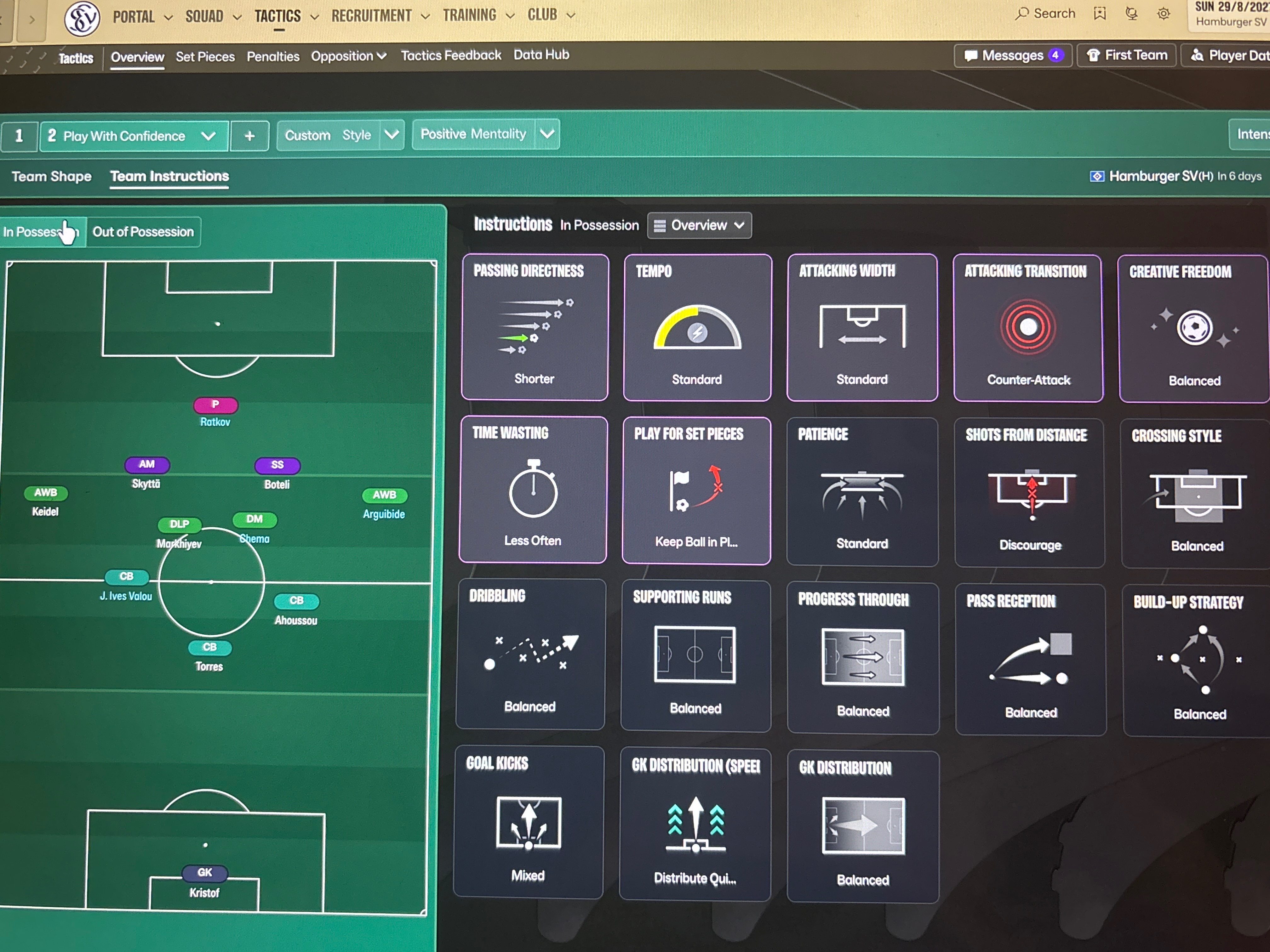
3-2-4-1
Use central build-up and direct progression to reach the front line, while defending in a Mid Block and retaining a screening presence in front of the…
Loading tactical analysis...
3-2-4-1
4-1-4-1 DM
Positive
Clean Slate
1
3
Ball-Playing Goalkeeper
Goalkeeper
2
2
Wide Center-Back
Centre-Back
2
3
Ball-Playing Center-Back
Centre-Back
3
2
Defensive Midfielder
Full Back
5
1
Wide Forward
Tracking Wide Midfielder
5
2
Channel Midfielder
Central Midfielder
5
4
Channel Midfielder
Central Midfielder
5
5
Wide Forward
Wide Midfielder
6
3
Center Forward
Center Forward
2
4
Wide Center-Back
Full Back
3
4
Defensive Midfielder
Screening Defensive Midfielder
More Direct
Higher
Standard
Standard
Balanced
Less Often
Keep Ball in Play
Standard
Discourage
Low Crosses
Balanced
Overlap Balanced
Balanced
Balanced
Balanced
Balanced
Short
Balanced
Center-Backs
Underlap Balanced
Mid Block
Standard
Balanced
Less Often
Standard
Standard
No
Trap Outside
Trap Outside
Stop Crosses
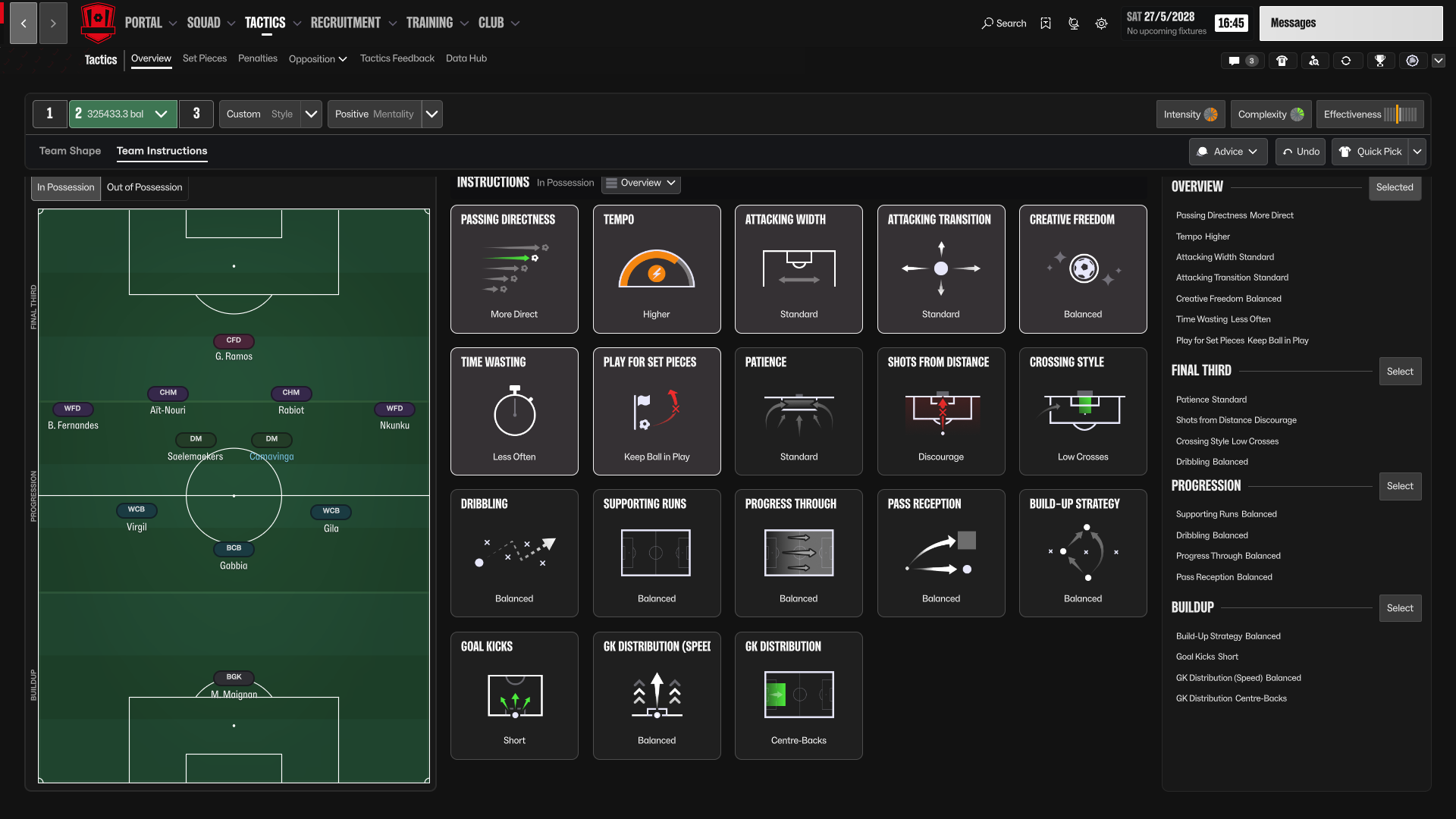
Short Goal Kicks and GK Distribution to Center-Backs offer a secure starting point, while the Ball-Playing Goalkeeper and Ball-Playing Centre-Back can support progression from the back.
[1,3] Ball-Playing Goalkeeper and [2,3] Ball-Playing Centre-Back
The two Wide Forwards provide outlets on both sides, and the Tracking Wide Midfielder role on one flank offers defensive recovery in the mid-block.
[5,1] Wide Forward and [5,1] Tracking Wide Midfielder
More Direct passing and Higher tempo favour quick progression, but Discourage shots from distance and Balanced final-third patience do not specify a similarly direct chance-creation route; attacks may reach the final third without a clear finishing pattern.
[5,2] Channel Midfielder and [6,3] Centre Forward
Unprotected flanks during defensive transitions
The 3-2-4-1 becomes a 4-1-4-1, but a Full-Back in one defensive slot and a Tracking Wide Midfielder on only one flank leave the wide coverage asymmetric. Standard defensive transition and Less Often pressing may make it harder to recover quickly when possession is lost.
[3,2] Full-Back and [5,1] Tracking Wide Midfielder
medium
Exposure behind the midfield line
A Mid Block with Standard defensive line creates a moderate block rather than a very compact deep defence, while Less Often pressing gives opponents more time to progress the ball. The Screening Defensive Midfielder is a useful shield, but the central protection depends heavily on that single role.
[3,4] Screening Defensive Midfielder and [5,2] Central Midfielder
medium
Ball-playing centre-backs with a screening midfielder
The Ball-Playing Centre-Back can contribute to central build-up, while the Screening Defensive Midfielder provides a protective presence behind the midfield line when possession is lost.
[2,3] Ball-Playing Centre-Back and [3,4] Screening Defensive Midfielder
Wide forwards supported by channel midfielders
Wide Forward roles offer width and attacking outlets, while Channel Midfielders can support play in the adjacent channels and give the Centre Forward nearby options.
[5,1] Wide Forward, [5,2] Channel Midfielder, and [6,3] Centre Forward
How can I make my 3-2-4-1 transition into a more secure 4-1-4-1 without losing both wide attacking outlets?
What should I change first if my More Direct passing and Higher tempo lead to rushed attacks?
How can I protect the flanks when my defensive shape uses a Tracking Wide Midfielder on only one side?
This is a positive, fairly direct 3-2-4-1 that has a clear central build-up base and wide attacking outlets, with a 4-1-4-1 defensive shape and a screening midfielder for central protection. The main concern is the potentially uneven wide recovery, combined with a conservative pressing frequency that can let opponents advance before the team is set. I would first test Regroup after turnovers and a Standard pressing frequency, then assess whether the attack needs a more explicit final-third approach.
Build from short goal kicks through the centre-backs, then progress at a higher tempo with more direct passing towards the wide forwards and centre forward. The final-third instructions remain flexible, with distance shooting discouraged and low crosses selected.
The team uses a Standard defensive transition, so the extraction does not specify either an immediate counter-press or a deliberate regroup after losing the ball.
Use central build-up and direct progression to reach the front line, while defending in a Mid Block and retaining a screening presence in front of the centre-backs.
The tactical theory behind the 3-2-4-1: roles, instructions, and the trade-offs that decide whether the system holds up.
Why circulation density and zonal occupation aren't the same thing in FM, and the half-space occupation rule that decides build-up.
Routines, takers, and target picks. How to turn corners and free-kicks into a reliable third of your goal output.
Protect a 1-0, chase a 1-0, hold a draw away. How to manage game state in FM through duties and roles, not by lurching to Defensive.