Tiki-Taka vs Positional Play
Why circulation density and zonal occupation aren't the same thing, and the half-space occupation rule that separates them.
By John Brawner · Updated May 2, 2026
Two Words That Aren't Synonyms
In FM forums and football media, "tiki-taka" and "positional play" (the Spanish coaching tradition calls it juego de posición) get used interchangeably to mean "the Spain and Barcelona thing where they pass the ball a lot." That conflation is why most attempts to recreate Pep's football in FM produce sterile possession tactics. The two ideas describe different priorities, recruit different players, and use the team-instruction sheet differently.
The cleanest split: tiki-taka is about circulation density, short, fast, repeated passes between nearby players that pull opponents out of shape and tire them. Positional play is about zonal occupation, making sure specific squares of the pitch always have a player in them, so that the ball can travel through structure rather than through ad-hoc combination play. Tiki-taka asks "are we keeping the ball?" Positional play asks "are we occupying the right zones?" You can do one without the other. Pep's best teams did both.
The reason FM players conflate them is that the in-game stats reward the same behaviours superficially: both push possession share, pass count, and short-pass completion. But possession share is a means, not an end. A tiki-taka tactic with no zonal structure ends up circulating in front of a deep block forever, never breaking it; a positional-play tactic with no circulation skill loses the ball under press because nobody is technically capable of executing the patterns. The two need each other, and they need to be set up differently.
The split in one line each
- • Tiki-taka: "We have the ball, and we won't give it up."
- • Positional play: "We control space; the ball follows."
Both philosophies value possession; only one of them treats possession as the outcome rather than the input.
The Five Vertical Channels
Positional play divides the pitch into five vertical channels: the two touchlines, the two half-spaces, and the central corridor. The half-spaces are the diagonal bands between the touchline and the central channel, the lanes where the inside-forward and the half-space eight live in modern football. That half-space eight is what Italians (and FM24) call a Mezzala: a central midfielder whose default carrying lane is the half-space rather than the centre, breaking forward off the pivot rather than alongside him. (FM26 removed the Mezzala role; the closest in-engine substitute is the Channel Midfielder, which the FM26 sources flag as the spiritual successor with adjusted mechanics. Where this guide says "Mezzala" below, FM26 users should read "Channel Midfielder.") Pep's positional rules (documented in Perarnau's Pep Confidential and in Juanma Lillo's coaching framework) are built around those five channels rather than around traditional positions.
The core occupation rule is simple. No two players in the same vertical channel at the same horizontal line. If your left winger is hugging the touchline, your left-back tucks into the half-space rather than overlapping. If your left-back is overlapping into the touchline, your winger pinches into the half-space. The result is that every channel has exactly one occupant at every line. Defenders staring at the ball can never cover two players with one body, because the players aren't stacked.
The corollary is the half-space occupation rule. The two half-spaces must always be occupied during build-up, because that is where the opposition's defensive shape is weakest. A 4-4-2 mid-block has full-backs covering the touchlines and a midfield pair covering the centre, and the half-spaces fall in the seam between. A team that occupies both half-spaces permanently is forcing the opposition to make a choice every pass: cover the half-space and concede the wing, or cover the wing and concede the half-space. That recurring dilemma, applied for ninety minutes, is how positional play breaks deep blocks.
A second supporting principle is the forward-options rule: at every moment in possession you should have at least three players ahead of the ball, distributed across channels rather than stacked together. This is what stops a possession side becoming flat and predictable; the ball-carrier always has forward options in multiple lanes instead of being forced into the same recycled sideways pass. (Pep's own canonical "three-line rule" is a different and more specific constraint (no more than three teammates on any horizontal line, no more than two on any vertical line) which keeps the shape from collapsing into rows or columns.)
Channel rules in plain English
- • Five channels: two touchlines, two half-spaces, one centre
- • One body per channel per line: never stack two players vertically in the same lane
- • Both half-spaces occupied at all times during build-up: the seam is where blocks break
- • If the wide man holds width, the inside man tucks; if the inside man widens, the wide man drops
- • Forward-options rule: at least three players ahead of the ball at every moment, distributed across channels (Pep's literal three-line rule is stricter still: max 3 on any horizontal, max 2 on any vertical)
FM Setup: Tiki-Taka (Circulation Density)
Tiki-taka in FM is the simpler of the two to set up because it leans on instructions the simulation already models cleanly: Shorter Passing, Lower Tempo, possession recycling. Spain 2008-2012 is the prototype: at the 2010 World Cup most often a 4-2-3-1 with Xavi as the 10 and Busquets-Alonso as the double pivot; by Euro 2012 the shape had shifted toward 4-3-3 / 4-1-4-1 with Busquets as a single pivot, Xavi and Xabi Alonso as the 8s, Iniesta and Silva ahead of them, and Cesc Fàbregas drifting in as a false 9. The recipe is two ball-playing centre-backs and a deep-lying playmaker (a moving pivot, not a static one) always available within a few yards of whoever has the ball. The point is volume of touches, not zonal coverage.
Roles
- • GK: Sweeper Keeper - Support
- • CBs: Two Ball-Playing Defenders - Defend
- • FBs: Full-Back - Support (not Wing-Back)
- • DM: Deep-Lying Playmaker - Support
- • CMs: Two Mezzalas on Support (or Advanced Playmaker / Box-to-Box on Support)
- • Wide: Inside Forward - Support (no Attack duty)
- • ST: False 9 - Support
Team Instructions
- • Mentality: Balanced
- • Passing: Shorter
- • Tempo: Lower
- • Width: Standard
- • Play Out of Defence: ON
- • Work Ball Into Box: ON
- • Counter-Press: ON
- • Pressing Intensity: More Urgent (not Extremely Urgent; circulation needs the press to hold shape, not chase)
- • Standard Defensive Line + Standard LOE (mid-block, not high)
Note what's missing: no Attack duties anywhere. Tiki-taka is allergic to Attack duty because Attack-duty players run beyond the ball, which fragments the passing network. Everyone is on Support except the centre-backs, and the False 9 pulls the striker into the midfield rather than pushing forward. The goal is to make every pass available, not to break lines vertically.
Notice the out-of-possession choice: a mid-block, not a high press. Pure tiki-taka (the Spain-2012 version) used possession dominance to reduce its own out-of-possession workload. When Spain lost the ball they counterpressed the immediate carrier (hence Counter-Press ON, Pressing Intensity More Urgent), but they rarely sustained a high line for ninety minutes, because they were so confident circulation would win the ball back that they didn't need to. Positional play, below, uses Higher Line + Higher LOE to compress the pitch and force errors. That's the OOP split: tiki-taka recovers via the ball; positional play recovers via space.
FM Setup: Positional Play (Zonal Occupation)
Positional play is harder to set up because FM's role/duty system doesn't have an explicit "occupy the half-space" instruction. You build it through role pairings that produce the right channel coverage. The reference point is Pep's Manchester City (2016-present), the prototypical inverted-full-back system; his Bayern (2013-2016) used a similar 3-2-5 attacking shape achieved through Lahm/Alaba stepping into midfield from full-back, but the modern Cancelo/Stones- style inversion belongs to the City era.
Roles
- • GK: Sweeper Keeper - Support
- • CBs: BPD - Defend, paired with CB - Defend
- • FBs: Inverted Full-Back - Support (both sides)
- • DM: Deep-Lying Playmaker - Defend (anchor function, not the Anchor role)
- • CMs: Mezzala - Attack, paired with Mezzala - Support
- • Wide: Winger - Attack (touchline holder; an Inverted Winger is for systems where the Mezzala holds wider, since IWs cut into the half-space by definition)
- • ST: Complete Forward - Support
Team Instructions
- • Mentality: Positive
- • Passing: Shorter
- • Tempo: Standard
- • Width: Wider (stretch the block)
- • Play Out of Defence: ON
- • Counter-Press: ON
- • Pressing Intensity: More Urgent
- • Higher Defensive Line + Higher LOE
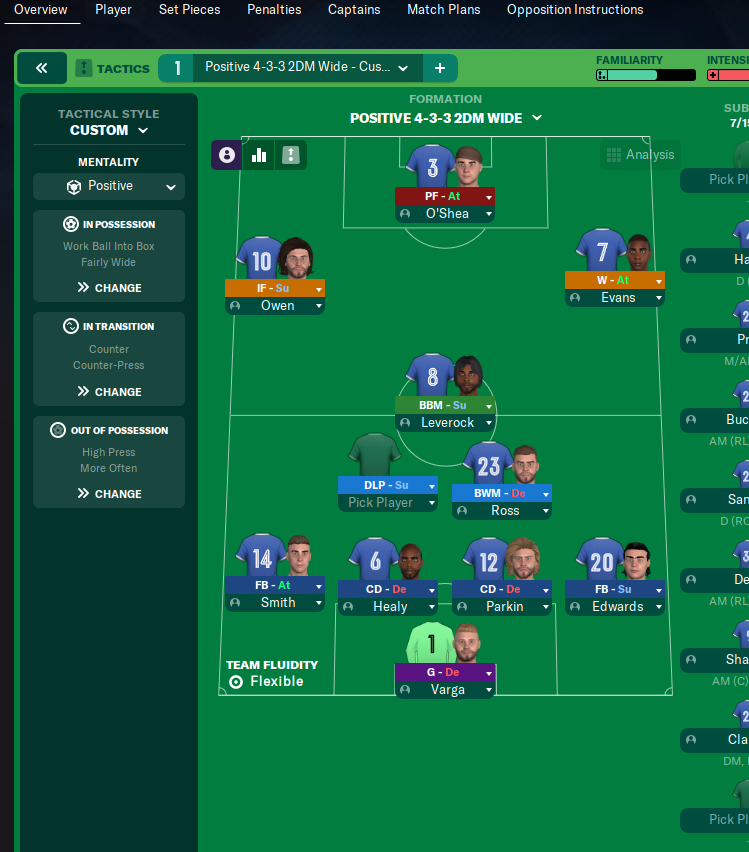
The key role choices are the inverted full-backs and the asymmetric Mezzala pair. Inverted full-backs tuck into the half-space when the ball is wide, producing the 3-2-5 shape that Pep teams attack in: three at the back, two in front of them (the DM plus one IFB), five across the front (two wide forwards holding width, two Mezzalas in the half-spaces, one striker between centre-backs ). Wider Width pulls the wingers to the touchline so the half-space is permanently empty for the Mezzala to occupy.
Crucially, neither setup uses Pass Into Space. Pass Into Space tells your players to play balls into channels behind the defence, the opposite of what either system wants. Tiki-taka wants short feet-to-feet circulation; positional play wants the ball played to a player already standing in a specific zone, not lobbed into a vacant space ahead of him. Pass Into Space breaks both philosophies and is one of the most commonly miscoded instructions in attempted Pep clones.
Real-World Examples
Three reference points, each illustrating a different point on the spectrum.
Spain 2008-2012 (the tiki-taka peak). Spain won two Euros and a World Cup with a midfield core of Xavi and Iniesta, anchored by Marcos Senna in 2008 and Sergio Busquets from 2010 onward (with Xabi Alonso partnering or relieving him in 2010, and Cesc Fàbregas adding an advanced rotation as a false 9 by Euro 2012). Senna's job at Euro 2008 was a more orthodox holding shield in front of the back four; the salida lavolpiana (the pivot dropping between the centre-backs in build-up) became Spain's automatism only with Busquets from 2009-10 onward. Watch Spain in the 2012 Euro final against Italy: 4-0, fewer than two clear-cut chances conceded, and entire stretches where the ball goes Busquets-Xavi- Iniesta-Xavi-Busquets-Alba in five seconds without traveling more than fifteen yards forward. That is tiki-taka in its purest form. The zonal structure was looser than Pep's Barcelona. Iniesta and Xavi occupied the half-spaces, but with freer roaming permission than the rigid one-body-per-zone rule. Spain wore opponents out through circulation, then struck when the opponent's shape collapsed from exhaustion. It works at international level when you have a generational midfield like Xavi-Iniesta-Busquets, which is why Spain (2008–2012) is the only sustained example. It mostly doesn't translate to club football below the elite tier, because the technical ceiling required is unobtainable for nine-tenths of squads.
Pep's Barcelona 2008-2012 (positional play in its purest form). The same era as Spain, with five of the same players, but a meaningfully different system. Barcelona played 4-3-3 with strict positional rules synthesised from Cruyff's Barcelona and Lillo's coaching framework: Dani Alves held the right touchline; Messi roamed the central channel as a False 9, dropping deep to receive between the lines; Xavi operated in the right half-space; Iniesta the left half-space; Pedro or Villa held the left touchline. The shape was a 3-2-5 in attack with Busquets dropping between the centre-backs in build-up (the salida lavolpiana, a move he also performed regularly for Spain) and Alves pushing forward. Every channel had exactly one occupant. That zonal discipline is what let Barcelona break low blocks consistently: the half-spaces were always full, so the opposition full-backs couldn't pinch in without leaving the touchline free. Spain at the same time circulated more; Barcelona occupied better.
Pep's Manchester City 2016-present (positional with verticality). The modern evolution. City still play 3-2-5 in attack (Cancelo, until his January 2023 loan exit, inverted from full-back into midfield; Stones now does similar work from centre-back, the famous version being the 2022-23 treble season, in both cases making a 3-2 base with five players forward), but the game-model has shifted toward more vertical penetration. City aren't satisfied with 65% possession and 1-0 wins; they want 65% possession and a Haaland tap-in. The key change is that wide forwards are now expected to run in behind on triggers (once the half-space is occupied), and Kevin De Bruyne from the right Mezzala spot plays balls forward that 2010 Iniesta would have played sideways. The structure is still positional play; the intent has been bolted onto it. In FM terms: same shape, but with one or two Attack duties added to the Mezzala pair and a more aggressive Mentality. Possession-as-end-state has given way to possession-as-set-up-for-verticality.
Frequently Asked Questions
Can I run positional play without inverted full-backs?
Not really, no. The inverted full-back is what creates the 3-2 base shape when the wingers hold width. Without it, you either lose width (because the full-back pushes wide and the winger has to tuck in) or you lose the half-space (because both sit narrow and the lane stays empty). Wing-Backs on Support can occasionally produce a similar shape with the right Mezzala pairing, but the cleanest version of the system needs inverted FBs. If you don't have full-backs with the technical profile to play inverted, you're closer to a tiki-taka setup than a positional-play one.
Why no Attack duties in tiki-taka?
Attack duty in FM tells a player to push beyond the ball and run into space. That fragments the passing network: the player on Attack is twenty yards ahead of his nearest team-mate, so the next pass either goes forward (which isn't what tiki-taka wants) or recycles back (which means the Attack-duty player wasted his run). Spain 2010 worked because everyone on the pitch except the lone striker stayed within passing range of two team-mates at all times. The False 9 (or Complete Forward on Support) is the cleanest way to enforce that in FM.
Should I ever use Pass Into Space with these systems?
No. See the FM Setup section above for the full rationale. Short version: Pass Into Space is a useful instruction for direct or counter-attack systems, but it actively breaks possession football. Leave it off.
My team has 70% possession but only one or two shots on target. What's wrong?
Almost always: you have tiki-taka (circulation) without positional play (zonal occupation). The team holds the ball but never reaches a position where the ball is a problem for the opposition, because the half-spaces are empty. Fix the occupation first: switch to inverted full-backs, set Wider Width, and pair a Mezzala on Attack with a Mezzala on Support so the half-spaces are permanently filled. Possession share will drop slightly; expected goals will jump.
Which system is easier to install in a mid-table FM squad?
Positional play, surprisingly. Tiki-taka requires an entire midfield of Xavi-grade technical players; without them, the short passing breaks down under press and you turn the ball over in dangerous areas. Positional play works because the structure does the heavy lifting. Even average players, if they stand in the right zone, force the opposition into uncomfortable coverage choices. You can install a positional 3-2-5 with mid-table technical attributes and get most of the benefit. You cannot install Spain-2010 tiki-taka with mid-table technical attributes; you'll get sideways passes, low tempo, and a 0-0 draw.
Conclusion
Tiki-taka and positional play sit on the same family tree, but they're different ideas. Tiki-taka is what the ball does: circulating densely between technically dominant players. Positional play is what the players do: occupying specific zones so the ball has somewhere to go. Pep's best teams ran both at once. For mid-table sides, positional play is the realistic option; tiki-taka demands Xavi-grade midfielders you almost certainly don't have. The structure of a 3-2-5 with inverted full-backs and a Mezzala pair compensates for merely-good technicians; pure circulation does not. Pick positional play unless your midfield really is that good, and if it is, layer the circulation on top rather than choosing between them.
Related guides
Keep exploring the tactical library. These go well with the topic above.
Understanding the 4-3-3 Formation
Master the classic 4-3-3: player roles, tactical variations, and the trade-offs that decide whether it sings or stalls.
Possession-Based Tactics in Football Manager
Build the patient, control-the-tempo style without watching your opponents counter through the gaps you leave behind.
Counter-Attacking Excellence
Sit deep, win the ball, and break in three passes. The roles, instructions, and squad profile that make it work.