Building a Possession-Based Tactic
Learn how to create a possession-heavy tactical approach that controls games through patient build-up play and intelligent movement.
Philosophy of Possession Football
Possession football controls the rhythm of the game by circulating the ball patiently and creating chances through movement, not urgency. The technical bar matters most in the build-up corridor (centre-backs, deepest midfielder, and goalkeeper); the wider you get, the more profiles can vary. Movement comes from off-ball roles and duty changes, not from cranking the tempo.
Key Player Roles for Possession Play
Build-Up Phase
Ball Playing Defender (Defend)
Essential for starting attacks from deep positions with accurate passing.
- • High passing and vision attributes
- • Comfortable under pressure
- • Can switch play effectively
Deep Lying Playmaker (Support)
The metronome of your team, dictating tempo and distributing possession.
- • Excellent passing range
- • High composure and decisions
- • Good positioning sense
Progression Phase
Advanced Playmaker (Support)
Links midfield and attack, creating opportunities in the final third.
- • Creative passing ability
- • Good first touch and close control
- • Spatial awareness
Inside Forward (Support)
Cuts inside from a wide starting position to create overloads and provide passing options. IFs do not hold width and do not cross.
- • Technical ability and dribbling
- • Good passing and dribbling; crosses are not the IF's job
- • Movement off the ball
Formation Options
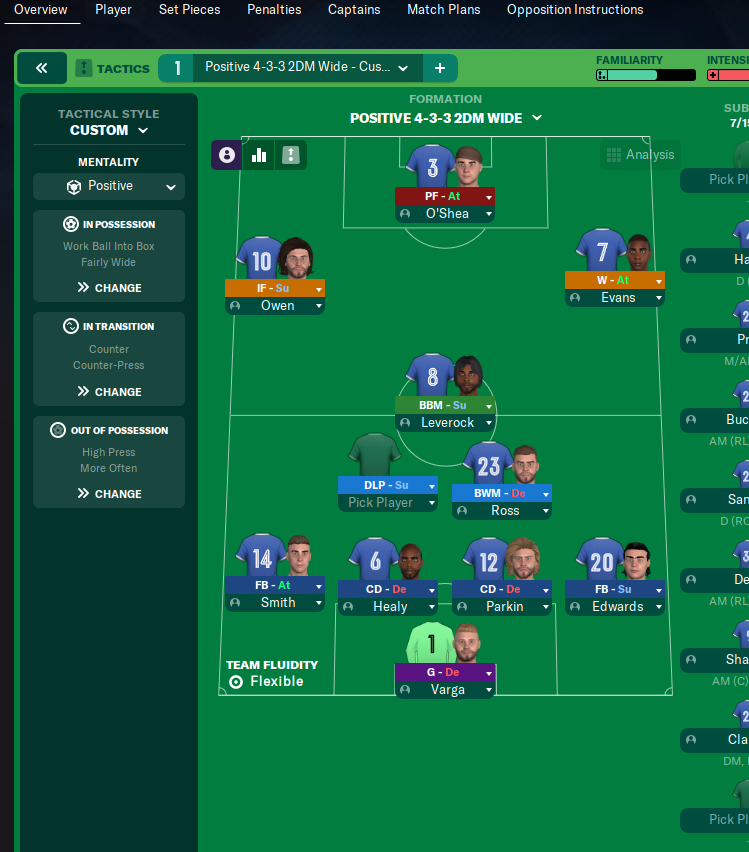
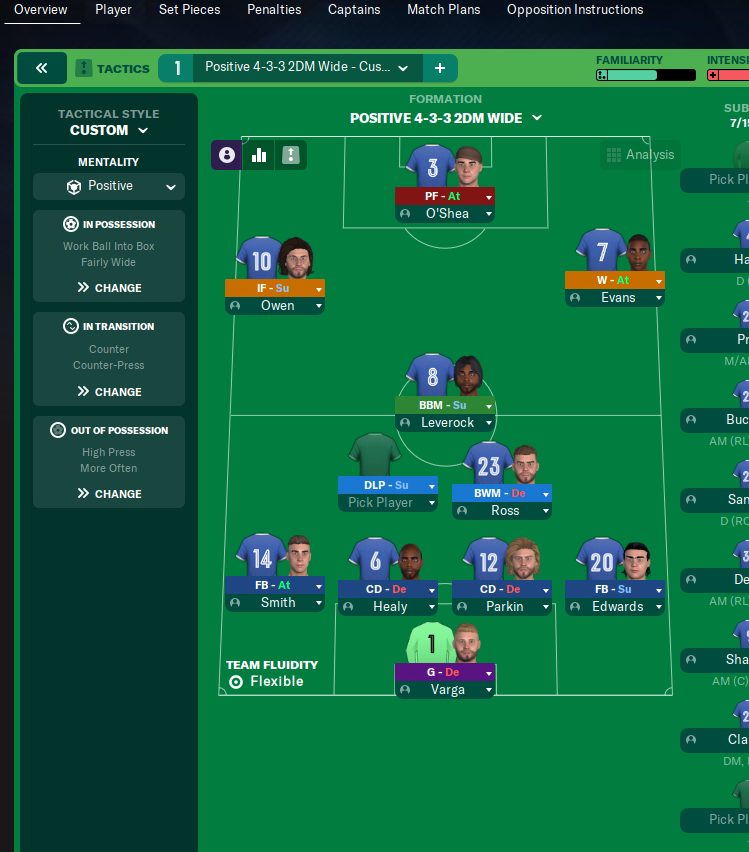
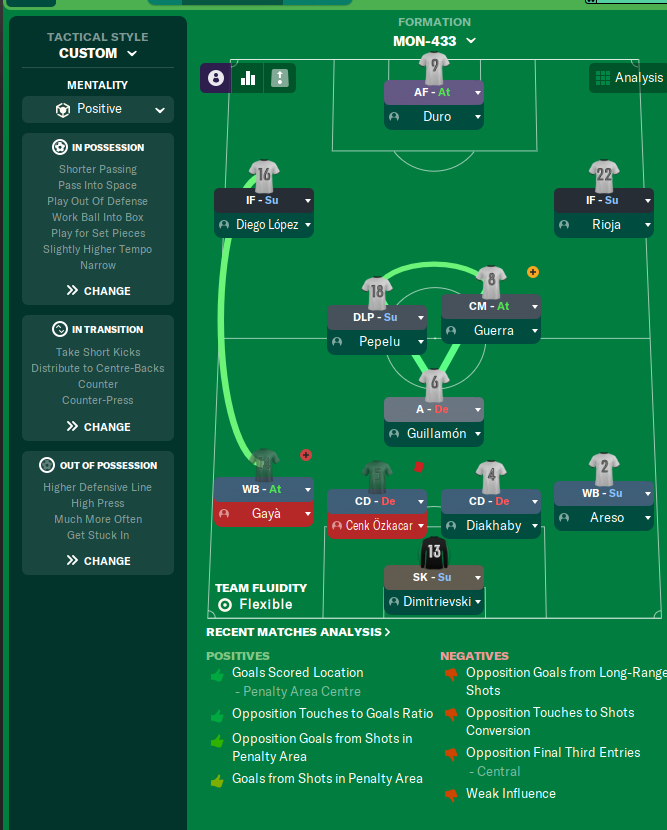
4-3-3 Possession Variant
Classic possession formation with emphasis on midfield control and wide play.
- • Ball Playing Defenders
- • Inverted Wing-Backs
- • Deep Lying Playmaker
- • Box-to-Box Midfielder
- • Advanced Playmaker
- • Inside Forwards
- • False Nine, Complete Forward, or Pressing Forward
4-2-3-1 Control Setup
Provides extra creativity in midfield with dedicated playmakers.
- • Deep Lying Playmaker
- • Box-to-Box Midfielder
- • Two Inside Forwards (AML/AMR)
- • One Advanced Playmaker (AMC)
- • Deep-Lying Forward
- • Complete Forward
Essential Team Instructions
Recommended Instructions
- Shorter Passing: Maintains possession and reduces risk
- Work Ball Into Box: Ensures quality chances over speculative shots
- Play Out of Defence: Builds from the back consistently
- Tempo: Standard (Lower for very patient circulation): Higher Tempo only when transitioning into vertical phases (e.g. last 15 minutes when chasing a goal). Higher Tempo as a default contradicts Shorter Passing and forces hurried, hoofed clearances.
- Retain Possession: Prioritizes keeping the ball over risky passes
Instructions to Avoid
- Direct Passing: Contradicts possession philosophy
- Get Stuck In: Can lead to unnecessary turnovers
- Shoot on Sight: Wastes possession with poor shots
- Hit Early Crosses: Often results in losing possession
Note on goalkeeper distribution: leave any "long, direct" GK distribution option off; use Distribute to Centre-Backs or Take Short Kicks for a possession setup.
Training and Development
Key Attributes to Develop
Technical
- • Passing
- • First Touch
- • Technique
- • Dribbling
Mental
- • Vision
- • Composure
- • Decisions
- • Anticipation
Physical
- • Stamina (for constant movement)
- • Agility
- • Balance
Common Challenges and Solutions
Problem: Static Possession
Players pass the ball around without creating any danger or progression.
Solution: Add an off-ball runner via duty change (Mezzala(A), or shift an IF to W(A) on one side). Add "Pass Into Space" only if you have a runner to receive it, and only outside a Pep-control build-up (see Real-World Examples for when to leave it off entirely). The fix is movement, not urgency, so don't reach for Higher Tempo.
Problem: Vulnerable to Counter-Attacks
High possession but conceding goals on the break when you lose the ball.
Solution: Enable Counter-Press in the In Transition panel under the "When We Lose Possession" team triggers. Pair it with the attribute floor in the FAQ below; without the engine to back it up, the press just opens space behind your front three.
Problem: Low Scoring Despite Possession
Dominating possession but struggling to create clear scoring opportunities.
Solution: Add risk via "Be More Expressive" at the team level, and apply the "Take More Risks" Player Instruction (sometimes labelled "More Risky Passes") to your AP and Mezzala specifically, not as a team-wide TI. If after that you still need a runner, swap one Support duty in central midfield for an Attack duty.
Real-World Examples
Possession football has many faces. The version Pep Guardiola's Manchester City play is genuinely controlling. The back line plays incredibly high, midfielders rotate constantly, and the team is comfortable holding 70% of the ball for long stretches. The midfield base is a double pivot, not a single-pivot Half-Back, with Rodri on Defensive Midfielder (Defend) and an inverting partner alongside him (Stones stepping up from CB in the spring 2023+ shape, or a true Inverted Wing-Back like Cancelo tucking into midfield in the pre-Jan 2023 shape). To replicate that in FM you need a Sweeper Keeper on Support, ball-playing centre-backs with passing 14+, a Defensive Midfielder on Defend, and either an Inverted Wing-Back tucking into midfield or a ball-playing CB stepping up to form the second pivot. Critically, do not use "Pass Into Space" with this setup. That instruction tends to push players into riskier vertical balls and breaks the patient circulation the tactic depends on. Combine "Shorter Passing" and "Work Ball Into Box" instead, and add "Be More Expressive" if the shape is becoming static.
Mikel Arteta's Arsenal is a different version: still possession-heavy, but more vertical. Their build-up routinely targets a quick switch-and-attack rather than patient circulation. The FM equivalent is a 4-3-3 with two CBs (one Ball-Playing Defender on Defend, one Centre-Back on Stopper), one Inverted Full-Back, one attacking Wing-Back, a DLP, an Advanced Playmaker, a Mezzala (FM24; replaced by Channel Midfielder in FM26), and a front three of two IFs/IWs flanking a False 9 or Complete Forward. The fullback asymmetry is deliberate, because it means whichever side they switch to has a fresh outlet.
And there's the Brighton version under Roberto De Zerbi: provocative possession, where the team deliberately invites pressure with short passes near their own box in order to bait and break the press. This is a high-skill setup in FM. You need composure 14+ across the back line and a press-resistant DM. Most managers shouldn't try it on lower-level squads, because the cost of one error is a goal.
Frequently Asked Questions
My team has 65% possession but loses 1-0. What's wrong?
You're playing what we call "comfortable possession", keeping the ball in safe areas without progressing it. The fix isn't more aggressive duties; it's more risk in passing. Add "Be More Expressive" to team instructions and apply the "Take More Risks" Player Instruction to your AP and Mezzala (as covered above), and only after that consider replacing one Support duty with an Attack duty in central midfield. (Don't reach for "Pass Into Space" here; it breaks the patient circulation, as covered above.) Expect a meaningful uptick in shot volume, though the magnitude depends on squad fit.
What tempo should I use with possession football?
Standard Tempo as the default, with Higher Tempo only for late-match vertical phases (last 15 minutes when chasing). Lower Tempo is the right call for very patient, De Zerbi–style circulation. Higher Tempo paired with Shorter Passing creates a contradiction: you're asking your players to circulate the ball patiently and play at maximum urgency, and what you'll see in matches is hurried, hoofed clearances. Higher Tempo belongs to vertical and counter-press systems, not possession ones.
Do I need elite technical attributes across the whole squad?
No, but you need them in specific positions. Both centre-backs and the deepest midfielder need passing 14+ and composure 13+. Wide players can be more physical. Strikers can be one-dimensional finishers. The build-up corridor is where the technical bar sits. Everywhere else, profiles can vary.
Counter-press or drop-and-recover after losing possession?
Counter-press if your midfield clears the floor (Stamina 15+ and Work Rate 15+ at Premier League top sides; 14+ at PL mid-table; 13+ with rotation in lower leagues) with Aggression 13+ and Anticipation 13+ on top of those, paired with a high defensive line; drop-and-recover otherwise. The mistake is selecting Counter-Press without the physical profile to back it up. Your front three jog into a press your back line can't support, and the gap behind them becomes a runway.
Can possession football work in lower leagues?
A simplified version, yes. Drop the high line, replace ball-playing CBs with standard CBs, swap Inverted Wing-Backs for Full-Backs on Support, and use a flat midfield three instead of the double-pivot Pep City shape. You won't dominate games the way Pep does, but you can absolutely out-pass most lower-league opponents who don't have the technical floor to press you intelligently.
Conclusion
Possession is a means, not a goal: 65% of the ball in your own half wins nothing. Pick the version of possession you actually want to play (Pep control, Arteta vertical switches, or De Zerbi provocation), staff the build-up corridor with the right technical floor, and resist the urge to crank tempo when the shape goes static; the fix is movement and risk in passing, not urgency.
Related guides
Keep exploring the tactical library. These go well with the topic above.
Understanding the 4-3-3 Formation
Master the classic 4-3-3: player roles, tactical variations, and the trade-offs that decide whether it sings or stalls.
Counter-Attacking Excellence
Sit deep, win the ball, and break in three passes. The roles, instructions, and squad profile that make it work.
Defensive Transitions
The five seconds after losing the ball decide most matches. Counter-press, drop-and-recover, and how to know which one you should be doing.