
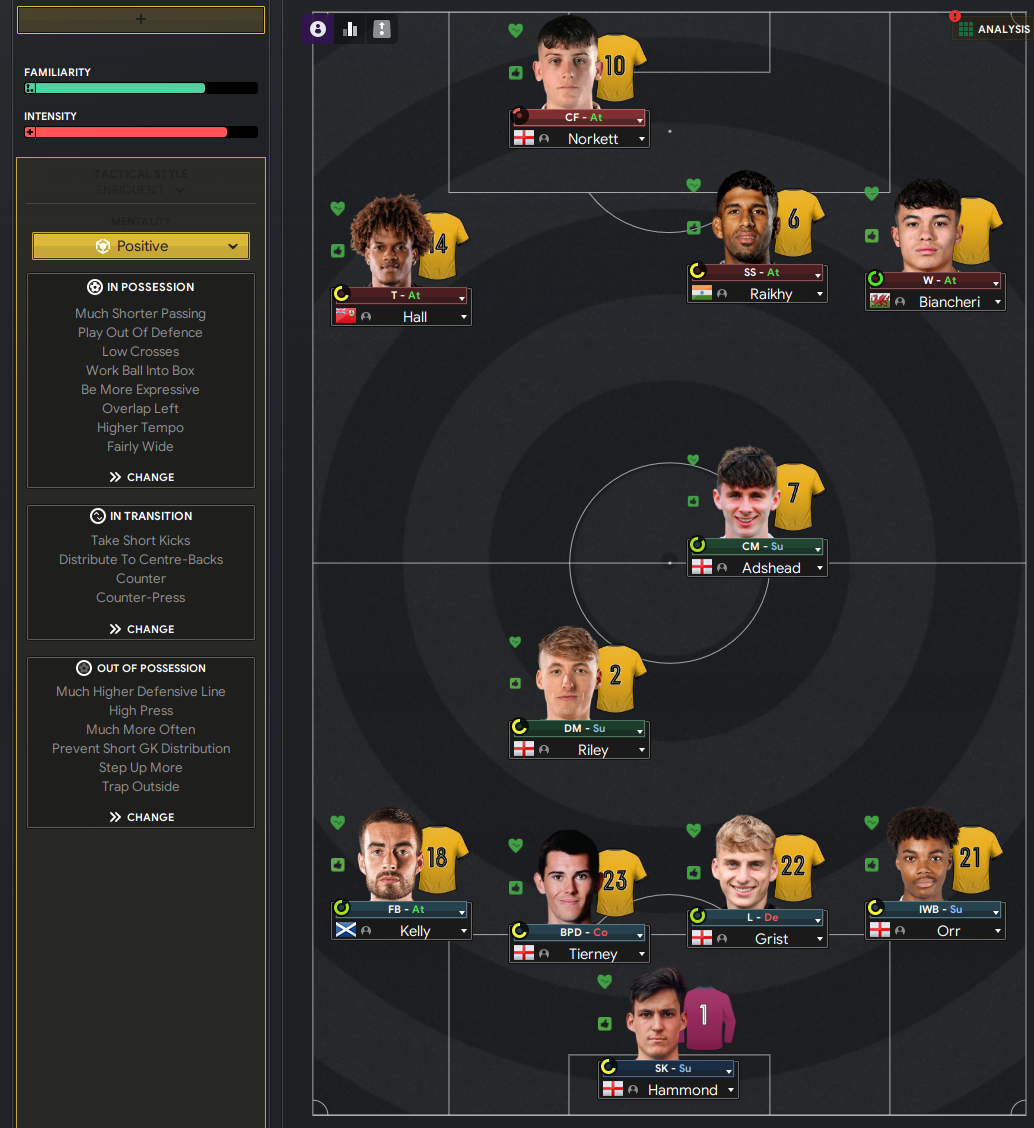
3-1-3-1-2
With the use of an advanced forward and inside forward, the formation creates multiple avenues for penetration, enhancing goal-scoring opportunities.
Loading tactical analysis...
Gegenpress
Positive
3-1-3-1-2
Fairly Wide
Much Shorter Passing
Play Out Of Defence
Work Ball Into Box
Overlap Left
Higher Tempo
Take Short Kicks
Distribute To Centre-Backs
Counter
Counter-Press
Much Higher Defensive Line
High Press
Much More Often
Prevent Short GK Distribution
Step Up More
Trap Outside
CF
Advanced Forward
Attack
SS
Inside Forward
Attack
W
Winger
Attack
CM
Box to Box Midfielder
Support
DM
Deep Lying Playmaker
Support
FB
Wing-Back
Attack
BPD
Ball Playing Defender
Defend
L
Full-Back
Defend
SK
Sweeper Keeper
Support
With the use of an advanced forward and inside forward, the formation creates multiple avenues for penetration, enhancing goal-scoring opportunities.
The box-to-box midfielder and deep-lying playmaker provide a solid connection between defense and attack, facilitating ball retention and distribution.
While a high defensive line aids in pressing the opposition, it could leave defenders exposed to counter-attacks if the press is bypassed.
Shorter passing is typically a slower buildup, which conflicts with a higher tempo, potentially leading to rushed plays.
Is the current forward partnership providing enough goal threat?
Are the full-backs offering sufficient support in attack while maintaining defensive responsibilities?
How well is the midfield linking play and covering defensively?
Is the high press yielding consistent results against opponents?
How effective is the team in transitioning from defense to attack?
Are the players comfortable with the current tactical style and instructions?
The tactical theory behind the 3-1-3-1-2: roles, instructions, and the trade-offs that decide whether the system holds up.
How Mentality, Duty, and Role interact in FM, why duty trumps mentality every time, and the role-on-top-of-duty composition rules.
Counter-Press, Regroup, Stand Off, Trigger Press: what each pressing instruction does in FM and how to pair them without contradicting.
The pairing rule for Defensive Line and Line of Engagement, all 9 combinations, and the gap that costs goals.



