
3-1-5-1
With three central midfielders, the team can dominate the middle of the pitch, controlling possession and dictating play.
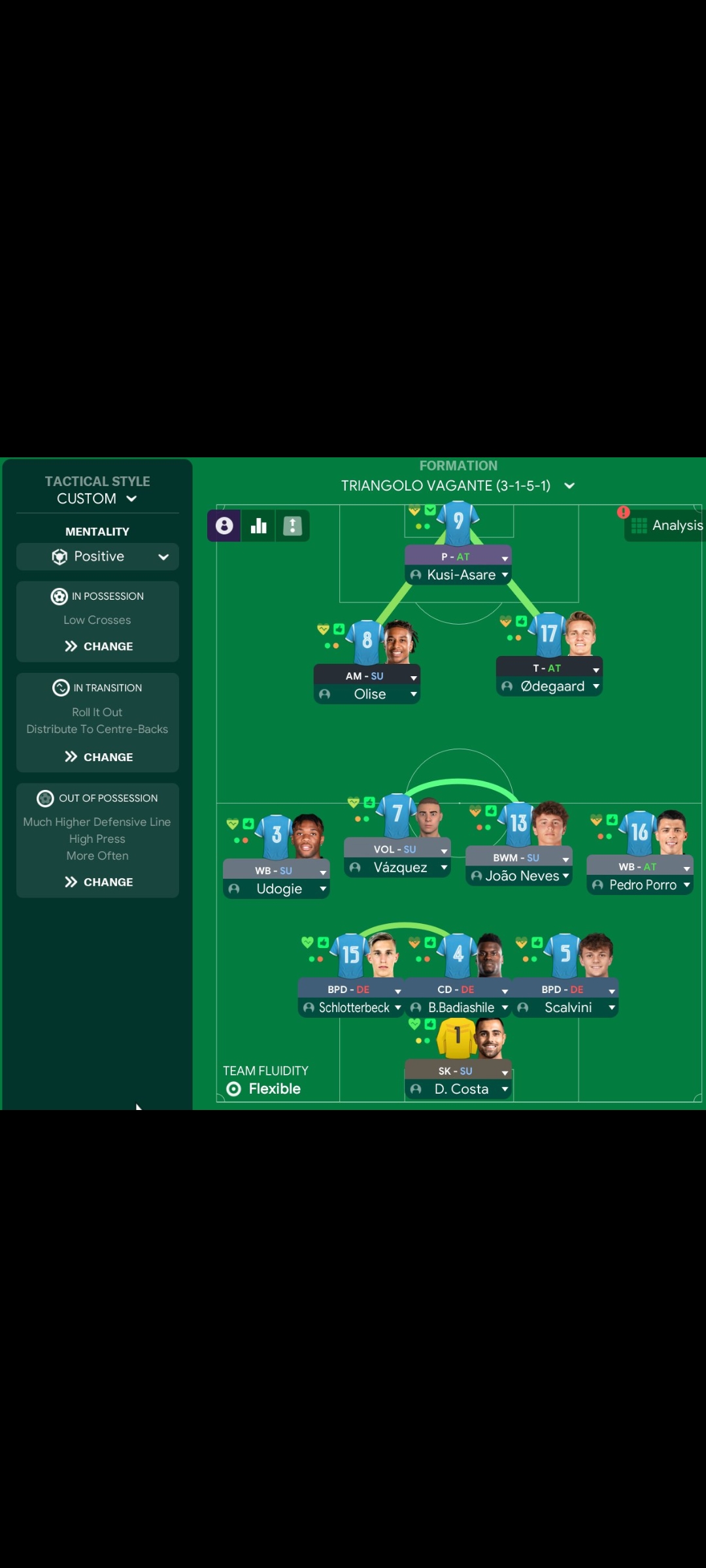
Loading tactical analysis...
Custom
Positive
3-1-5-1
Flexible
Low Crosses
Roll It Out
Distribute To Centre-Backs
Much Higher Defensive Line
High Press
More Often
ST
Advanced Forward
Attack
AM
Attacking Midfielder
Support
T
Inside Forward
Attack
WB
Wing-Back
Support
BPD
Ball Playing Defender
Defend
CD
Central Defender
Defend
BWM
Ball Winning Midfielder
Support
VOL
Volante
Support
With three central midfielders, the team can dominate the middle of the pitch, controlling possession and dictating play.
The roles of the Advanced Forward and Inside Forward allow for dynamic attacking movements, creating space and opportunities.
Having both Udogie and Porro as attacking wing-backs may leave space exposed on the flanks, particularly if the team commits too many forward.
The high defensive line can be risky if the opposition can exploit it with fast attackers, leading to potential one-on-one situations.
How can we improve defensive coordination between the wing-backs and center-backs?
Is the team fluidity impacting our attacking movements negatively?
Should we adjust our set-pieces based on our player roles?
What adjustments can be made to our pressing intensity?
How can we better utilize the width created by wing-backs?
Are the current player roles maximizing individual strengths effectively?
The tactical theory behind the 3-1-5-1: roles, instructions, and the trade-offs that decide whether the system holds up.
Protect a 1-0, chase a 1-0, hold a draw away. How to manage game state in FM through duties and roles, not by lurching to Defensive.
Mentality, duty, role, instruction, sub. The change hierarchy from lightest to heaviest intervention, and 60th-minute patterns by game state.
Pass map, average position, xG, possession by zone: what each tablet panel tells you in FM and the tactical change it should trigger.