
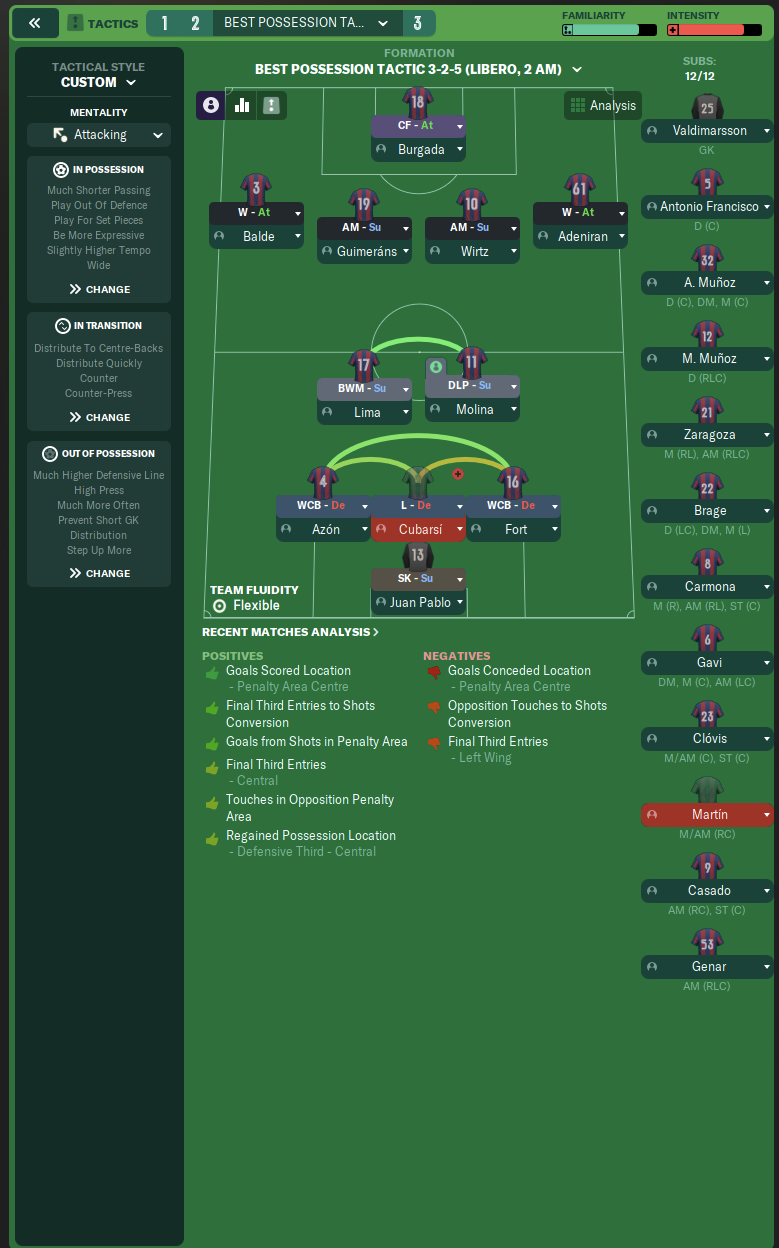
3-2-5 (Libero, 2 AM)
The emphasis on shorter passing and playing out from the back allows for greater retention of possession, making it difficult for opponents to regain the…
Loading tactical analysis...
Custom
Attacking
3-2-5 (Libero, 2 AM)
Flexible
Much shorter passing
Play out of defence
Be more expressive
Slightly higher tempo
Distribute to centre-backs
Counter-press
Much higher defensive line
High press
CF
Advanced Forward
Attack
AM
Attacking Midfielder
Support
BWM
Ball Winning Midfielder
Support
DLP
Deep-Lying Playmaker
Support
W
Winger
Attack
WCB
Wing-Back
Defend
SK
Sweeper Keeper
Support
The emphasis on shorter passing and playing out from the back allows for greater retention of possession, making it difficult for opponents to regain the ball.
Utilizing wingers and two attacking midfielders creates opportunities to stretch the opponent's defensive shape, allowing for penetrative plays into the box.
While the high defensive line aids in pressing, it also makes the team vulnerable to quick counter-attacks, especially against fast strikers.
With multiple offensive players, there’s a risk of overcrowding in central areas, potentially limiting offensive effectiveness if spacing is not managed.
How can we better integrate the libero into the attacking phases?
Are the pressing triggers well understood by all players?
What adjustments are necessary when facing teams that counter quickly?
How can we improve the connection between midfield and attack?
Should we consider changing the roles of the wingers to maintain defensive balance?
Is the team familiar with the importance of maintaining shape during transitions?
The tactical theory behind the 3-2-5 (Libero, 2 AM): roles, instructions, and the trade-offs that decide whether the system holds up.
Why circulation density and zonal occupation aren't the same thing in FM, and the half-space occupation rule that decides build-up.
Mentality, duty, role, instruction, sub. The change hierarchy from lightest to heaviest intervention, and 60th-minute patterns by game state.
Pass map, average position, xG, possession by zone: what each tablet panel tells you in FM and the tactical change it should trigger.