
3421 W
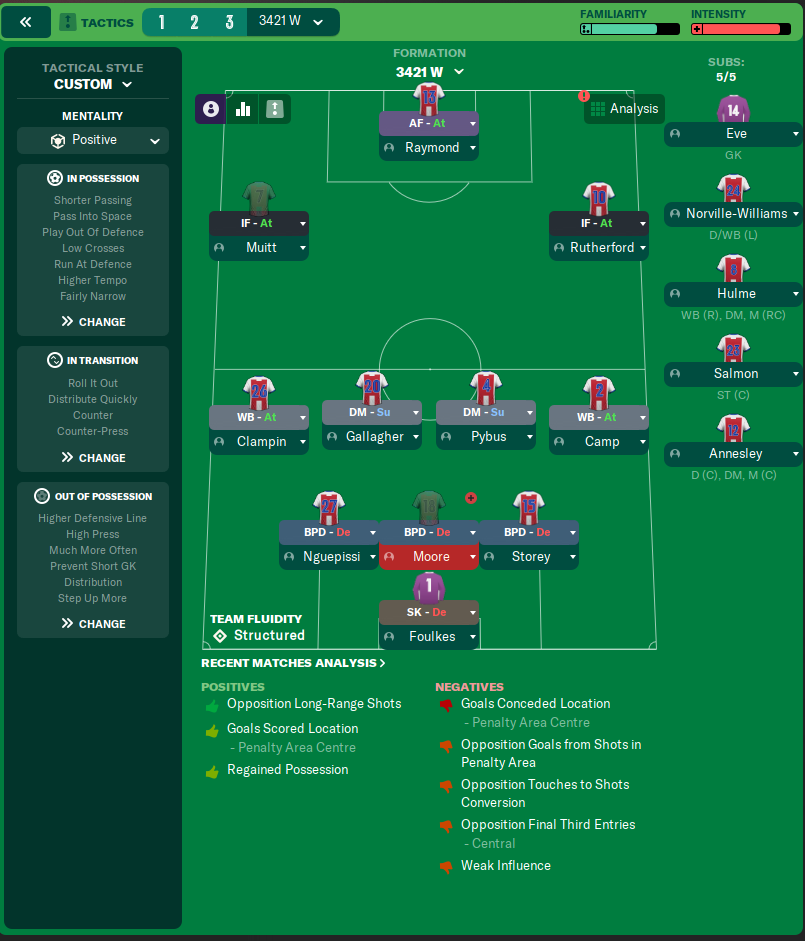
To dominate possession while creating high-quality chances from the width and breaking down compact defenses. The wing-backs and inside forwards create…
Loading tactical analysis...
Custom
Positive
3421 W
Structured
Shorter Passing
Pass Into Space
Play Out of Defence
Low Crosses
Run At Defence
Higher Tempo
Fairly Narrow
Roll It Out
Distribute Quickly
Counter
Counter-Press
Higher Defensive Line
High Press
Much More Often
Prevent Short GK Distribution
Step Up More
GK
Sweeper Keeper
Defend
Defence
Ball-Playing Defender
Defend
Defence
Ball-Playing Defender
Defend
Defence
Wing-Back
Attack
Defensive Midfield
Deep-Lying Playmaker
Support
Defensive Midfield
Defensive Midfielder
Support
Defensive Midfield
Deep-Lying Playmaker
Support
Attack
Inside Forward
Attack
Attack
Advanced Forward
Attack
Attack
Inside Forward
Attack
Utilizes pace from the inside forwards and wing-backs to stretch opposition defenses while maintaining quick ball movement.
Focused on recovering possession quickly through counter-pressing, aiming to disrupt opposition before they can organize.
To dominate possession while creating high-quality chances from the width and breaking down compact defenses.
3-4-2-1
Compact shape with three center-backs supported by wing-backs, providing both defensive resilience and width.
Wing-Back (WB-A at [2,5]) and Defensive Midfielders (DM-Su at [3,2], [3,3], [3,4]) offering protection.
3-4-3
Flexible front three with two inside forwards and an advanced forward allowing for variety in attack and depth.
Inside Forwards (IF-A at [5,2], [5,4]) and Advanced Forward (AF at [6,3]) are positioned to exploit spaces.
The wing-backs and inside forwards create width, allowing for effective stretching of opposition defenses.
WB-A at [2,5] and IF-A at [5,2] allow for goal-scoring opportunities from the flanks.
The high press adds pressure on opposition when out of possession, disrupting their build-up play.
Implementation of 'High Press' instruction combined with counter-pressing tactics.
With a higher defensive line and emphasis on pressing, the team may leave themselves exposed on quick counter-attacks.
High Press and Higher Defensive Line may create gaps that opposing teams can exploit.
Midfielders may become overloaded if they do not effectively support the defense and attack.
Transition segments place demand on DM-Su at [3,3] to cover both defensive duties and support the attack.
Defensive Transition
Quick counters from opponents could exploit gaps left by advancing wing-backs.
Much More Often pressing combined with High Defensive Line creates situational vulnerabilities.
Midfield Control
While effective, may lead to congestion if opposing teams play through the middle.
The setup does not fully account for overload situations in the midfield area.
DLP-Su and IF-A
DLP-Su facilitates intelligent passing to inside forwards, increasing their attacking threat.
DLP-Su at [3,2] significantly enhances chances created for IF-A at [5,2] and [5,4].
WB-A and AF
Wing-back's attack aligns well with an advanced forward's need for width, creating space for attacking plays.
WB-A at [2,5] provides width for AF at [6,3] to exploit gaps in opposition lines.
How can we further exploit spaces left by the opposition?
What adjustments can be made to improve defensive solidity?
Are there alternative setups that could better suit our player strengths?
The tactical theory behind the 3421 W: roles, instructions, and the trade-offs that decide whether the system holds up.
Pass map, average position, xG, possession by zone: what each tablet panel tells you in FM and the tactical change it should trigger.
FM27 keeps FM26's tactic system. Here is what stays the same, the small changes that can catch you out, and what the new Tactical Effectiveness system asks of you.
How Mentality, Duty, and Role interact in FM, why duty trumps mentality every time, and the role-on-top-of-duty composition rules.