Uploaded Tactic
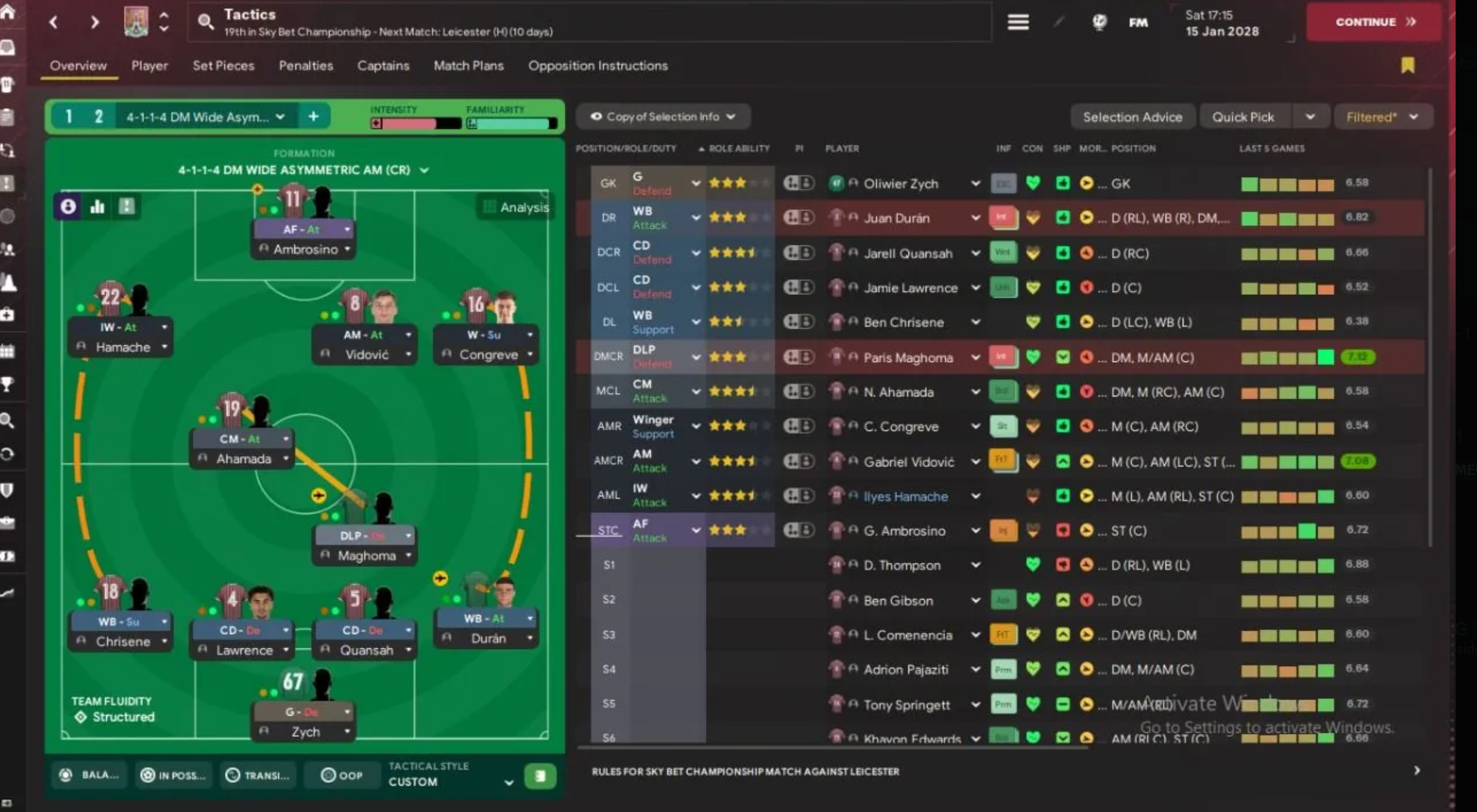
Formation & Style
Tactical Style:Custom
Mentality:Positive
Formation:4-1-1-4 Wide Asymmetric AM
Team Fluidity:Structured
In Possession
Play out of defence
Focus play down the flanks
Overlapping wing-backs
In Transition
Counter-attack
Distribution to full-backs
Out of Possession
Higher defensive line
Increased pressing intensity
Team Shape Without Ball
Shape:4-1-4-1
Description:A compact shape with a solid midfield base supporting the defence, allowing for quick recovery of the ball.
Evidence:CD at [2,2] and [2,3] with DLP-D at [3,2]
Team Shape With Ball
Shape:4-1-3-2
Description:Wide attackers pulling opposition defense apart while the advanced forward acts as a focal point.
Evidence:AF at [6,3] supported by IW-A at [6,1] and Winger-S at [6,4]
Phase Description
Attacking Play
Utilizes width from the wing-backs and an attacking midfielder to create chances, looking for quick transitions.
Defensive Transition
Focuses on regaining possession quickly through pressing and counter-attacking at speed.
Main Focus
To exploit wide areas and use the advanced forward as a primary attacking threat.
Key Strengths
Wide Play
Effective use of width through wing-backs provides cross opportunities and stretches the opponent's defense.
Midfield Control
The presence of a deep-lying playmaker ensures control over midfield operations and transitions.
Attacking Variation
The asymmetric setup allows for dynamic combinations and movement in attacking phases.
Conflicting Directions
Overlapping Risks
While overlapping wing-backs are effective, they can leave gaps in the defence if countered quickly.
High Defensive Line
Pressing higher may lead to vulnerabilities against fast counter-attacks due to space behind the defenders.
Dependence on Wing Play
Relying heavily on wing threats can be predictable and may become ineffective against well-organized defences.
Tactical Suggestions
Adjust Width
Consider narrowing the attacking width against teams with solid defences to create central space for through balls.
Pressing Strategy
Modulate pressing intensity to prevent defensive exhaustion and maintain structure during transitions.
Alternative Midfield Roles
Experimenting with different midfield roles may add more creativity or solidity based on opposing strengths.