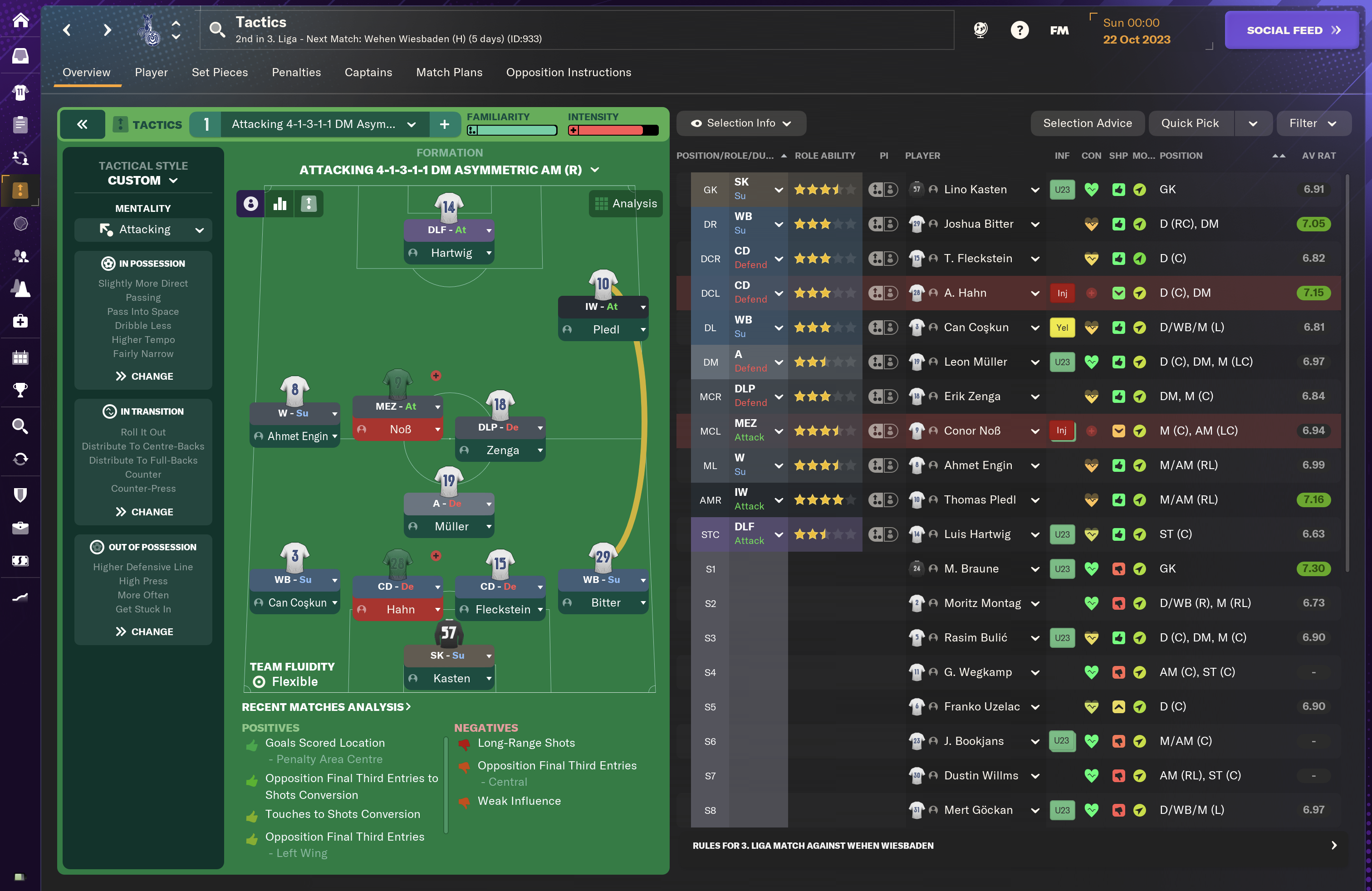
4-1-3-1-1 DM Asymmetric AM (R)
Maintaining possession while providing options for both short and long passes. The combination of an advanced forward and inside forward can exploit…
Loading tactical analysis...
Custom
Cautious
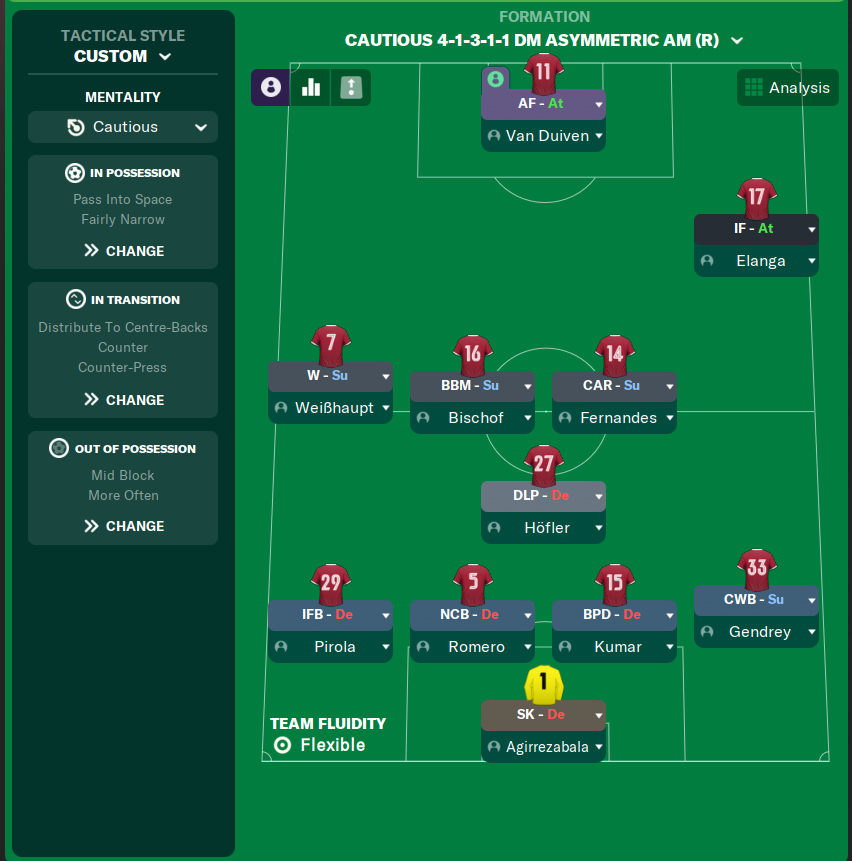
4-1-3-1-1 DM Asymmetric AM (R)
Flexible
Pass Into Space
Fairly Narrow
Distribute To Centre-Backs
Counter
Counter-Press
Mid Block
More Often
GK
Sweeper Keeper
De
Defence
Inverted Full-Back
De
Defence
No-Nonsense Centre-Back
De
Defence
Ball-Playing Defender
De
Defence
Complete Wing-Back
Su
Defensive Midfield
Deep-Lying Playmaker
De
Midfield
Box-to-Box Midfielder
Su
Midfield
Carrilero
Su
Wide
Winger
Su
Attack
Advanced Forward
At
Attack
Inside Forward
At
Utilizes space effectively, engaging the wings through the winger and inside forward.
Focuses on getting back quickly to form a compact midfield and defensive shape.
Maintaining possession while providing options for both short and long passes.
4-1-4-1
Midfielders track back to form a solid wall in front of the defence during defensive phases.
Four defenders with a DM providing support at [3,3].
4-3-3 (asymmetric)
Utilizes width via wingers and an advanced forward, providing options centrally.
The roles of Winger at [6,1] and Inside Forward at [6,5] indicate a spread across the front.
The combination of an advanced forward and inside forward can exploit defensive gaps effectively.
AF at [6,3] and IF at [6,5] with diverse attacking roles.
Three midfielders with varied duties support both attacking and defensive transitions.
BBM-S at [4,2], DLP-D at [3,3], and CAR-S at [4,4].
May limit attacking potential, particularly against weaker opposition.
Cautious mentality may reduce attacking impetus despite having attacking players.
Relying heavily on wingers can be problematic if marked tightly.
Fairly narrow passing suggests a lack of width could limit overall attacking options.
Counter-Attacks
Vulnerable to quick transitions if midfielders are caught out of position.
The reliance on counter-pressing with an aggressive stance could expose the backline.
Inverted Full-Back Displacement
Inverted full-back might leave gaps if pushed too far upfield without support.
IFB at [2,1] needs secure positioning to not expose space.
Winger and Inside Forward
Creates opportunities for cut-backs or combinations to confuse defenders.
W-S at [6,1] and IF-A at [6,5] can interchange.
Box-to-Box Midfielder and Carrilero
Provides dynamic movement and options in midfield, supporting transitions.
BBM-S at [4,2] and CAR-S at [4,4] work well in creating overloads.
How do individual player roles affect the overall team tactic?
In which scenarios would the cautious mentality limit our overall effectiveness?
What adjustments could optimize the transition phases to maximize scoring opportunities?
The tactical theory behind the 4-1-3-1-1 DM Asymmetric AM (R): roles, instructions, and the trade-offs that decide whether the system holds up.
Mentality, duty, role, instruction, sub. The change hierarchy from lightest to heaviest intervention, and 60th-minute patterns by game state.
Pass map, average position, xG, possession by zone: what each tablet panel tells you in FM and the tactical change it should trigger.
FM27 keeps FM26's tactic system. Here is what stays the same, the small changes that can catch you out, and what the new Tactical Effectiveness system asks of you.