4-1-3-1 DM Asymmetric AM (R)
The Tiki-Taka style emphasizes short passing and movement, resulting in high possession and control in midfield.
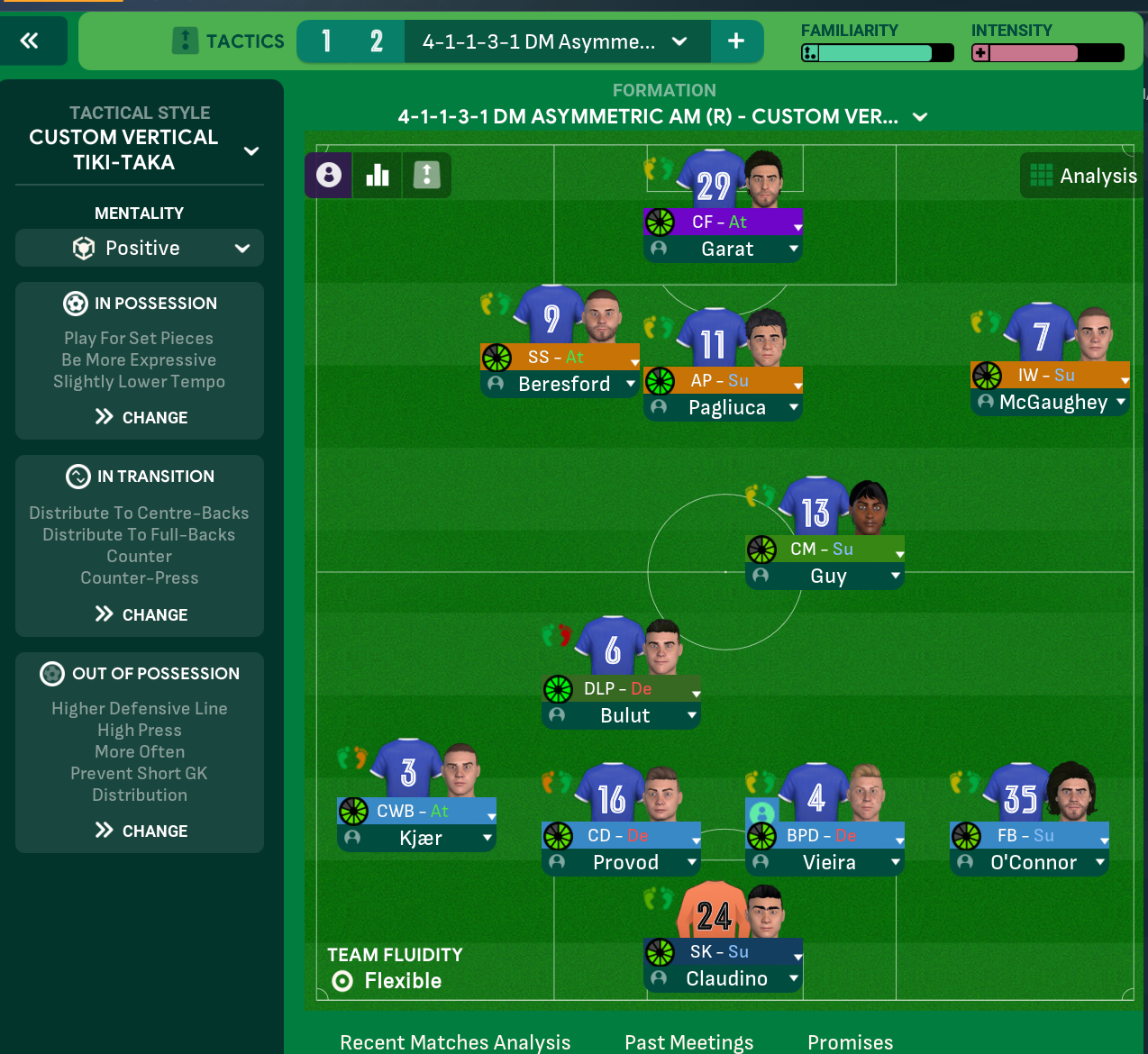
Loading tactical analysis...
Custom Vertical Tiki-Taka
Positive
4-1-3-1 DM Asymmetric AM (R)
Flexible
Play For Set Pieces
Be More Expressive
Slightly Lower Tempo
Distribute To Centre-Backs
Distribute To Full-Backs
Counter
Counter-Press
Higher Defensive Line
High Press
More Often Prevent Short GK Distribution
CF
Advanced Forward
Attack
SS
Shadow Striker
Attack
AM
Advanced Playmaker
Support
CM
Central Midfielder
Support
DLP
Deep Lying Playmaker
Defend
CWB
Complete Wing-Back
Attack
FB
Full-Back
Support
BPD
Ball Playing Defender
Defend
CD
Central Defender
Defend
SK
Sweeper Keeper
Support
The Tiki-Taka style emphasizes short passing and movement, resulting in high possession and control in midfield.
The asymmetric formation provides diverse attacking paths, allowing players to exploit gaps in the opposition's defense.
The preference for a slightly lower tempo may conflict with a high pressing strategy, causing breaks in attacking momentum.
Utilizing both a Shadow Striker and an Advanced Playmaker may create gaps defensively or disrupt the overall team shape.
How effective is the current high press against teams that play out from the back?
Are the wing-backs getting sufficient defensive cover during counter-attacks?
Is the team's fluidity impacting the consistency of passing plays?
How well are the forward players connecting with the midfield in the final third?
What adjustments can be made to the DLP role to enhance creativity?
Is the current tempo allowing the team to exploit opposition weaknesses effectively?
The tactical theory behind the 4-1-3-1 DM Asymmetric AM (R): roles, instructions, and the trade-offs that decide whether the system holds up.
Counter-Press, Regroup, Stand Off, Trigger Press: what each pressing instruction does in FM and how to pair them without contradicting.
The pairing rule for Defensive Line and Line of Engagement, all 9 combinations, and the gap that costs goals.
What Higher Tempo, Wider, and Narrower actually do in FM, plus the dial contradictions and antipatterns players run into most often.