Formation & Style
Tactical Style:Positive
Mentality:Positive
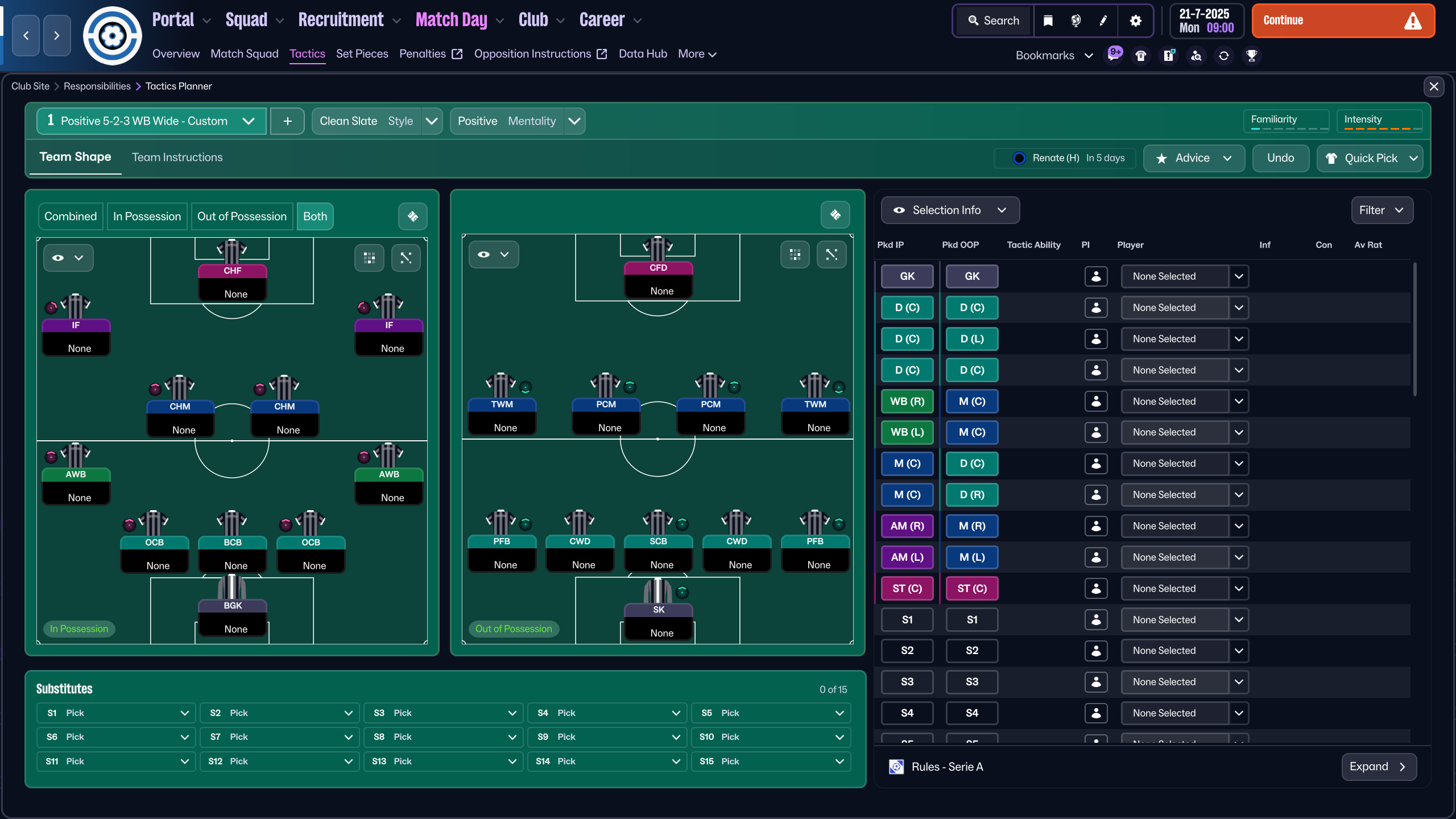
Formation:5-1-2-2 DM WB Asymmetric M (CR)
Team Fluidity:Flexible
In Possession
Shorter Passing
Play Out Of Defence
Slightly Lower Tempo
In Transition
Take Short Kicks
Distribute To Centre-Backs
Counter-Press
Out of Possession
Mid Block
More Often
Prevent Short GK Distribution
Team Shape Without Ball
No team shape without ball data available
Team Shape With Ball
No team shape with ball data available
Key Strengths
Defensive Solidity
The use of three central defenders provides a strong foundation, allowing the team to absorb pressure effectively.
Wide Attacking Options
Wing-backs provide width, stretching opponents and creating space for the two forwards and attacking midfielder.
Midfield Support
With a Box-to-Box Midfielder and Deep-Lying Playmaker, there is a good balance in midfield for attacking and defending.
Flexibility in Attack
The asymmetrical formation allows for varied attacking patterns, with the Target Forward and Advanced Forward working in tandem.
Conflicting Directions
Weak Influence in Attack
Despite providing midfield support, the team may struggle to penetrate deep if the wing-backs do not push high enough.
Conservative Tempo
The slightly lower tempo could hinder quick transitions, particularly against teams that press aggressively.
Inadequate Midfield Coverage
The deep-lying playmaker may result in gaps if opponents exploit transitional moments, resulting in counter-attacks.
Limited Central Creativeness
The formation relies heavily on wide play; central creativity might suffer if the attacking midfielder is marked tightly.
Tactical Suggestions
Increase Tempo
Consider increasing the tempo to support quick transitions and counter-attacking opportunities.
Utilize One-Stop Forward Movement
Instruct the forwards to switch their roles when attacking, creating confusion for the opposition's defense.
Adjust Wing-Back Roles
Experiment with one wing-back on 'Attack', to provide more attacking width while maintaining defensive solidity.
Implement Rotational Systems
Encourage players to rotate positions during attacks to enhance unpredictability and open passing lanes.
Ask Questions About Your Lineup
More Positive tactics
Guides for this formation
The tactical theory behind the 5-1-2-2 DM WB Asymmetric M (CR): roles, instructions, and the trade-offs that decide whether the system holds up.