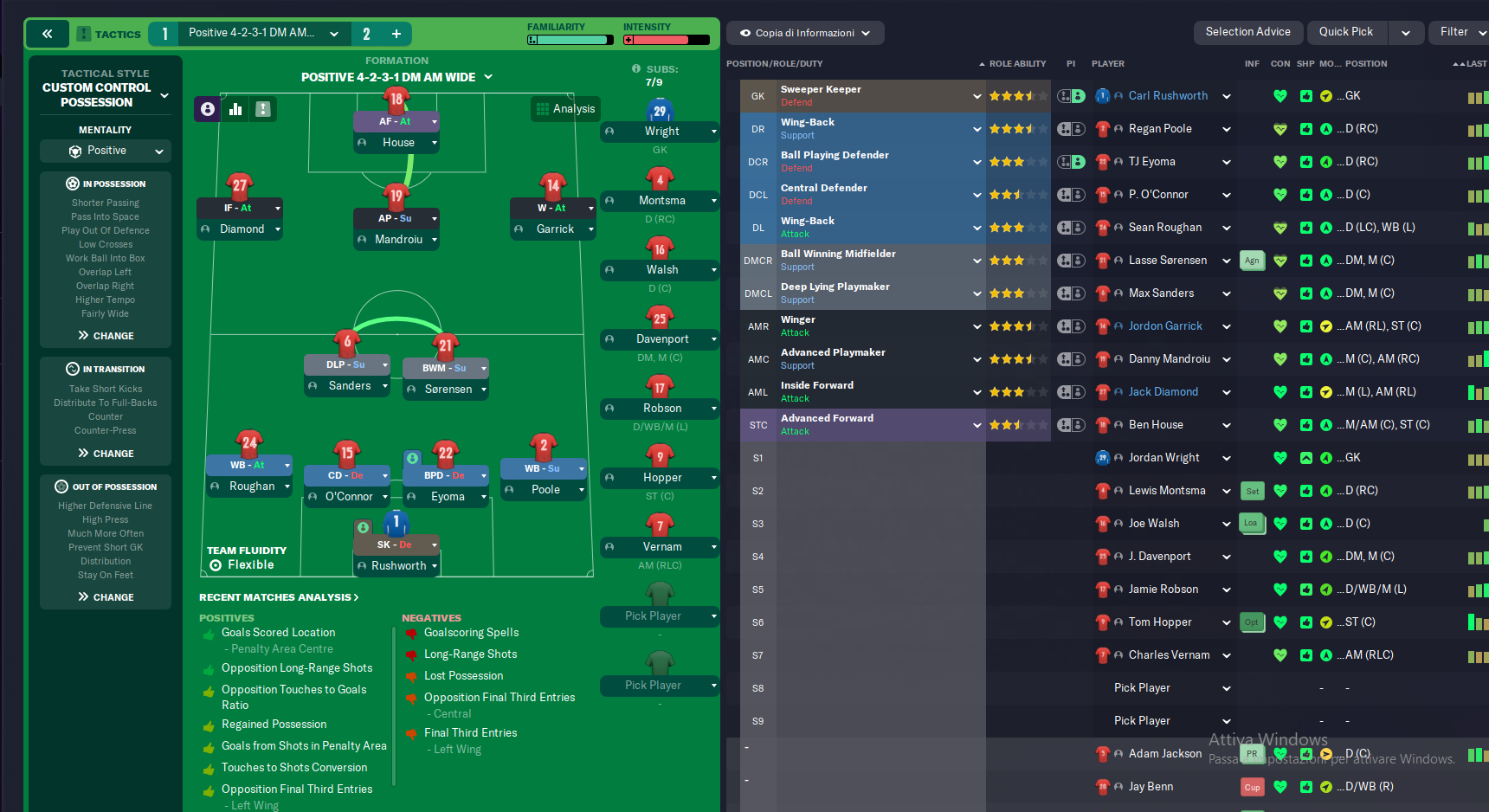
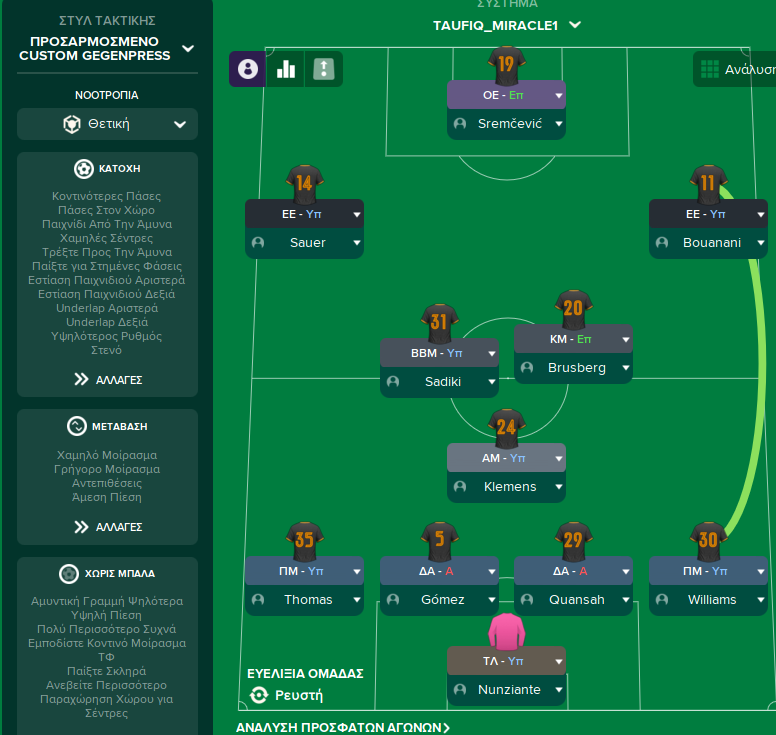
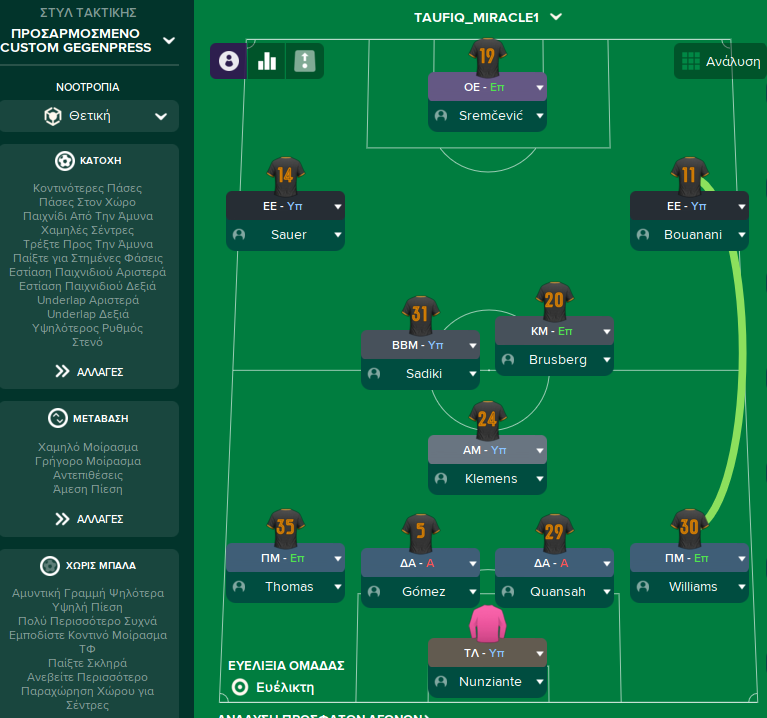
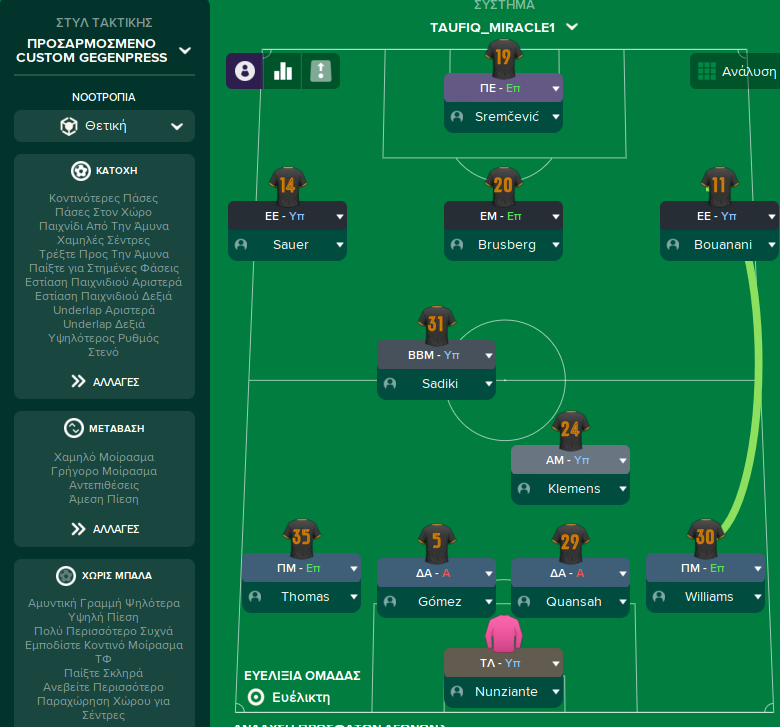
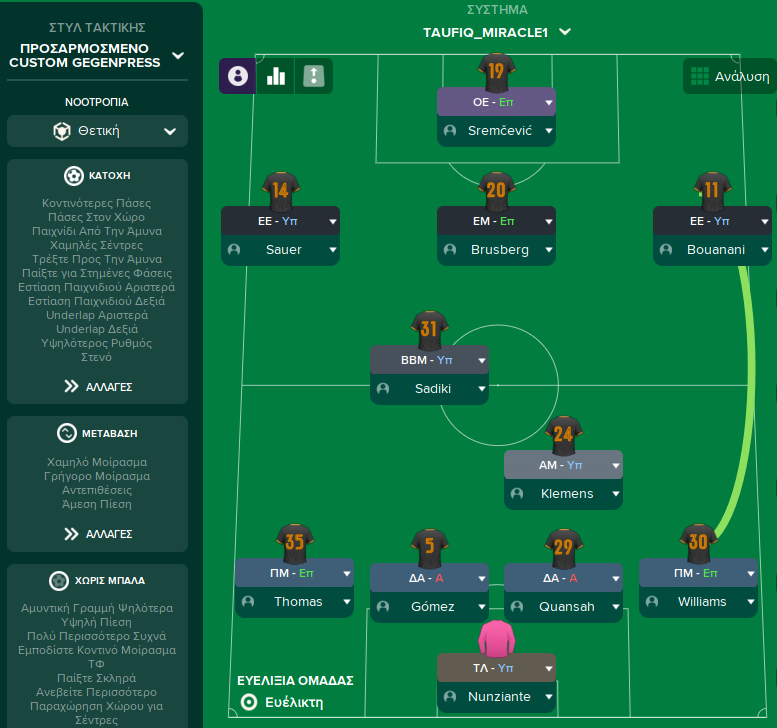
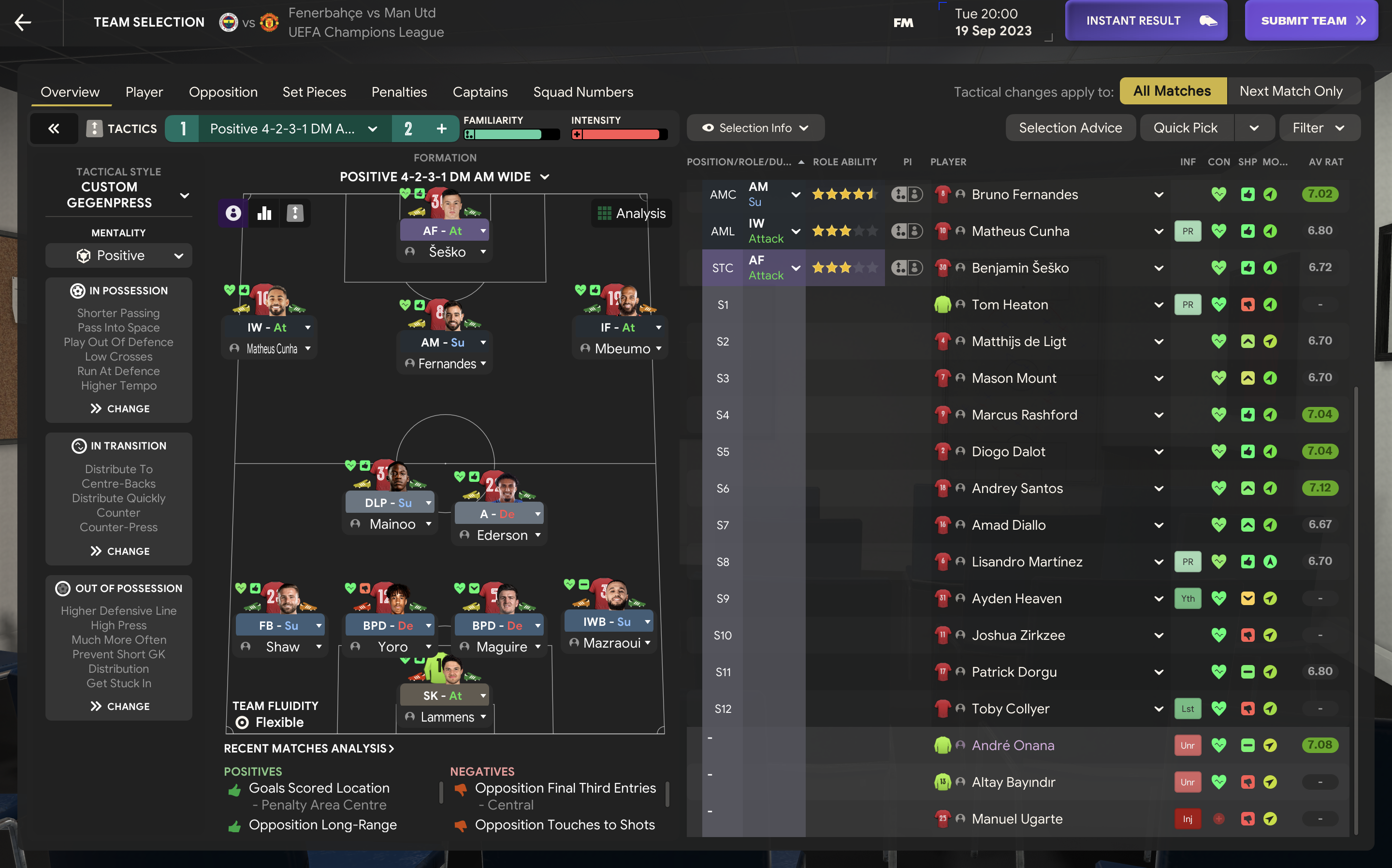
Positive 4-2-3-1 DM Wide
Creating opportunities through a combination of short passing and swift attacking play, while maintaining structural integrity in defence. The attacking…
Loading tactical analysis...
Custom Gegenpress
Positive
Positive 4-2-3-1 DM Wide
Flexible
Shorter Passing
Pass Into Space
Play Out Of Defence
Low Crosses
Run At Defence
Higher Tempo
Distribute To Centre-Backs
Distribute Quickly
Counter
Counter-Press
Higher Defensive Line
Much More Often
Prevent Short GK Distribution
Get Stuck In
GK
Sweeper Keeper
Attack
LB
Full-Back
Support
CB
Ball-Playing Defender
Defend
CB
Ball-Playing Defender
Defend
RB
Inverted Wing-Back
Support
DM
Deep-Lying Playmaker
Support
CM
Advanced Playmaker
Support
AM
Attacking Midfielder
Support
AM
Inside Forward
Attack
ST
Advanced Forward
Attack
Utilizing width from the wide players and attacking full-backs to overload the opposition flanks and create scoring opportunities.
Rapidly transitioning to a pressing system to regain possession upon losing the ball, utilizing counter-press tactics to disrupt the opponent's build-up.
Creating opportunities through a combination of short passing and swift attacking play, while maintaining structural integrity in defence.
4-2
Compact and organized, limiting spaces between the defensive and midfield lines.
Defensive line with two DM roles and a higher defensive line employed.
4-3
Dynamic attacking shape with options for width and central penetration.
Utilizes full-backs and inside forwards to stretch the opposition.
The attacking shape allows for various routes into the final third, maintaining high tempo.
Two inside forwards and an advanced forward working closely create numerous attacking avenues.
Balanced defensive setup provides protection to the back line while allowing midfielders to contribute to pressing.
DM support with ball-playing capabilities allows for transitions.
The strategy heavily depends on maintaining high intensity and may lead to fatigue throughout the match.
Frequent counter-pressing could lead to gaps as players tire, especially with a high defensive line.
The attacking approach can leave gaps in transition if possession is lost carelessly.
Higher defensive line height might expose defenders to fast break situations.
Transition
Quick transitions against the defensive line can lead to complications.
High line combined with aggressive pressing can exploit defensive gaps.
Wide Defensiveness
Inverted wing-back roles may expose flanks without proper cover.
Need for full-backs to track back effectively upon loss of possession.
DLP-S and AM-S
The combination allows for smooth transitions into attacking play while maintaining midfield stability.
DLP-S at [3,3] supports AM-S at [5,3] with excellent passing options.
FB-S and IWB-S
Disciplined roles cooperate to create width and depth in the attacking phase.
FB-S at [2,1] works in tandem with IWB-S at [2,5] stretching the pitch.
How can the pressing strategy be adjusted to mitigate fatigue?
What tactics can be deployed against teams that focus on wide play?
How can player roles be evolved to create more attacking options?
The tactical theory behind the Positive 4-2-3-1 DM Wide: roles, instructions, and the trade-offs that decide whether the system holds up.
Protect a 1-0, chase a 1-0, hold a draw away. How to manage game state in FM through duties and roles, not by lurching to Defensive.
Mentality, duty, role, instruction, sub. The change hierarchy from lightest to heaviest intervention, and 60th-minute patterns by game state.
Pass map, average position, xG, possession by zone: what each tablet panel tells you in FM and the tactical change it should trigger.