Custom
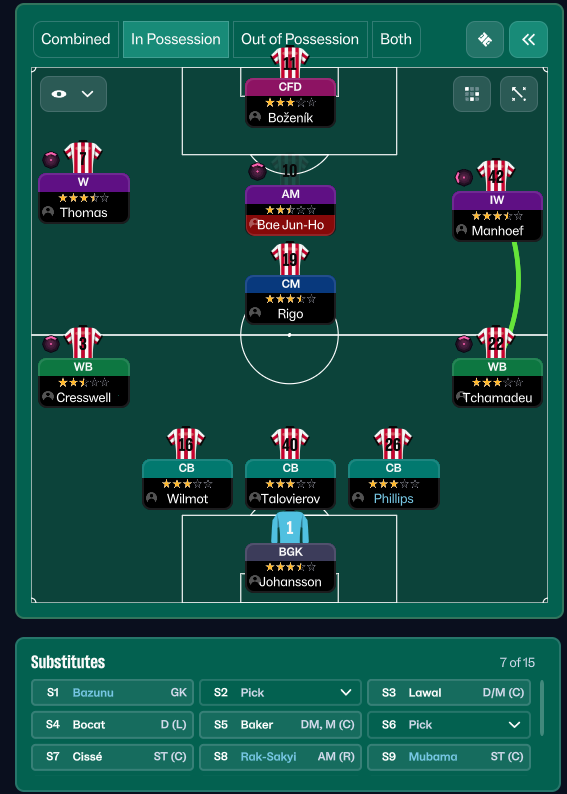
Wide attacking play and a secure back line, with a thin midfield that needs support. Three Centre-Backs and a Ball-Playing Goalkeeper give a solid, secure…
Loading tactical analysis...
Custom
Custom
Balanced
Clean Slate
6
3
Centre Forward
Centre Forward
5
1
Winger
Tracking Winger
5
3
Attacking Midfielder
Central Outlet Attacking Midfielder
5
5
Inside Winger
Tracking Winger
4
3
Central Midfielder
Central Midfielder
3
1
Wing-Back
Full-Back
3
5
Wing-Back
Full-Back
2
2
Centre-Back
Centre-Back
2
3
Centre-Back
Centre-Back
2
4
Centre-Back
Centre-Back
1
3
Ball-Playing Goalkeeper
Goalkeeper
Three Centre-Backs and a Ball-Playing Goalkeeper give a solid, secure platform for building from the back and good cover across the width of the defence.
Centre-Back at [2,2], [2,3], [2,4] and Ball-Playing Goalkeeper at [1,3]
Wing-Backs plus a Winger provide natural width on the left, while the Inside Winger can drift inside to create overloads with the Attacking Midfielder.
Wing-Back at [3,1] and [3,5], Winger at [5,1], Inside Winger at [5,5]
One Central Midfielder has to link a back five with a front four, leaving a large gap and little ball progression through the middle.
Central Midfielder at [4,3] is the only midfielder between lines
No in-possession or out-of-possession instructions are set, so the roles are not supported by a clear team plan on tempo, line or pressing.
Centre Forward at [6,3] and Attacking Midfielder at [5,3] have no instruction support
Central midfield overrun
With only one Central Midfielder, opponents with a three-man midfield can overload the centre and bypass the press.
Central Midfielder at [4,3]
high
Wide transitions
Wing-Backs pushing high leave space behind when possession is lost, with only the wide Centre-Backs to cover.
Wing-Back at [3,1] and [3,5], Centre-Back at [2,2] and [2,4]
medium
Inside Winger + Attacking Midfielder + Centre Forward
The Inside Winger moving infield creates a central attacking trio that can combine around the box.
Inside Winger at [5,5], Attacking Midfielder at [5,3], Centre Forward at [6,3]
Wing-Back + Winger on the left
The Winger holds the touchline or cuts in while the Wing-Back supports, giving a two-man attacking unit on that flank.
Wing-Back at [3,1], Winger at [5,1]
Are you facing opponents who play three in midfield?
Do you want to play on the counter or dominate possession?
Is your left Winger comfortable with one-on-one dribbling?
This is a back-three system with strong width and a secure defensive base thanks to the three Centre-Backs and the Ball-Playing Goalkeeper, with plenty of attacking options up front. Its main flaw is the lone Central Midfielder, which exposes the middle of the pitch, and the absence of any team instructions leaves the roles without direction. Adding a mid block and a more positive mentality with higher tempo would give the shape a clearer identity and protect the centre.
A back three builds through the Ball-Playing Goalkeeper, with Wing-Backs providing width and the Inside Winger and Attacking Midfielder supporting the Centre Forward.
Wing-Backs drop into Full-Backs and the wide forwards track back to form a compact back five, but the single Central Midfielder is left exposed.
Wide attacking play and a secure back line, with a thin midfield that needs support.
The tactical theory behind the Custom: roles, instructions, and the trade-offs that decide whether the system holds up.
Pass map, average position, xG, possession by zone: what each tablet panel tells you in FM and the tactical change it should trigger.
FM27 keeps FM26's tactic system. Here is what stays the same, the small changes that can catch you out, and what the new Tactical Effectiveness system asks of you.
How Mentality, Duty, and Role interact in FM, why duty trumps mentality every time, and the role-on-top-of-duty composition rules.