Custom
A high press designed to force turnovers, backed by screening midfield roles and a balanced mentality. The key structural focus should be keeping the…
Loading tactical analysis...
Custom
Custom
måske
Balanced
Gegenpress
2
2
Centre-Back
Centre-Back
2
4
Ball-Playing Center-Back
Centre-Back
3
2
Inside Wing-Back
Pressing Full-Back
3
3
Defensive Midfielder
Screening Defensive Midfielder
3
5
Wing Back
Pressing Full-Back
4
2
Central Midfielder
Pressing Defensive Midfielder
5
3
Advanced Playmaker
Pressing Central Midfielder
5
5
Wide Forward
Winger
1
3
Ball-Playing Goalkeeper
Goalkeeper
5
1
Winger
Tracking Winger
6
3
Center Forward
Tracking Centre Forward
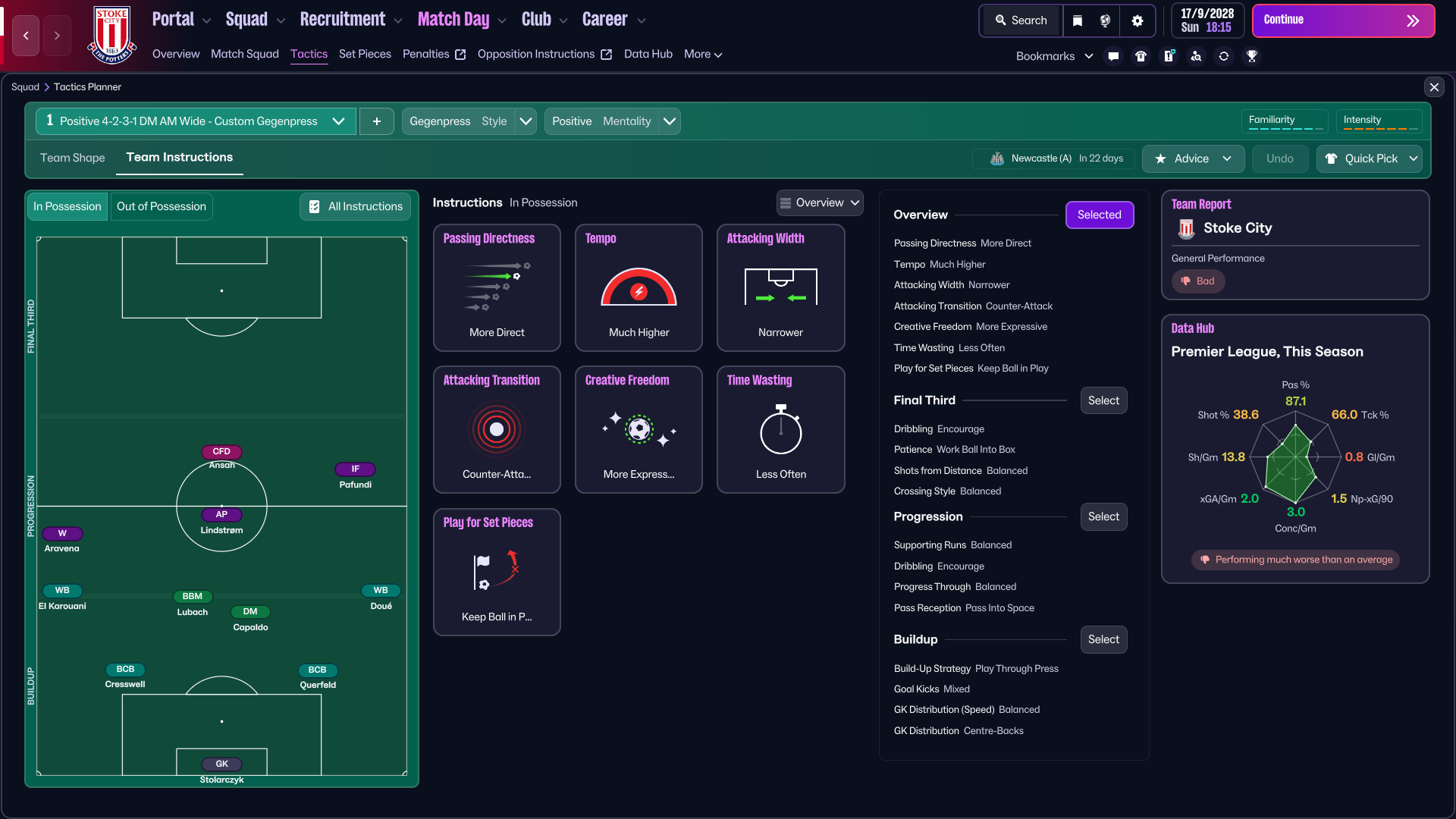
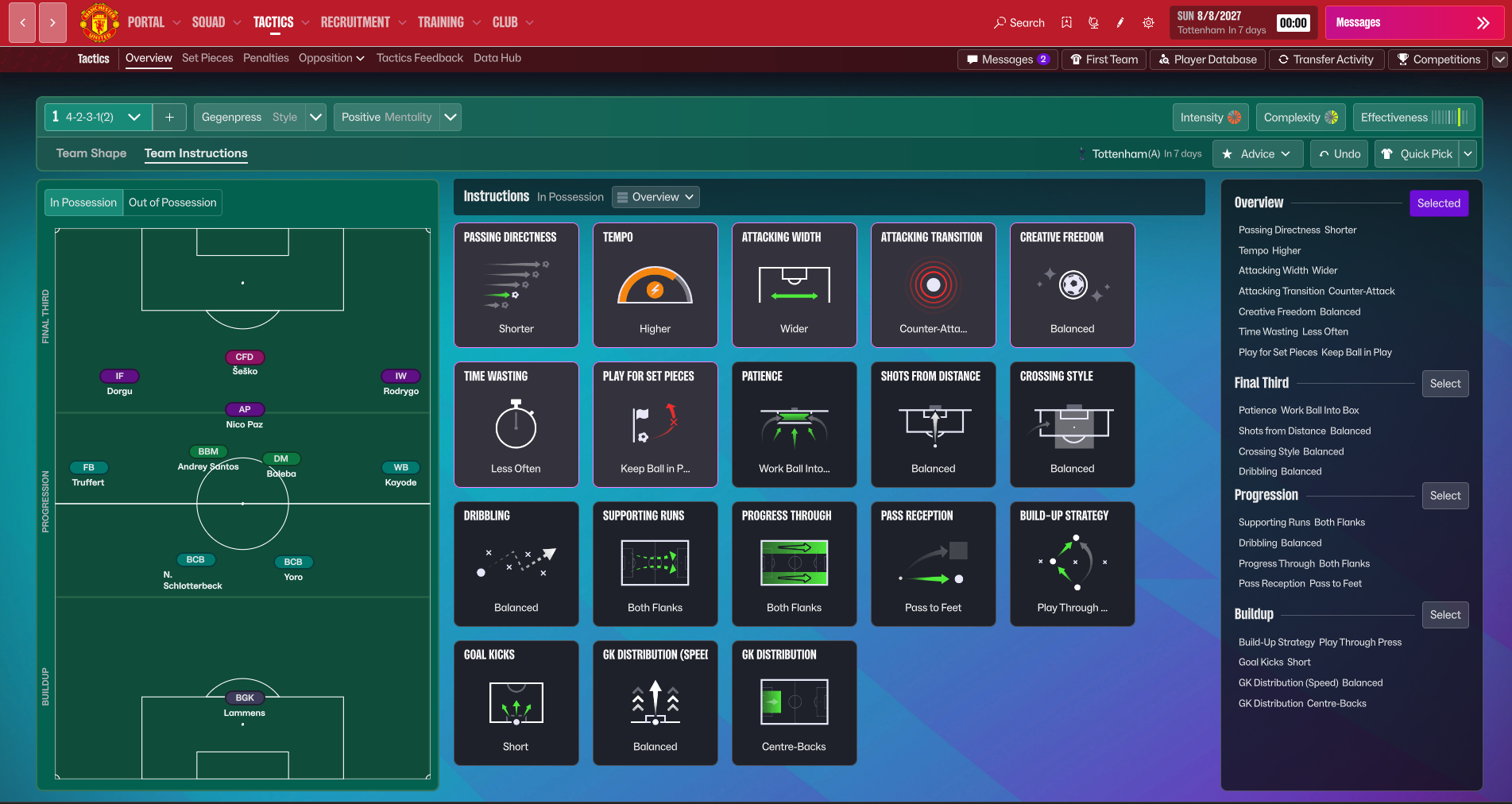
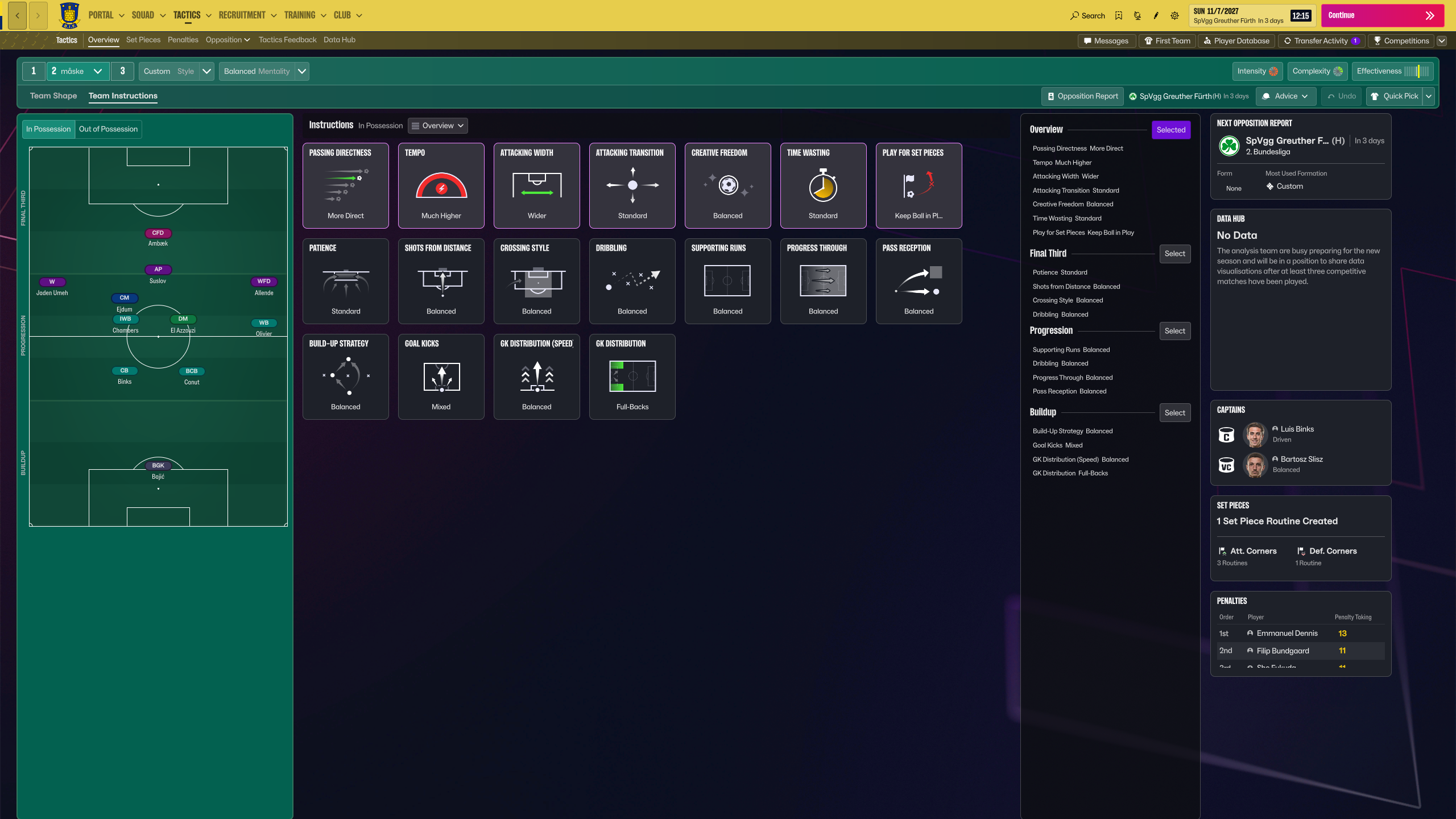
More Direct
Much Higher
Wider
Standard
Balanced
Standard
Keep Ball in Play
Standard
Balanced
Balanced
Balanced
Overlap Balanced
Balanced
Balanced
Balanced
Balanced
Mixed
Balanced
Full-Backs
Underlap Balanced
High Press
Higher
Drop Off More
Much More Often
Regroup
Get Stuck In
Yes
Trap Inside
Trap Inside
Stop Crosses
High Press, Much More Often pressing and Get Stuck In aim to force turnovers quickly, while the Tracking Winger and Tracking Centre Forward provide defensive work from the front.
Team settings: Line of Engagement = High Press, Trigger Press = Much More Often, Tackling = Get Stuck In; [5,1] Tracking Winger; [6,3] Tracking Centre Forward.
The Defensive Midfielder and Screening Defensive Midfielder can protect the space in front of the centre-backs, with the second midfield screen adding further cover.
[3,3] Defensive Midfielder / Screening Defensive Midfielder; [4,2] Central Midfielder / Pressing Defensive Midfielder; [2,2] Centre-Back.
A High Press paired with Drop Off More can leave inconsistent distances between the pressing line and defence: the front presses high while the back line retreats, opening space between the lines.
Line of Engagement = High Press; Defensive Line Behaviour = Drop Off More; [5,3] Pressing Central Midfielder.
More Direct passing and Much Higher tempo push attacks forward quickly, but the Defensive Transition is Regroup, so the team is set to recover shape rather than immediately counter-press after losing the ball.
Passing Directness = More Direct; Tempo = Much Higher; Defensive Transition = Regroup; [3,2] Inside Wing-Back.
Space between the press and defensive line
High pressing paired with Drop Off More can separate the forward press from the retreating defence, giving opponents room to receive and turn between the lines.
Line of Engagement = High Press; Defensive Line Behaviour = Drop Off More; [3,3] Screening Defensive Midfielder.
high
Transitions after possession losses
Much Higher tempo and More Direct passing can lead to turnovers during fast attacks; Regroup prioritises defensive recovery rather than immediate pressure on the ball, potentially allowing opponents to launch counters.
Passing Directness = More Direct; Tempo = Much Higher; Defensive Transition = Regroup; [3,5] Wing-Back.
medium
Ball-Playing Goalkeeper with Ball-Playing Centre-Back
Both roles support a passing-based first phase, and distribution to Full-Backs offers a clear outlet away from central pressure.
[1,3] Ball-Playing Goalkeeper; [2,4] Ball-Playing Centre-Back; GK Distribution = Full-Backs.
Screening Defensive Midfielder with pressing midfield roles
The Screening Defensive Midfielder can hold the central screen while the Pressing Defensive Midfielder and Pressing Central Midfielder apply pressure around it.
[3,3] Screening Defensive Midfielder; [4,2] Pressing Defensive Midfielder; [5,3] Pressing Central Midfielder.
How can I keep my High Press compact when Defensive Line Behaviour is set to Drop Off More?
What should I look for in my players to sustain Much More Often pressing and Get Stuck In?
How can I reduce the danger of losing the ball with More Direct passing and Much Higher tempo?
This is an aggressive Gegenpress with a clear high-press identity, central screening and useful passing options from the goalkeeper and centre-backs. Its main weakness is the mismatch between the High Press and Drop Off More, which can open space between the lines; Regroup also undercuts the immediate ball recovery normally associated with this approach. Aligning the defensive line behaviour and transition response should be the first priority, with a small reduction in tempo helping to control the risk of hurried turnovers.
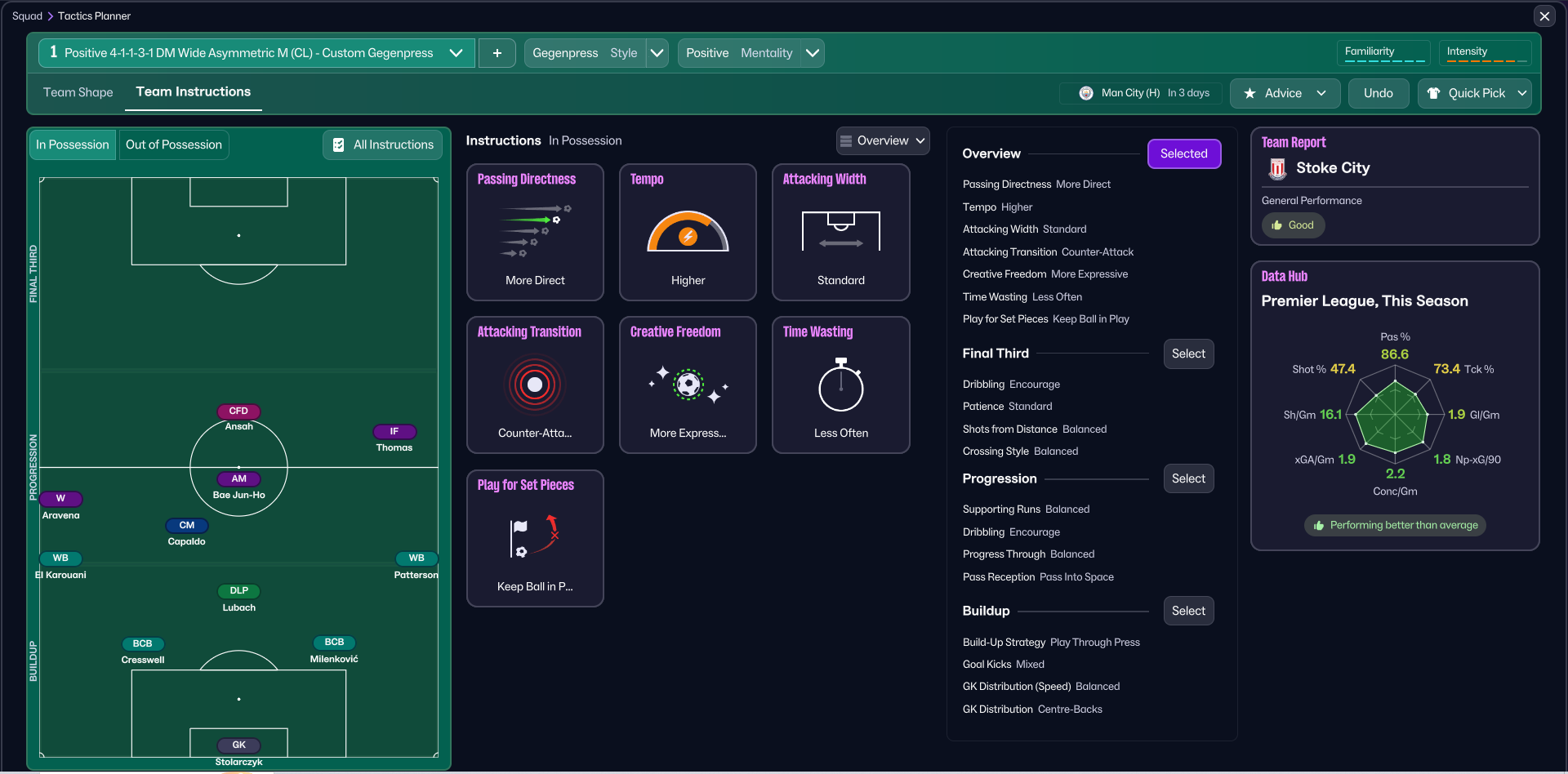
The team uses More Direct passing at Much Higher tempo and Wider attacking width, with balanced final-third choices. Ball-Playing Goalkeeper and Ball-Playing Centre-Back support build-up, while GK Distribution to Full-Backs provides a wide outlet.
After losing possession, the team is instructed to Regroup rather than Counter-Press. This is a notable contrast with the Gegenpress style, High Press and Much More Often trigger press.
A high press designed to force turnovers, backed by screening midfield roles and a balanced mentality. The key structural focus should be keeping the defensive line connected to the press.
The tactical theory behind the Custom: roles, instructions, and the trade-offs that decide whether the system holds up.
Mentality, duty, role, instruction, sub. The change hierarchy from lightest to heaviest intervention, and 60th-minute patterns by game state.
Pass map, average position, xG, possession by zone: what each tablet panel tells you in FM and the tactical change it should trigger.
FM27 keeps FM26's tactic system. Here is what stays the same, the small changes that can catch you out, and what the new Tactical Effectiveness system asks of you.