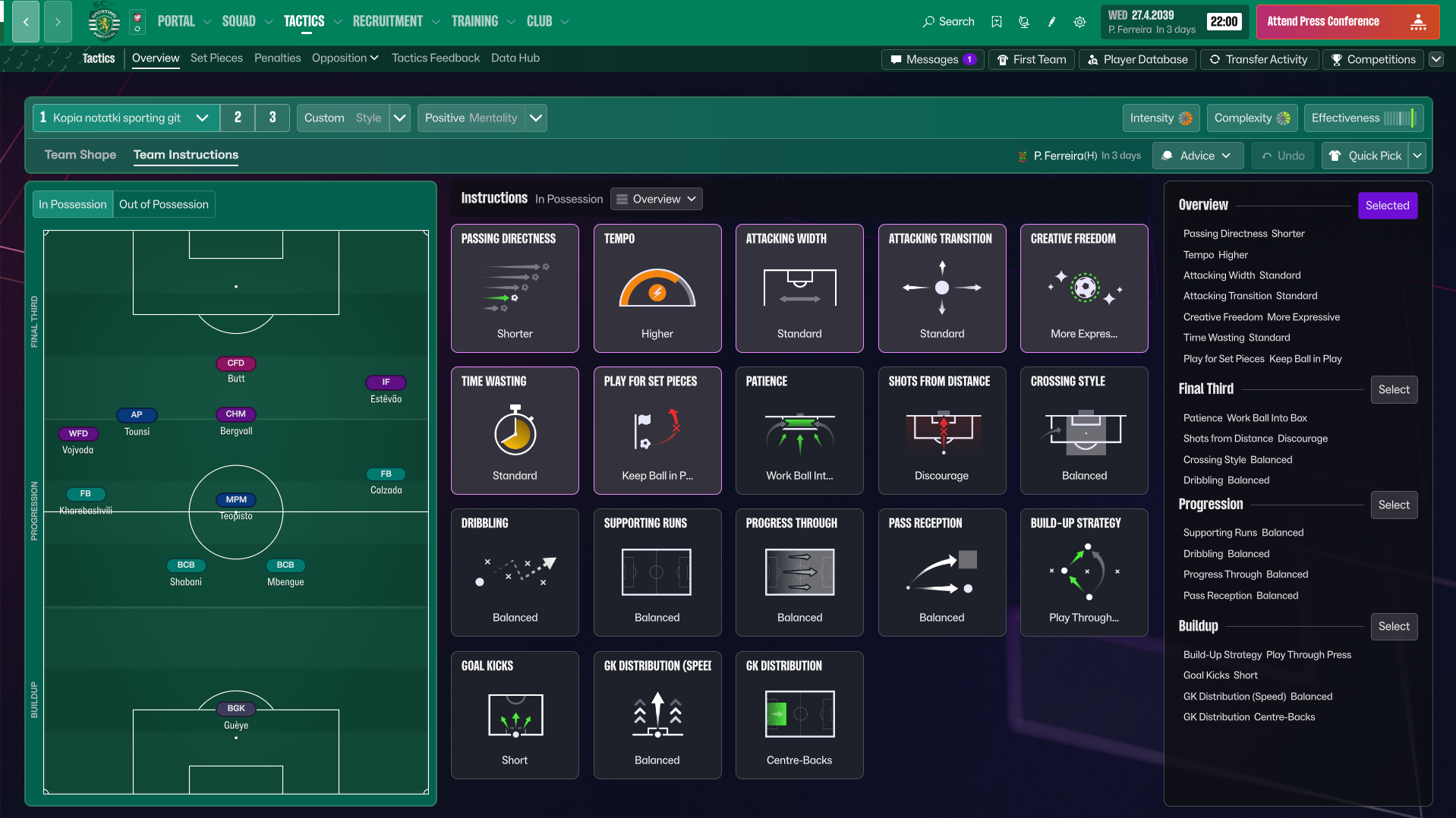
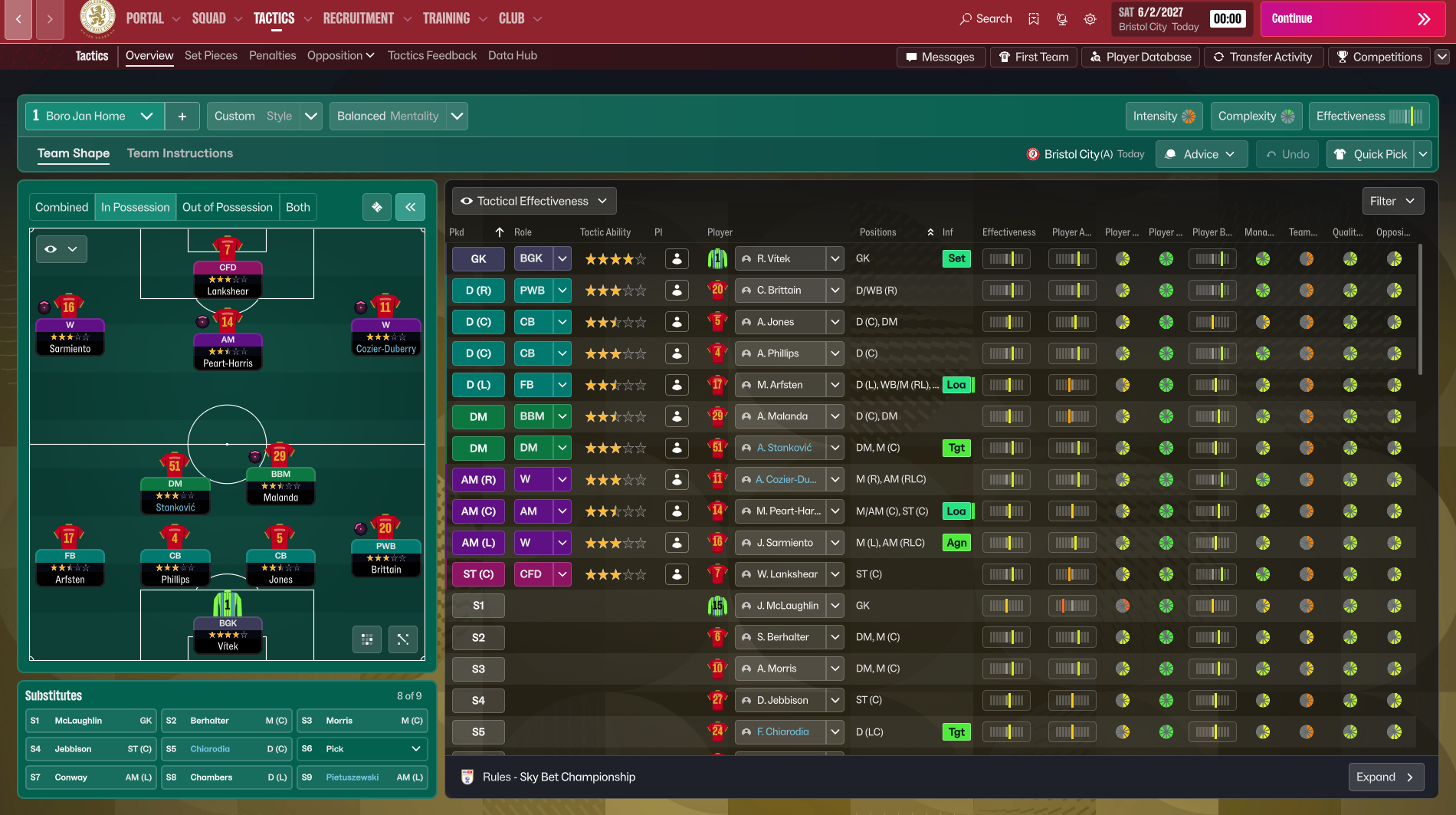
Custom
Build centrally from the goalkeeper through the centre-backs, connect play through the midfield roles and use the wide attackers as outlets; defend from a…
Loading tactical analysis...
Custom
4-3-3 DM Wide
Balanced
6
3
Center Forward
Center Forward
5
4
Advanced Playmaker
Pressing Central Midfielder
5
5
Winger
Winger
2
1
Inside Full-Back
Holding Full-Back
3
3
Defensive Midfielder
Defensive Midfielder
2
3
Centre-Back
Centre-Back
1
3
Ball-Playing Goalkeeper
Goalkeeper
5
1
Wide Forward
Winger
4
2
Midfield Playmaker
Central Midfielder
2
4
Inside Wing-Back
Pressing Full-Back
2
5
Ball-Playing Center-Back
Centre-Back
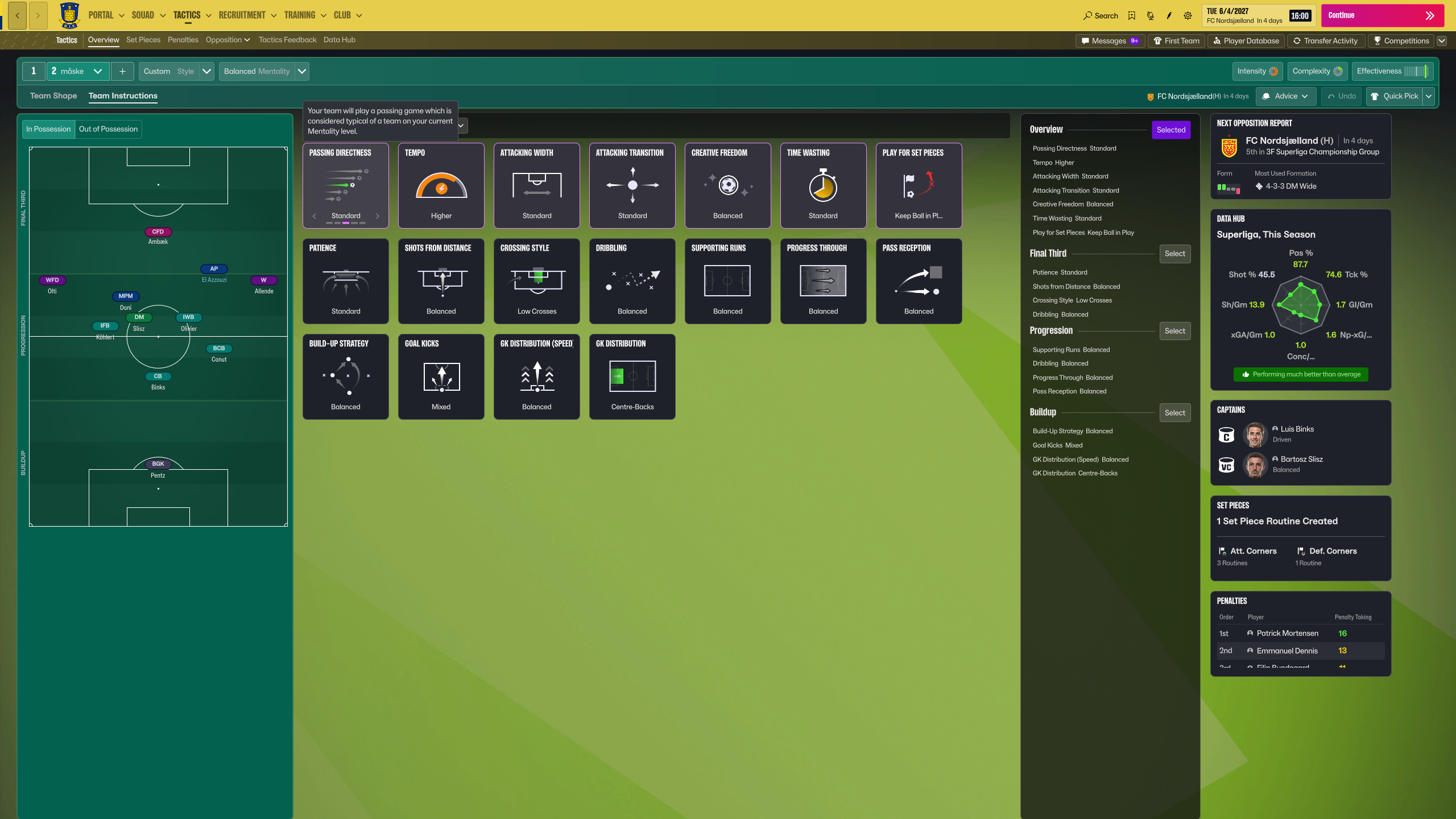
Standard
Higher
Standard
Standard
Balanced
Standard
Keep Ball in Play
Standard
Balanced
Low Crosses
Balanced
Overlap Balanced
Balanced
Balanced
Balanced
Balanced
Mixed
Balanced
Center-Backs
Underlap Balanced
Mid Block
Standard
Balanced
More Often
Regroup
Standard
Yes
Balanced
Balanced
Balanced
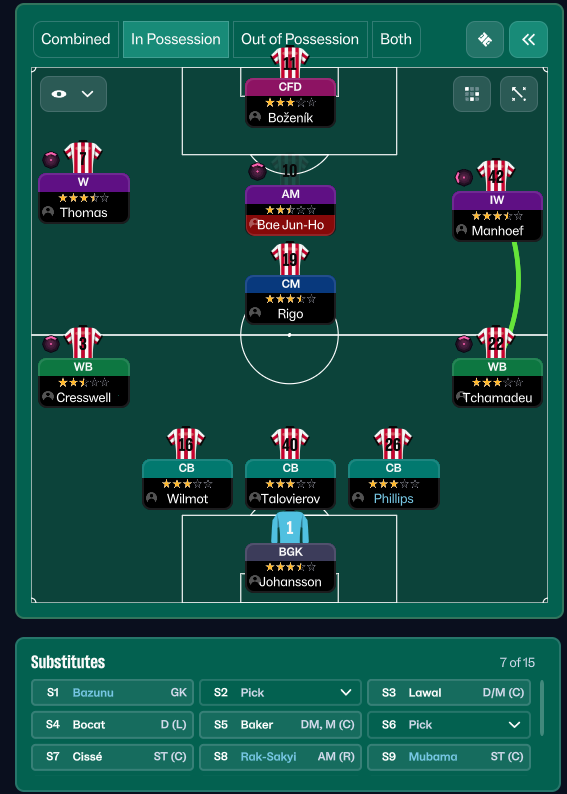
Centre-Back and Ball-Playing Centre-Back roles are paired with Centre-Backs goalkeeper distribution, giving the Ball-Playing Goalkeeper short central outlets.
Ball-Playing Goalkeeper at [1,3], Centre-Back at [2,3], Ball-Playing Centre-Back at [2,5], and GK Distribution: Centre-Backs.
The Defensive Midfielder, Midfield Playmaker and Advanced Playmaker offer multiple routes to connect the back line with the attack.
Defensive Midfielder at [3,3], Midfield Playmaker at [4,2], and Advanced Playmaker at [5,4].
More Often pressing asks for frequent pressure, but Regroup prioritises recovering shape after possession is lost. This can make the response to turnovers less cohesive.
Trigger Press: More Often and Defensive Transition: Regroup, alongside Pressing Central Midfielder at [5,4].
Higher tempo increases urgency, while Balanced build-up does not specialise in either retaining the ball under pressure or bypassing it. The combination may produce rushed or inconsistent progression.
Tempo: Higher and Build-Up Strategy: Balanced, with Ball-Playing Goalkeeper at [1,3].
Space behind the standard defensive line
A Standard defensive line offers less protection against through balls than a deeper line, while the extraction shows no specific defensive-line behaviour to prioritise dropping off.
Defensive Line: Standard and Defensive Line Behaviour: Balanced, with Centre-Back at [2,3] and Ball-Playing Centre-Back at [2,5].
medium
Turnovers during the pressing response
More Often pressing can pull players out of position, and Regroup means fewer immediate attempts to win the ball back after losing it. Opponents may exploit the gap before the team settles.
Trigger Press: More Often and Defensive Transition: Regroup, with Pressing Full-Back at [2,4] and Pressing Central Midfielder at [5,4].
medium
Ball-Playing Goalkeeper with two ball-playing central outlets
Centre-Backs distribution aligns with the two centre-back slots, including a Ball-Playing Centre-Back, to offer a central route out from goal.
Ball-Playing Goalkeeper at [1,3], Centre-Back at [2,3], Ball-Playing Centre-Back at [2,5], and GK Distribution: Centre-Backs.
Midfield playmaking around a defensive base
The Defensive Midfielder can sit behind the two playmaking roles, creating a central structure for circulation and progression.
Defensive Midfielder at [3,3], Midfield Playmaker at [4,2], and Advanced Playmaker at [5,4].
How can I make my pressing response more coherent with More Often pressing and Regroup?
What should I look for in my centre-backs if I keep a Standard defensive line?
How can I make my central build-up less vulnerable when opponents press my Ball-Playing Goalkeeper?
This tactic has a clear central build-up foundation, with a Ball-Playing Goalkeeper distributing to centre-backs and three central midfield roles offering passing connections. The wide attacking roles add outlets, but the fast tempo combined with a non-specialised build-up can make progression hurried. The main adjustment I would test first is aligning the defensive transition with the frequent pressing; I would also consider a deeper defensive line if opponents are finding space behind.
The team uses a balanced passing and build-up approach at Higher tempo, with Centre-Backs selected for goalkeeper distribution. Central midfield playmaking supports progression, while wide attacking roles provide additional outlets. Low Crosses and Keep Ball in Play are selected in possession.
The team is set to Regroup after losing possession, despite using More Often pressing when defending. This favours recovery into shape rather than an immediate counter-press.
Build centrally from the goalkeeper through the centre-backs, connect play through the midfield roles and use the wide attackers as outlets; defend from a Mid Block with a Standard defensive line.
The tactical theory behind the Custom: roles, instructions, and the trade-offs that decide whether the system holds up.
Mentality, duty, role, instruction, sub. The change hierarchy from lightest to heaviest intervention, and 60th-minute patterns by game state.
Pass map, average position, xG, possession by zone: what each tablet panel tells you in FM and the tactical change it should trigger.
FM27 keeps FM26's tactic system. Here is what stays the same, the small changes that can catch you out, and what the new Tactical Effectiveness system asks of you.