2-7-2 (Attacking) Tactic
2-7-2
Maximizing attacking transitions while maintaining defensive structure. Using width through inside forwards and overlapping full-backs creates space.
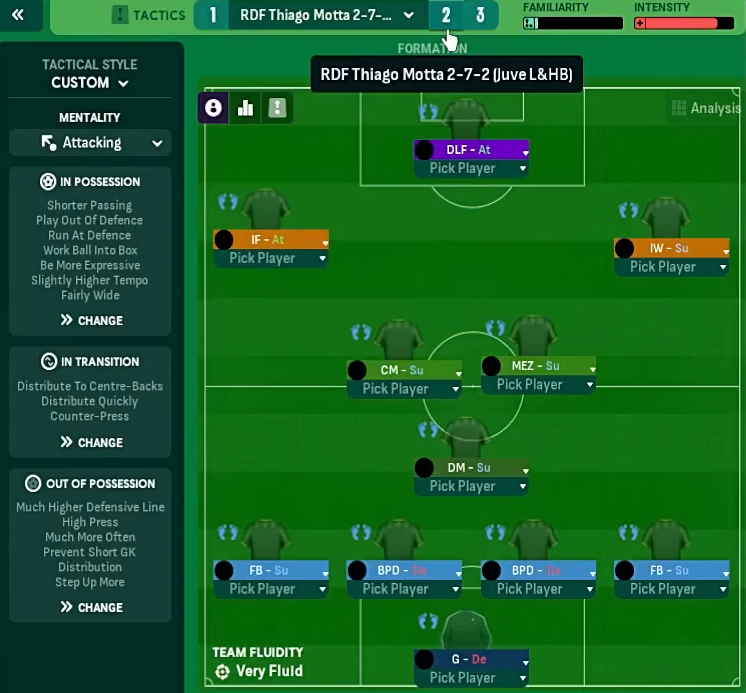
Loading tactical analysis...
Formation and style
Custom
Attacking
2-7-2
Very Fluid
In possession
Shorter Passing
Play Out Of Defence
Run At Defence
Work Ball Into Box
Be More Expressive
Slightly Higher Tempo
Fairly Wide
In transition
Distribute To Centre-Backs
Distribute Quickly
Counter-Press
Out of possession
Much Higher Defensive Line
High Press
Much More Often
Prevent Short GK Distribution
Step Up More
Player roles
GK
G
De
Defender
BPD
De
Defender
FB
Su
Defender
FB
Su
Defensive Midfield
DM
Su
Central Midfield
CM
Su
Attacking Midfield
MEZ
Su
Attacking Midfield
IW
Su
Forward
DLF
At
Forward
IF
At
Phase description
Utilizing width with overlapping full-backs and inside forwards to create goal-scoring opportunities.
Quick transition towards a high press to recover possession.
Maximizing attacking transitions while maintaining defensive structure.
Team shape defence
Compact and High Line
The team maintains a compact shape while pressing high up the pitch, increasing the pressure on the opposition.
Much Higher Defensive Line and High Press instructions.
Team shape attack
Fluid and Attacking
The team emphasizes fluid play with interchangeable positions, maximizing width and creativity.
Shorter Passing, Fairly Wide, and Be More Expressive instructions.
Key strengths
Attacking Width
Using width through inside forwards and overlapping full-backs creates space.
Inside Forward (IF-A) at [6,2] and Full-Back (FB-Su) at [2,1] and [2,5].
Controlled Possession
Shorter passing and working the ball into the box help retain possession and set up opportunities.
Shorter Passing and Work Ball Into Box instructions.
Conflicting tactics
High Defensive Line vs. Fast Attackers
Against teams with quick counter-attacking players, your high line may be vulnerable.
Much Higher Defensive Line combined with a high press.
Shape vs. Width Balance
If attacked through the wings, the two defenders might be exposed, leading to over-reliance on the midfields.
Only two defenders for a 2-7-2 formation.
Risk exposures
Risk Exposures
Items
Defensive Vulnerability
The lack of defensive depth can expose the goal to counter-attacks.
Only two defenders in the formation.
Midfield Overload
Against teams with a strong midfield presence, possession can be lost in midfield battles.
Heavy reliance on three midfield roles.
Role synergies
Role Synergies
Items
Inside Forward and Full-Backs
Creates overloads on the flanks, allowing for crossing opportunities and pulling defenders.
IF-A at [6,2] with FB-Su at [2,1] and [2,5].
Dynamic Midfielders
Midfielders working together can create passing triangles, retaining possession and moving the ball effectively.
CM-Su at [4,3] working alongside MEZ-Su at [4,4].
Suggested questions
How do you intend to adjust your formation against teams with strong counter-attacks?
What are your plans to maintain player fitness with a high-tempo game?
Are there specific player attributes you prioritize for your full-backs?
Related Tactics
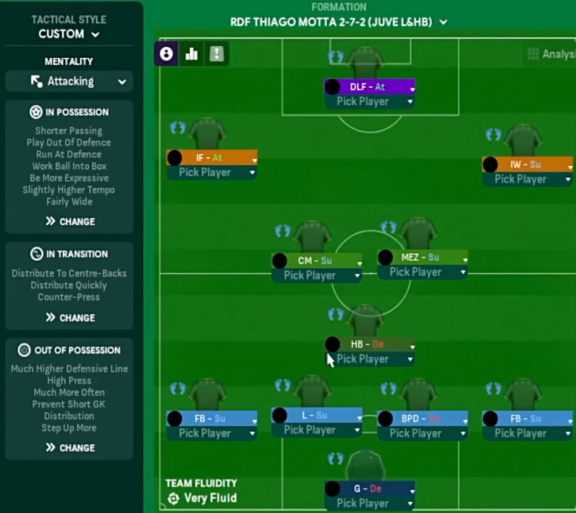
Guides for this tactic
The tactical theory behind the 2-7-2: roles, instructions, and the trade-offs that decide whether the system holds up.
Mentality, Duty & Roles
How Mentality, Duty, and Role interact in FM, why duty trumps mentality every time, and the role-on-top-of-duty composition rules.
Pressing Triggers and Intensity
Counter-Press, Regroup, Stand Off, Trigger Press: what each pressing instruction does in FM and how to pair them without contradicting.
Defensive Line and Line of Engagement
The pairing rule for Defensive Line and Line of Engagement, all 9 combinations, and the gap that costs goals.