Uploaded Tactic
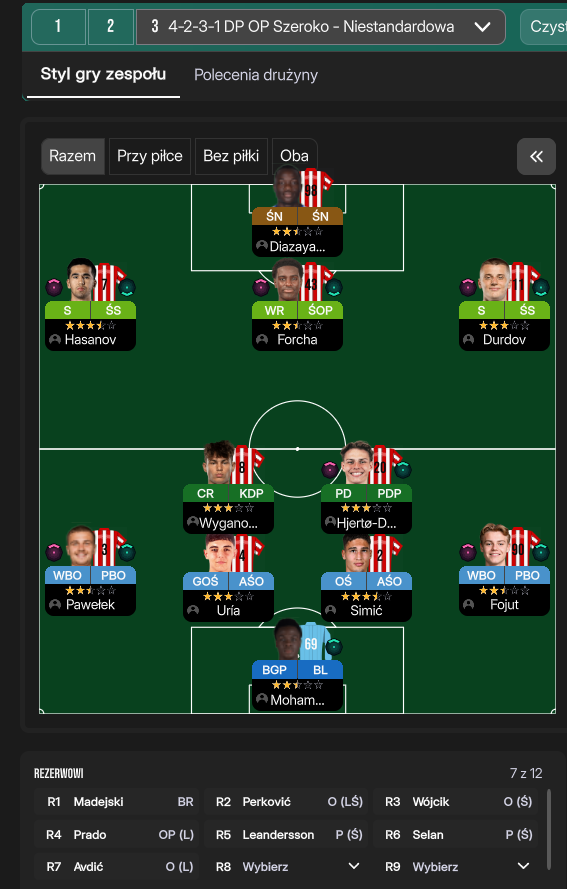
Formation & Style
Tactical Style:Standard
Mentality:Positive
Formation:4-2-3-1
Team Fluidity:Structured
In Possession
Play out of defence
Maintain possession
Exploit the flanks
In Transition
Counter-attack
Pressing after loss of possession
Out of Possession
Standard defensive line
Get stuck in
Team Shape Without Ball
Shape:4-2-3-1
Description:Compact shape with two defensive midfielders shielding the backline.
Evidence:DM at [3,3] and CM at [4,3] provide support to the defence.
Team Shape With Ball
Shape:4-2-3-1
Description:Dynamic attack utilizing width and a central playmaker.
Evidence:Wingers at [5,2] and [5,4] stretching the play with an attacking midfielder at [5,3].
Phase Description
Attacking Play
Focuses on creating width and utilizing wingers to deliver crosses, while the AM creates opportunities centrally.
Defensive Transition
Aiming to regain possession quickly with counter-pressing tactics.
Main Focus
Exploiting flanks while maintaining central presence with attacking midfield.
Key Strengths
Player Distribution in Midfield
A well-distributed midfield with both creative and defensive roles allows for flexibility during transitions.
Width and Stretching Opponents
The presence of two wing-backs allows the team to stretch the opponent's defence, creating space centrally.
Versatile Forward Options
Utilizing an advanced forward as well as attacking midfielders to penetrate defenses and create chances.
Conflicting Directions
Potential Defensive Vulnerabilities
High attacking roles may leave gaps during transitions if not managed well.
Limited Central Protection
With only one DM, the team might struggle against teams with strong central attacks.
Reliance on Wide Play
Overemphasis on wing play can lead to predictability in attack.
Tactical Suggestions
Consider a Secondary Playmaker in Midfield
Introducing a more dynamic midfielder could improve ball retention and creativity.
Adjust Wing-Backs to Support Duty
Switching Wing-Backs to Support may offer more balance defensively.
Utilize High Pressing Strategy
Encouraging the team to recover the ball higher up the pitch can exploit opponent weaknesses.
Ask Questions About Your Lineup
Related Tactics
More Standard tactics
Guides for this formation
The tactical theory behind the 4-2-3-1: roles, instructions, and the trade-offs that decide whether the system holds up.
Player pairings
Midfield Pairs in 4-2-3-1 and 4-4-2
Double pivots and flat pairs in 4-2-3-1 and 4-4-2: when each pairing works, when it collapses, and the AMC unicorn that rescues both.
Read guide
Playing styles
Gegenpressing: A Full Guide
Klopp-style gegenpressing in FM, including squad profile, line-and-press pairing, sustainable workload, and the antipatterns to avoid.
Read guide