Midfield Pairs in 4-2-3-1 and 4-4-2
Double pivots and flat pairs: the role pairings that work, the AMC interaction that decides your shape, and the two-destroyers trap that hides in plain sight.
By John Brawner · Updated May 1, 2026
The Pair's Missing Third
Three-man midfields obey a clean rule: one holder, one runner, one creator. A midfield pair cannot. With only two seats, you pick two of the three jobs, and the third has to come from outside the pair, almost always the AMC in a 4-2-3-1 or a dropping striker in a 4-4-2.
That structural difference is what makes pairs harder to build than trios. In a trio you can hide a creator behind a holder; in a pair, every choice is visible. Pick two destroyers and you have no creator in central midfield (fine if your AMC is de Bruyne, ruinous if he isn't). Pick a creator and a runner and you have no holder (fine if your full-backs cover centrally, a disaster if they overlap). The pair plus the player directly ahead of it is the unit; you can never reason about the two midfielders in isolation.
The Pair's Distribution Rule
Count the holder, runner, and creator jobs across your pair AND the player directly ahead of them (the AMC in a 4-2-3-1, or the dropping striker in a 4-4-2). Across those three players, you still need 1 holder + 1 runner + 1 creator. The pair just gives you fewer arrangements that work.
- • Holder + Creator pair: AMC plays the runner
- • Holder + Runner pair: AMC plays the creator
- • Two-Destroyer pair: AMC must be runner AND creator (rare elite territory)
- • Creator + Runner pair: no holder, structurally fragile
Two Pair Archetypes
The 4-2-3-1 double pivot and the 4-4-2 flat pair look superficially similar (two central midfielders side by side) but they sit on different strata and behave very differently. Treat them as separate problems.
Archetype 1: Double Pivot (4-2-3-1)
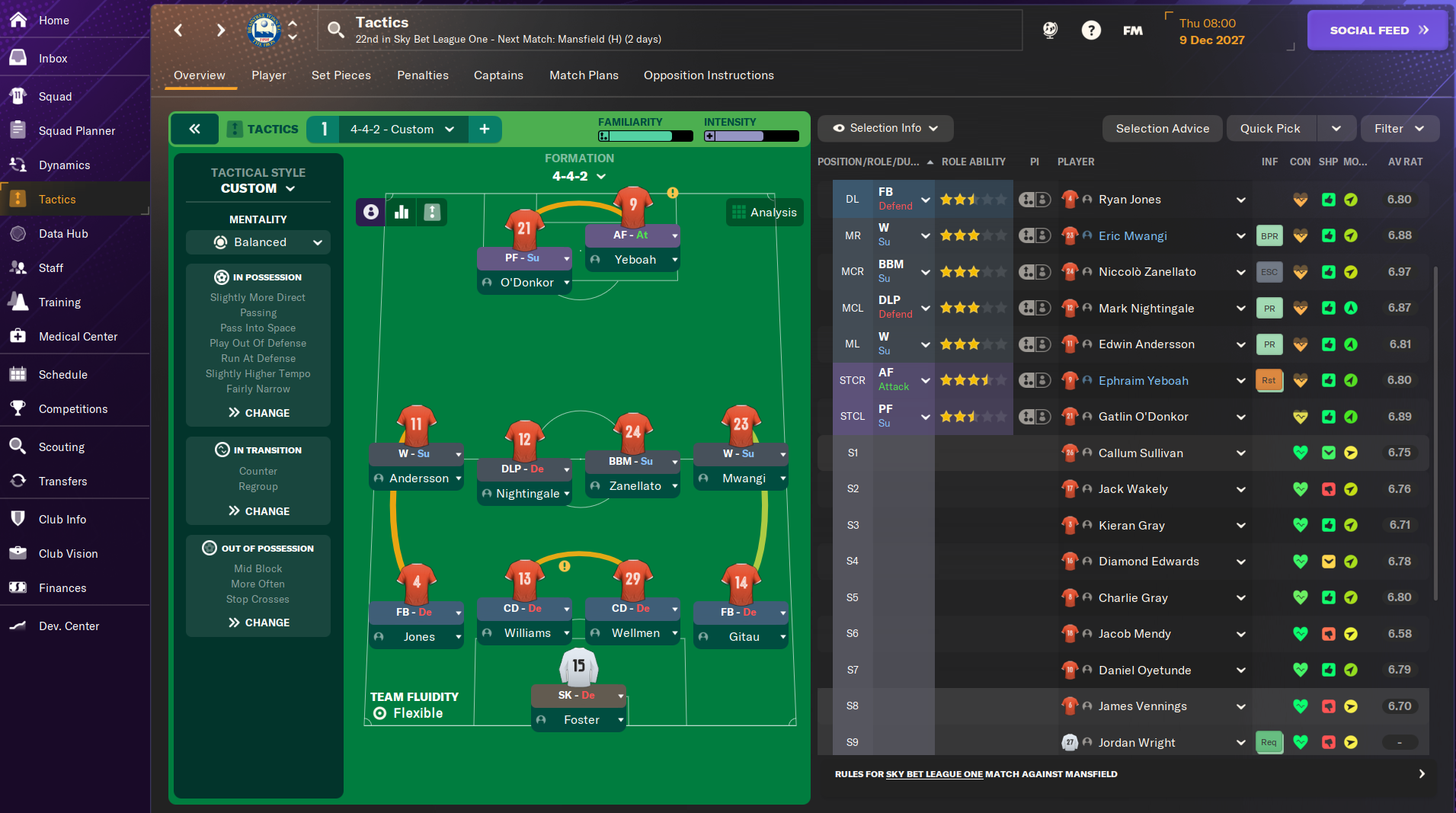
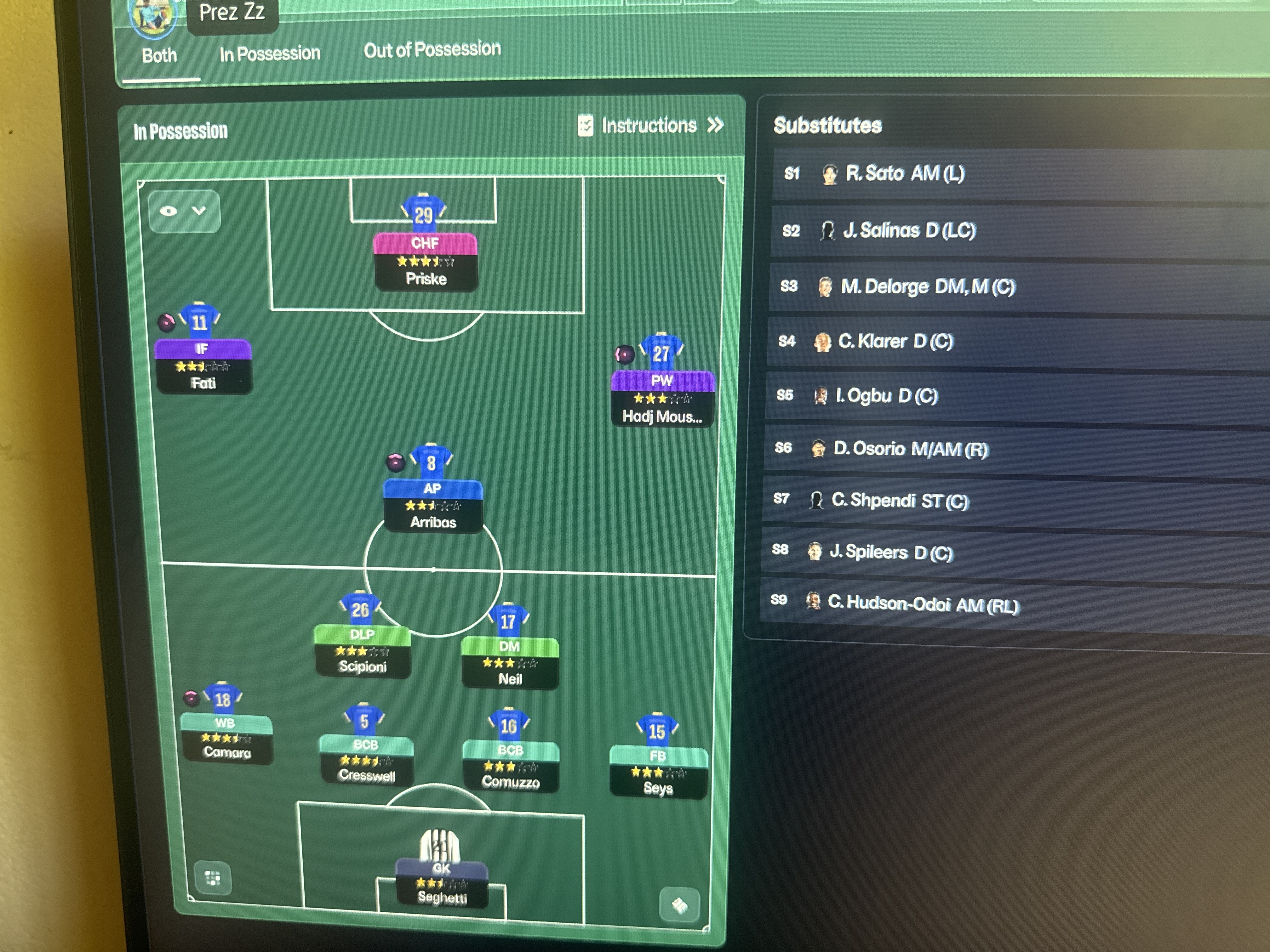
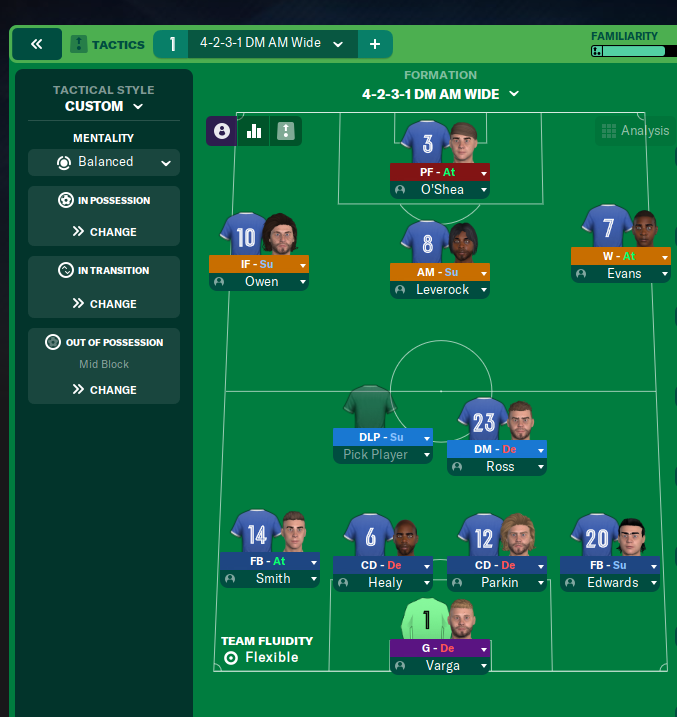
Both midfielders typically sit on the DM strata of the shape sheet (the standard 4-2-3-1 Wide setup, registered as DMs rather than CMs) with an AMC and three forwards ahead. Placing them on DM strata gives the pair a stronger screen on the back four; a 4-2-3-1 with the pair on MC strata is a thinner-screen variant of the same idea. Default duty is Defend on at least one of the two; both on Defend gives maximum screen, both on Support gives maximum progression but a shallower screen.
| Position | Role | Duty | Job |
|---|---|---|---|
| Left DM | Defensive Midfielder | Defend | Holder |
| Right DM | Deep Lying Playmaker | Defend | Creator |
The other common variant pairs a DM with a Ball-Winning Midfielder (two destroyers) and pushes the entire creative load onto the AMC:
| Position | Role | Duty | Job |
|---|---|---|---|
| Left DM | Defensive Midfielder | Defend | Holder |
| Right DM | Ball-Winning Midfielder | Defend | Holder #2 |
When it works: against opponents who like to play through central midfield. Two screens are difficult to break with short combinations, and the AMC ahead has space to run into when the pair recovers. When it breaks: against opponents who go around you; width, switches, and high crosses bypass the central screen entirely, leaving your pair as spectators.
Archetype 2: Flat Pair (4-4-2)
Both midfielders sit on the MC strata (flat in line) with no AMC, two wide midfielders, and two strikers. There is no second midfield line: the pair is the only screen between the back four and the front four. They cannot vacate the centre at the same time, which makes duty distribution stricter than in a double pivot.
| Position | Role | Duty | Job |
|---|---|---|---|
| Left CM | Defensive Midfielder | Defend | Holder |
| Right CM | Box-to-Box Midfielder | Support | Runner |
The classic Italian variant pairs a Deep-Lying Playmaker with a Ball-Winning Midfielder, the regista-and-mediano pattern made famous by Pirlo and Gattuso in Ancelotti's Milan diamond. The pairing logic translates cleanly to a flat 4-4-2 pair too:
| Position | Role | Duty | Job |
|---|---|---|---|
| Left CM | Deep Lying Playmaker | Support | Creator |
| Right CM | Ball-Winning Midfielder | Defend | Holder |
When it works: with a Complete Forward or Deep-Lying Forward who drops into the runner space, plus tucked-in wide midfielders that pinch toward the half-spaces. The pair is holder + creator; the dropping striker is the runner. When it breaks: against any modern 4-3-3. You are outnumbered 3v2 in central midfield, and a flat pair has no positional answer. You either accept the man advantage centrally or rotate one of your wide midfielders inside, which loses you width.
AMC Interaction in 4-2-3-1
In the 4-2-3-1, the AMC is the third midfielder by a different name. He completes the holder/runner/creator distribution that the pair cannot manage on its own, and his role choice constrains the pair's role choice in ways most save players miss. Pick the AMC's role first; let it dictate the pair's job assignment.
- AMC as Attacking Playmaker, Trequartista, or AM (Support). The AMC plays the creator and works between the lines. AP(S) holds position, Trequartista (Attack) bakes in Roam from Position, Dribble More, and Move Into Channels; unlike Advanced Playmaker, the role does no defensive work, so it's a bigger commitment to the creative half of the pair. In FM24 the Trequartista is a distinct role; in FM26 it was absorbed into Advanced Playmaker and Free Role, so pick AP(S) or Free Role on an FM26 save. AM(S) is a creator with more mobility than AP(S) and more shooting freedom: same family, slightly less locked to the playmaker brief. All three are creators, not runners. The pair must therefore be Holder + Runner, typically DM(D) + B2B(S), or DM(D) + CM(S). Two destroyers behind a creator AMC leaves no runner anywhere on the pitch, and attacks die in the half-space.
- AMC as Shadow Striker (Attack). The AMC plays the runner, getting beyond the striker. The pair must be Holder + Creator: DM(D) + DLP(S) is the default. Pairing two Defend duties (DM(D) + DLP(D)) behind an attacking AMC against a press is quicksand in build-up; the DLP needs the Support duty to step into receiving lanes and feed the Shadow Striker in stride. Without that, the AMC ends up isolated and caught offside.
- AMC as Enganche (Support). Fixed-position creator, no roaming, the old-school #10 archetype, locked to the tip of the midfield. The pair must be Holder + Runner just as with AP(S), but the full-backs and wide forwards have to provide more width than usual because the Enganche will not drift. DM(D) + B2B(S) is the safe answer. In FM24 the Enganche is a distinct role; in FM26 it was absorbed into Free Role (and Advanced Playmaker for some configurations), so pick Free Role or AP(S) on an FM26 save.
If the AMC and the pair both want to be holders, you have three holders and a 1. You will not score. If both want to be creators, no one is screening the back four. You will concede transitions. The interaction is non-negotiable; pick the AMC's job first.
The Two-Destroyers Trap
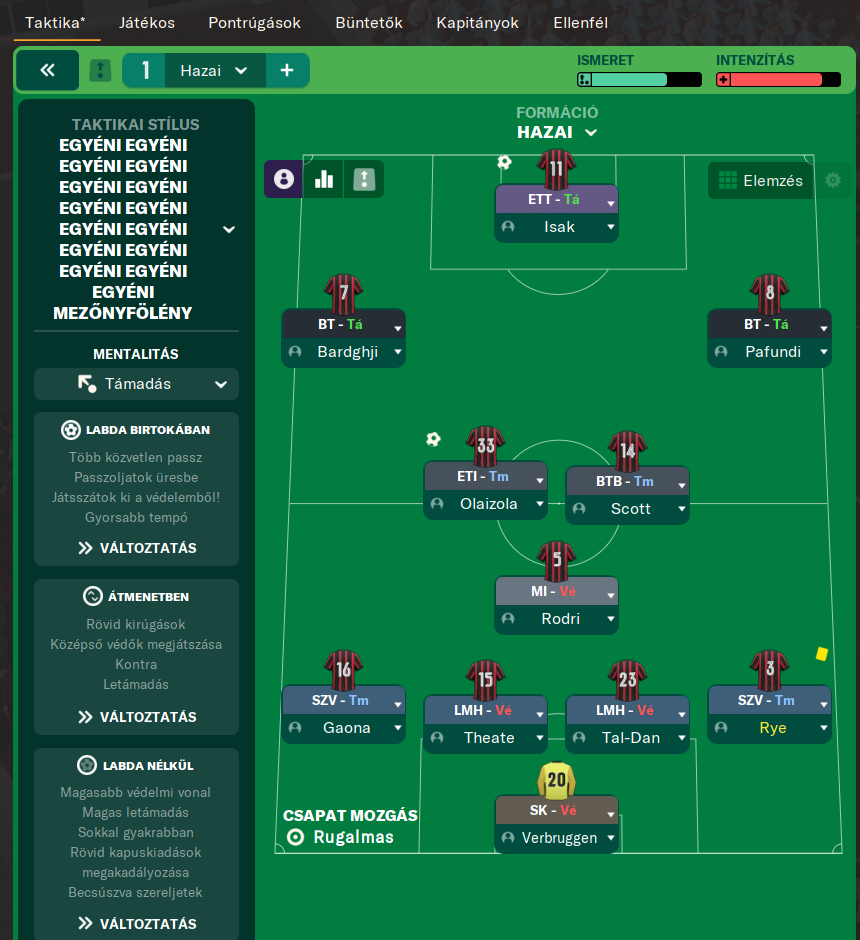
The most common pair antipattern in FM is the two-destroyers double pivot: DM (Defend) plus Ball-Winning Midfielder (Defend), set up as the standard "defensive-minded" 4-2-3-1. On paper it looks airtight. In practice it is the pair version of the same antipattern at trio level, with one extra wrinkle: there is an AMC who could rescue it.
The trap is that he usually can't. Two destroyers behind an AP(S) leaves the AMC as both the runner and the creator, a job description only a handful of players can actually fulfil. De Bruyne can. Modric can. In a top-flight save, Foden, Olise, Wirtz, Pedri shifted forward, and Musiala can carry that load too. Outside top-flight saves, this profile is rare. When you don't have one of those players, the AMC drops deeper and deeper trying to get the ball, the striker runs into channels with no service, and your central midfield has the ball but never within 40 metres of the opposition box.
Fix #1: Change the BWM to a DLP. You move from Holder + Holder to Holder + Creator, the AMC's job becomes humanly possible, and the central spine starts producing chances. Fix #2: Keep the destroyers, but only if your AMC is genuinely elite. Usually he isn't.
Pair-specific antipattern: DLP + B2B
The mirror image of two destroyers: a creator and a runner with no holder. The pair looks beautiful in possession; on transitions, the DLP is where he received the build-up (deep but offset) and the B2B has burst forward. There is nothing in front of the centre-backs. Counters live in that space. Fix: change the B2B to a CM(D), or accept that your full-backs must always tuck inside on transition, which most full-backs cannot.
Real-World Examples
Four pairs that illustrate the rule: one Holder + Creator behind a runner AMC, one Holder + Holder/Distributor pair behind a creator AMC (Inter 2009-10, a different distribution pattern, but the same three-job principle), one Creator + (Holder/Runner hybrid) behind two #10s, and one concealed double pivot built from a CB stepping into midfield. All four reached European finals (three winners, one runner-up), all four with the slot ahead of the pair used to complete the holder/runner/creator distribution.
Bender / Gündoğan behind Götze (Klopp's Dortmund, 2011-13): the canonical Holder + Creator pair in a 4-2-3-1, with a runner AMC ahead. Sven Bender on Defend was the pure holder, the physical screen who broke up counters and recycled possession sideways. İlkay Gündoğan on Support (after his summer 2011 signing; the 2010-11 partner was Nuri Şahin) was the deep-lying creator, threading vertical passes into the half-spaces and dictating tempo. Mario Götze ahead was the runner, a #10 who arrived late in the box, made third-man runs through the channels, and finished moves rather than starting them. Götze inherited the AMC role in 2012-13 after Kagawa's summer 2012 move to Manchester United (Kagawa was the central #10 across both 2010-11 and 2011-12), and the same pair carried Klopp's Dortmund to a Champions League final in 2013 (Götze missed the final injured; Reus filled the AMC slot at Wembley). The pair covered holder and creator; the AMC covered runner.
Cambiasso / Motta behind Sneijder (Mourinho's Inter, 2009-10): a slightly different shape from the Dortmund template: the holder/runner/creator distribution still resolves cleanly across the three slots, but the pair is Holder + Holder/Distributor and the creator role lives in the AMC slot. Esteban Cambiasso on Defend was the pure ball-winner and positional anchor: the holder who broke up transitions and screened the back four. Thiago Motta on Defend was the more distributive holder of the two: still a defensive pivot, but the partner Cambiasso could trust to receive under pressure and switch play. Wesley Sneijder ahead was the creative axis: the team's playmaker, dropping between the lines to receive Motta's progression and releasing Milito and Eto'o. The three-way distribution held across both strata: Cambiasso held, Motta held-and-distributed, Sneijder created; the running came from Eto'o tracking back wide and Milito playing the channels. Strip out any one of the three and the chain breaks; with all three it won the treble: Serie A, Coppa Italia, and the Champions League.
Jorginho / Kanté behind Mount and Havertz (Tuchel's Chelsea, 2020-21): a 3-4-2-1 with the same pair logic as a 4-2-3-1 double pivot, just with three centre-backs behind and two #10s ahead instead of one. Jorginho on Support was the regista: the deep-lying creator, dictating tempo with his passing range from in front of the back three. N'Golo Kanté on Support was the rare defensive analogue of the de Bruyne exception: a single player who covered the holder job (recovery, ball-winning, pressing trigger) and the runner job (high-energy ball progression, late arrivals into the final third) at the same time. Mount and Havertz ahead split creator duties from the half-spaces. The pair was Creator + (Holder/Runner hybrid); Kanté's two-jobs-in-one skill set is what made the system function. Strip out Kanté and Jorginho is exposed; the pair only worked because one player covered two of the three jobs on the defensive side. Champions League in 2021.
Rodri / Stones behind De Bruyne (Pep's Manchester City, 2022-23 treble): the concealed double pivot, and the reason the 4-3-3 on the team-sheet was a 3-2-5 in possession. Once Stones began stepping up from centre-back into midfield in spring 2023, City played with two screeners ahead of the back three: Rodri on Defend as the pure holder, sitting in front of Dias and Akanji and breaking up everything that came through the middle, and Stones on Support as the second pivot, a CB-trained reader who progressed the ball into the half-spaces and tucked back into the line the moment possession turned. De Bruyne ahead was the creator (long passes, killer balls into the box) with Bernardo Silva alongside as the creator-shaded runner who covered ground and led the press. The pair was Holder + Inverted CB, with the trick that one half of the pair wasn't a registered midfielder at all: Stones inverted from CB. The Premier League, Champions League, and FA Cup in the same season. The FM lesson: the pair-level reading of City's 2022-23 isn't Rodri + a midfielder, it's Rodri plus a centre-back stepping forward. The cleanest in-game approximation is a Half-Back behind a Defensive Midfielder on Defend, or a CB given the "Brings Ball Out of Defence" PPM stepping up from a back four under specific conditions (a high block, possession-heavy instructions, and a ball-playing partner who can cover behind). All of these are approximations only: Libero is a back-three role and won't reliably push to the DM strata in a 4-3-3, and the real Stones inversion took Pep two years and very specific personnel to invent. The trio-level reading is covered in the Midfield Trios guide.
Frequently Asked Questions
Can a midfield pair work without a creator in the pair?
Yes, but only if the AMC plays the creator job. Two-destroyer pairs behind an AP(S) or T(A) creator are valid distributions. The trap is putting two destroyers behind an AMC who cannot create at the level you need. Match the AMC's role to the pair's gap, and the pair-without-a-creator works.
What's the structural difference between a double pivot and a flat pair?
Strata. A double pivot in 4-2-3-1 sits on DM strata (both players registered as defensive midfielders, a few metres deeper than the MC line). A flat pair in 4-4-2 sits on MC strata, level with the wide midfielders. The double pivot screens the back four more strongly and has an AMC ahead; the flat pair has no second midfield line and must cover both screening and creation on its own (with the strikers helping). They are not interchangeable.
How do I know if my AMC's role conflicts with my pair?
Count holder/runner/creator across the three players (pair + AMC). If the count isn't 1-1-1, you have a conflict. The most common mismatch is two holders + an AP(S): three players covering 2 of the 3 jobs, with the runner unfilled. Fix it by changing one of the destroyers to a runner, or changing the AMC to a Trequartista or Shadow Striker so he covers the runner himself.
Is DLP + B2B too vulnerable defensively?
Usually yes. It's a creator + runner pair with no holder, and on every transition the DLP has dropped to receive the build-up while the B2B has burst forward. There is a 30-metre channel between them and the centre-backs. It works if your full-backs are positionally elite (rare) or if you are choosing it for high-tempo home matches against weaker opponents where transitions are unlikely. As a default away setup, no.
When does the two-destroyers trap actually work?
When the AMC is genuinely elite: top five in the world for his role, not "good enough." De Bruyne, Modric, Bruno Fernandes at peak. The two-destroyer pivot is a deliberate concentration of the creative burden onto a single player; if that player isn't world class, the burden crushes him and the system. Most saves don't have a player like that, which is why the default 4-2-3-1 advice is DM + DLP, not DM + BWM.
Putting It Together
A midfield pair is half a midfield trio with the third job outsourced to the AMC or the second striker. Pick the AMC's role first. Pick the pair's two jobs to complete the holder/runner/creator distribution across all three players. Avoid the two-destroyers trap unless you actually have a de Bruyne; avoid creator + runner unless your full-backs are elite covers. Match the formation to the strata (DM strata for double pivots, MC strata for flat pairs) and treat them as different problems.
If you remember nothing else: a pair plus the player directly ahead of it is the unit you reason about. Never the pair on its own.
Related guides
Keep exploring the tactical library. These go well with the topic above.
Understanding the 4-3-3 Formation
Master the classic 4-3-3: player roles, tactical variations, and the trade-offs that decide whether it sings or stalls.
Possession-Based Tactics in Football Manager
Build the patient, control-the-tempo style without watching your opponents counter through the gaps you leave behind.
Counter-Attacking Excellence
Sit deep, win the ball, and break in three passes. The roles, instructions, and squad profile that make it work.