Midfield Trios
Holder, runner, creator. The role distribution rule for three-man midfields and the antipatterns that break them.
The Holder, Runner, Creator Rule
Every functional three-man midfield decomposes into the same three jobs. A holder anchors the back line, screens the centre-backs, and recycles possession. The runner is the player bursting past the ball, late-arriving into the box, triggering the gegenpress, making support runs into the channels. That's where the trio's fingerprints show up. A creator turns midfield possession into chances: through balls, switches, killer passes between the lines.
Almost every working three-man midfield distributes these three jobs cleanly. When it appears not to, the missing job has been pushed to a wing-back, an inverted full-back, or a deep forward, at the cost of asking those players to be elite. The rule is descriptive most of the time and system-level the rest of the time: 1 holder + 1 runner + 1 creator, somewhere on the pitch, with the three midfielders filling all three jobs by default. This guide walks the three canonical archetypes (flat 3, DM-anchored, single-pivot), shows the role distribution that makes each work, names the three antipatterns that break the rule, and grounds it all in real teams.
Reading the Rule on the Shape Sheet
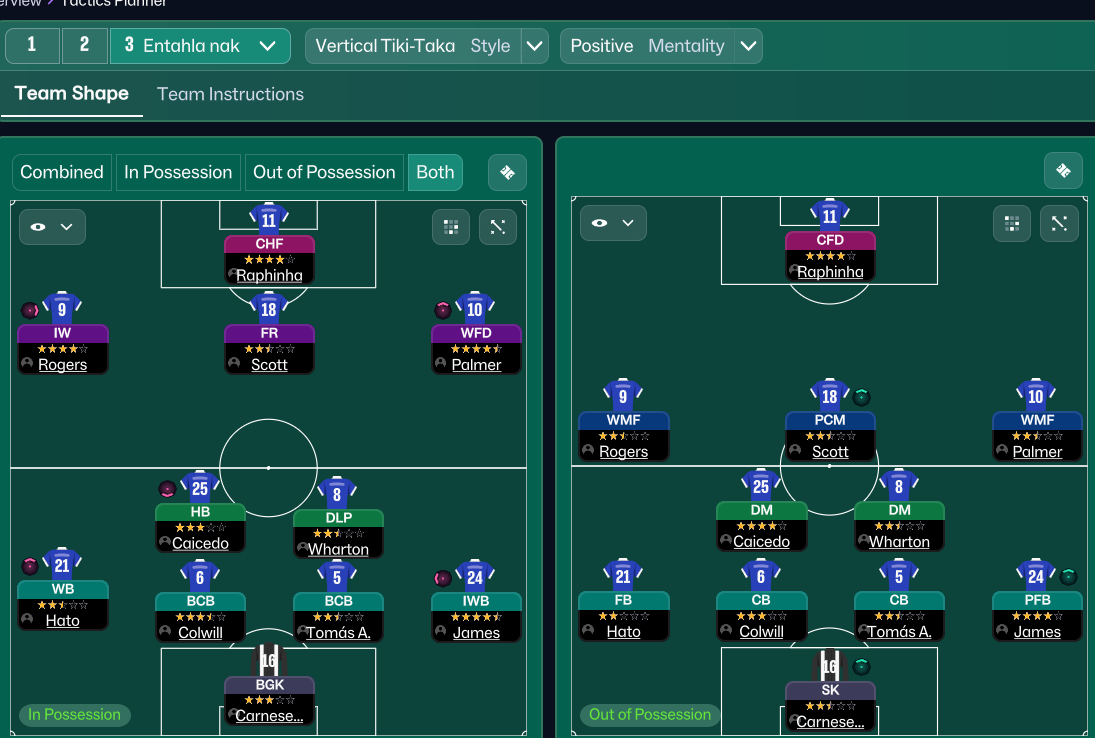
Pull up the Tactics shape sheet and assign each of your three midfielders a single label: Holder, Runner, or Creator. The default expectation is one of each. The rule applies at system level too: if the trio itself doesn't carry all three jobs, the missing job has to come from outside central midfield (a creator full-back, a striker who drops). If neither the trio nor the rest of the system supplies all three, the structure is broken before kickoff. Mentality, instructions, and player quality cannot fix a trio that fails this count. They can only amplify what the trio is already doing.
- • Holder: Defend duty, screening role (DM, Anchor, Half-Back, CM(D))
- • Runner: Support or Attack duty, forward-running role (B2B(S), Mezzala(A), CM(S); CM(A) exists but is rarer)
- • Creator: usually Support duty, playmaker role (DLP, AP, Roaming Playmaker, Mezzala(S)); occasionally Attack duty in more aggressive setups
Duty matters as much as role. The same role on different duties does different jobs: a Mezzala on Support is a creator (drifts into the half-space, plays through balls, doesn't push past the striker), while a Mezzala on Attack is a runner (breaks past the line and arrives late in the box). Read the duty before counting the trio.
Note on FM versions: Mezzala and Carrilero are FM24 role names; in FM26 they were replaced by Channel Midfielder and Wide Covering CM respectively. The job assignments in this guide carry across (the half-space-attacking midfielder is still the runner; the wide shuttler is still the soft holder), but the role-list strings differ in the FM26 UI.
Three Trio Archetypes
The three main shapes of a three-man midfield differ in vertical positioning (where the holder sits relative to the other two) and in how aggressively the runner and creator are allowed to push forward. Pick the archetype that fits your full-back setup and your DM's quality, not the one that looks most aggressive on paper.
Archetype 1: Flat 3 (Same-Line Midfield)
All three midfielders occupy the same line on the shape sheet: three CMs, no nominal DM, no nominal AM. Defensive responsibility rotates horizontally rather than vertically. Whichever of the three is closest to the ball-side covers; the other two pinch in. This works only when all three have the engine to recover and the positional discipline to stay compact.
| Position | Role | Duty | Job |
|---|---|---|---|
| Left CM | Carrilero | Support | Soft holder (wide shuttler, defensively positioned but not a screener) |
| Centre CM | Box-to-Box | Support | Runner |
| Right CM | Advanced Playmaker | Support | Creator |
A common variant promotes one of the three to a true Defend duty so the holder is unambiguous, at the cost of slightly less rotation flexibility:
| Position | Role | Duty | Job |
|---|---|---|---|
| Left CM | Central Midfielder | Defend | Holder |
| Centre CM | Box-to-Box | Support | Runner |
| Right CM | Mezzala | Support | Creator |
When it works: against teams that don't outnumber you in central midfield (anything 4-2-3-1 or 4-4-2 you can outnumber 3v2). When it breaks: against another 4-3-3 where their three exploit your rotational gap before your three can recover into shape.
Archetype 2: DM-Anchored (Triangle, Apex Forward)
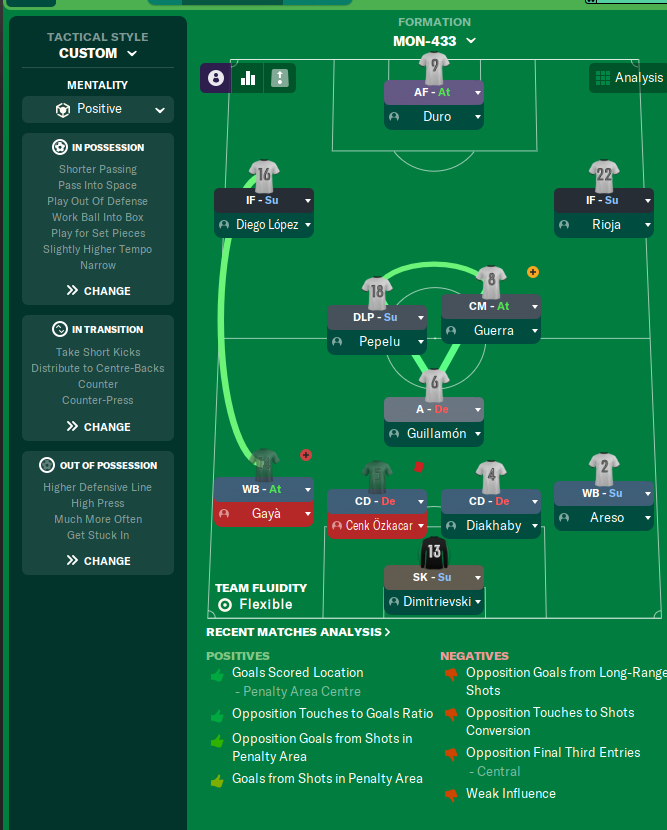
One midfielder sits as a defined DM (registered on the DM strata of the shape sheet, not the MC line) with two CMs ahead. The DM is the holder; the two CMs ahead are the runner and creator. This is the most stable of the three archetypes and the one most pre-set 4-3-3 tactics use.
| Position | Role | Duty | Job |
|---|---|---|---|
| DM | Defensive Midfielder | Defend | Holder |
| Left CM | Box-to-Box | Support | Runner |
| Right CM | Advanced Playmaker | Support | Creator |
A more aggressive variant uses an Anchor for the purest screen and pushes the two ahead into half-space attackers: the runner becomes a Mezzala on Attack, the creator a Roaming Playmaker:
| Position | Role | Duty | Job |
|---|---|---|---|
| DM | Anchor | Defend | Holder (purest screener) |
| Left CM | Mezzala | Attack | Runner (half-space) |
| Right CM | Roaming Playmaker | Support | Creator |
When it works: almost universally; this is the safe default for any 4-3-3. When it breaks: when the DM is paired with attacking full-backs on both sides. The DM cannot cover both centrally and out wide; if both full-backs push, the gaps either side of the DM become exploitable.
Archetype 3: Single-Pivot (Lone DM, Two Attacking 8s)
One DM sits alone, with two more advanced 8s pushed high, closer to AMC than CM strata, often registered as Mezzalas or as a CM and an AM. The DM does all the defensive work alone behind two players who are essentially attacking midfielders. This is the highest-risk, highest-reward archetype.
| Position | Role | Duty | Job |
|---|---|---|---|
| DM | Half-Back | Defend | Holder (alone) |
| Left CM | Mezzala | Attack | Runner |
| Right CM | Advanced Playmaker | Attack | Creator |
Single-pivot demands an exceptional holder (Rodri, Busquets, Makélélé): someone with elite positioning, stamina, and reading. It also demands a secondary screen, which usually comes from inverting the full-backs into midfield. When it works: with that elite DM and Inverted Wing-Backs giving central support. Pep's Barça (Busquets behind Xavi and Iniesta) is the canonical example; Pep's modern City no longer counts; once John Stones began inverting from centre-back the structure became a concealed double pivot. When it breaks: when you ask a merely-good DM to do this. Without an elite holder, the two attacking 8s become a structural liability rather than an asset.
The Three Antipatterns
Every broken trio looks like one of these three antipatterns. The root error is the same in all three cases: doubling up on one of the three jobs at the cost of another. If you can name your trio's antipattern, you can fix it in one role swap.
Antipattern 1: Two Destroyers
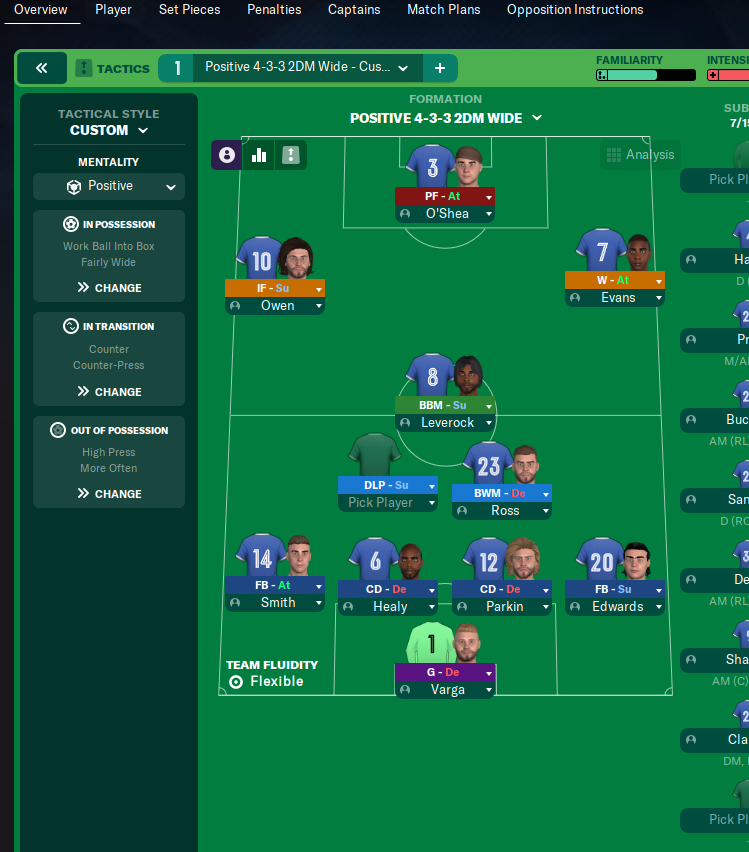
You have two ball-winners, typically a DM (Defend) plus a Ball-Winning Midfielder (Defend). The midfield is impervious to passes through the centre and contributes nothing to attack. Possession recycles back and forth between your destroyers, the front three are isolated, and you create one chance per game from individual brilliance.
Failure mode: no creator, no progression. The opposition is happy to let you have the ball because they know your midfield can't hurt them. Fix: change one of the destroyers to a creator role: Deep Lying Playmaker, Roaming Playmaker, or Advanced Playmaker depending on the height you want creation to happen at.
Antipattern 2: Two Creators
You have two playmakers, typically a Deep-Lying Playmaker at the base and an Advanced Playmaker ahead. Both want the ball; both want to dictate; neither wants to defend or run. The midfield is gorgeous in possession and gets destroyed on every transition.
Failure mode: no holder. When you lose the ball, the DLP is out of position (he had drifted deep and wide to receive the build-up, vacating the central screen) and the AP is up the pitch with the strikers. The 30-metre channel in front of your back four is where the counter lives. Fix: change one to an Anchor or DM (Defend), or accept that you need exceptional fullbacks who can cover centrally on every transition. Most teams do not have those fullbacks.
Antipattern 3: Two Rovers
Two players whose roles roam in practice: Box-to-Box and Roaming Playmaker have hardcoded Roam from Position; Mezzala drifts via Move Into Channels but behaves the same way structurally. Box-to-Box plus Roaming Playmaker, or two Mezzalas, or Mezzala plus Roaming Playmaker. Both leave their starting position; both go looking for the ball; both end up in the same channel at the same time.
Failure mode: no positional anchor. The shape sheet says you have a midfielder on each side; the actual game shows both stacked in the same half-space, with a 25-metre gap on the other flank. Opposition wingers find acres on that side, every match. Fix: change one rover to a position-disciplined role (Carrilero, CM (Defend), or Advanced Playmaker (Support) without Roam) to give the trio a fixed reference point.
Real-World Examples
Three reference points, all winners of major trophies. Heynckes's 2012-13 Bayern is one of the cleanest 1-1-1s in modern football; City 2022-23 was a 4-3-3 trio on paper but a concealed double pivot in possession; Madrid 2016-22 is the rule's most-celebrated edge case, where the trio itself doesn't satisfy the count and the runner job is supplied by elite players outside central midfield.
Martínez / Schweinsteiger / Kroos (Bayern Munich, 2012-13): Heynckes's treble-winning midfield three operated as a clean 1-1-1 inside a 4-2-3-1 / 4-3-3 hybrid, with Schweinsteiger and Martínez as the deeper screen and Kroos pushing forward to feed Robben/Ribéry/Müller. Treble winners, beating Barcelona 7-0 on aggregate in the semi-final and Dortmund in an all-German Wembley final. Holder (Martínez), runner (Schweinsteiger or Kroos depending on phase), creator (Kroos): one of each, the rule honoured.
Aside on Italy 2006: the famous Pirlo / Gattuso / Perrotta line-up is sometimes cited as a trio, but Italy actually played a 4-2-3-1 in the trophy-winning knockouts (Pirlo & Gattuso as a deep pair, Camoranesi / Totti / Perrotta as the band of three behind a lone Toni). It's a midfield-pair story, not a trio story; see the Midfield Pairs guide.
Rodri / de Bruyne / Bernardo (Manchester City, 2022-23): on paper a 4-3-3 trio, in possession something else. The team sheet listed three central midfielders, and the rule reads cleanly at that level: Rodri on Defend as the holder Pep treats as the irreplaceable spine of the team; De Bruyne on Support as the creator (long passes, killer balls into the box, set-piece deliveries); Bernardo Silva on Support as a creator-shaded runner who covered ground and led the press. But the actual possession shape during the treble wasn't a true trio; once John Stones inverted from centre-back into midfield, the structure became a concealed Rodri+Stones double pivot, with De Bruyne, Bernardo, Foden, and a rotating wide player (Grealish or Mahrez) operating as the forward four ahead of it (see the Midfield Pairs guide for the pair-level reading). The Champions League, the Premier League, and the FA Cup in the same season. Read as a trio the rule was honoured; read as a pair plus a forward four, the trio was a paper fiction. Both readings are useful: the formation on the team sheet and the shape on the pitch don't have to match.
Modric / Casemiro / Kroos (Real Madrid, 2016-22): DM-anchored, and the rule's most-celebrated edge case. Casemiro on Defend at the base as the pure holder, the physical screen who broke up everything that came through the middle. Kroos on Support as the deep-lying creator, recycling possession at metronomic tempo and switching the angle of attack with thirty-metre diagonals. Modric on Support, nominally the runner but really a higher-up second creator: line-breaking dribbles and through balls in the half-space, with late box arrivals as a secondary trait. Three Champions Leagues in a row, then a fourth in 2022. By central-midfield count alone the trio was one holder + two creators of different shapes; the runner job was distributed across the full-backs (Carvajal, Marcelo) and the front three (BBC for the three-peat seasons; Vinícius / Benzema / Rodrygo by the 2021-22 fourth). Treat it as a system-level 1-1-1 rather than a trio-level one: the rule held; the runner job was just played from outside the trio.
Simeone's Atlético (2013-14 onwards) is a quick sanity check that the rule generalises: a 4-4-2 with a flat midfield pair, not a trio, where the creator job lives outside central midfield (in Costa's link play as a Deep-Lying Forward on Support). The 1-1-1 still holds at system level even when the trio itself doesn't exist; see the Midfield Pairs guide for the pair-level treatment.
Frequently Asked Questions
Can I run a 4-3-3 with no DM and no AM, just three flat CMs?
Yes, that's the flat 3 archetype. It works when one of your three is a CM (Defend) acting as the holder (or a Carrilero acting as a soft holder, defensively positioned wide shuttler rather than a true screener), and the other two are clearly differentiated as runner and creator. It does not work when you've selected three Box-to-Box midfielders or three CMs (Support) with identical instructions; that's a flat 3 with no holder, which is the two-rovers antipattern wearing a different name.
Can the same player be both runner and creator?
In short bursts, yes. Modric and de Bruyne both ran and created, and that's why their teams could be so flexible. But the trio's structural job assignment doesn't change: one player is the primary runner and the other is the primary creator. If both are equally fluid and neither has a clear job, you've slid back into the two-rovers antipattern even if it doesn't look like it on the role list.
What's the difference between DM-anchored and single-pivot?
Vertical positioning of the two CMs and aggression of their duties. DM-anchored has two CMs on Support at the MC strata; they can break forward but they recover. Single-pivot has them on Attack and pushed higher (Mezzalas or even AM strata); they're attacking midfielders, not midfielders. The DM in a single-pivot does dramatically more defensive work alone and needs to be elite. DM-anchored is the safer default for almost every save.
Which archetype works best against a 4-2-3-1?
DM-anchored, with a caveat about duty. The 4-2-3-1's CAM is the danger man, and a DM in the 10-space gives you the cleanest matchup, but only if the duty steps out to him. A DM(D) often drops too deep and lets the CAM enjoy the pocket between the lines; you usually want a DM(S) or a Half-Back so the holder steps into the 10-space when the CAM receives. A stopper centre-back or one of the CMs dropping is a workable Plan B. Flat 3 leaves the CAM with a rotating mark instead of a dedicated one, which works against a quiet CAM but not against a good one. Single-pivot risks the CAM finding pockets either side of your lone DM; against a serious 10 it's the wrong answer.
My midfielders keep ending up in the same channel, how do I fix it?
You're running two rovers. Check whether two of your three roles roam in practice (Box-to-Box and Roaming Playmaker carry Roam from Position natively; Mezzala drifts via Move Into Channels and behaves the same way). Change one to a position-disciplined role with the same general job (Carrilero for the runner, Advanced Playmaker (Support) for the creator), and the channel discipline returns within a couple of matches.
Putting It Together
A working three-man midfield is not a mystery; it is a role distribution problem with one correct shape (1 holder + 1 runner + 1 creator) and three identifiable failure modes. Pick one of each. Pick the archetype (flat 3, DM-anchored, or single-pivot) that fits your full-back setup and your DM's quality. Avoid the three antipatterns. The rest is calibration.
If you remember nothing else: count the holders, the runners, and the creators on your shape sheet before kickoff. If the count isn't 1-1-1, fix it before you tinker with anything else. Mentality, instructions, and pressing intensity all amplify what your trio is doing; they cannot fix a trio that's structurally broken.
Related guides
Keep exploring the tactical library. These go well with the topic above.
Understanding the 4-3-3 Formation
Master the classic 4-3-3: player roles, tactical variations, and the trade-offs that decide whether it sings or stalls.
Possession-Based Tactics in Football Manager
Build the patient, control-the-tempo style without watching your opponents counter through the gaps you leave behind.
Counter-Attacking Excellence
Sit deep, win the ball, and break in three passes. The roles, instructions, and squad profile that make it work.