Gegenpressing: A Full Guide
Klopp-style gegenpressing in FM, squad profile, line-and-press pairing, and the sustainable version.
By John Brawner · Updated May 1, 2026
What Gegenpressing Actually Is
Gegenpressing is the most demanding tactical system in modern football, and the most expensive one to run badly. The idea, in two sentences: when you lose the ball, the nearest two or three players sprint at the carrier inside a five-second window, and the rest of the team holds a compact, high shape behind them so the first forward pass has nowhere to go. Played correctly, it produces a steady stream of high-value turnovers in the opposition third across a season. Played with the wrong squad, it generates fouls, yellow cards, exhaustion, and the kind of late-season collapse that gets managers fired.
The Four Pillars
Executive summary. The full position-by-position requirements (front three, full-backs, centre-backs, goalkeeper) are in the Squad-Profile Minimums section below; the four pillars are the load-bearing midfield floor that makes the rest of the squad spec coherent.
1. Squad profile
Central midfield floor: Stamina, Work Rate, Aggression, Anticipation, measured by the lowest number across your top six options, not the average.
2. Pairing
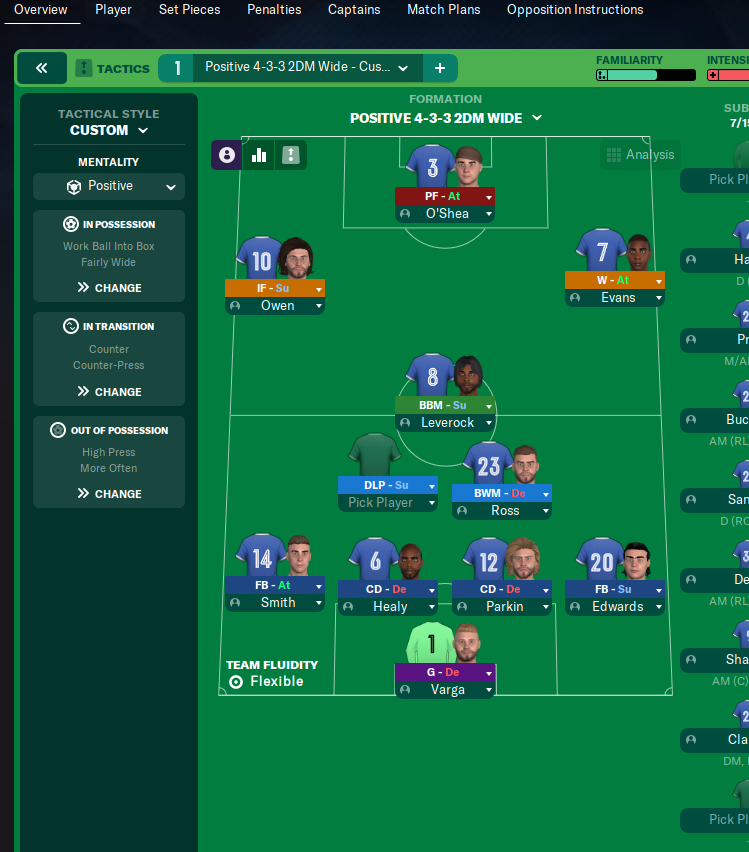
Counter-Press + More Urgent intensity + Higher Defensive Line. Break the pairing and you create the gap.
3. Training prep
Tactical familiarity on the saved Counter-Press tactic, plus Teamwork and Defensive Positioning sessions. Three weeks pre-season, then sustained.
4. Stamina management
Substitutions before the wall. Rotation in the cup runs. The system can't survive 60 matches on 11 names.
This guide covers the full system in Football Manager: the squad profile that makes Counter-Press a viable instruction, the five-second rule and how FM models it, the pairing rules with Defensive Line and pressing intensity, the sustainable version vs the burn-out version, and the warning signs that tell you which one your squad is actually running. It assumes you've read Pressing Triggers and Intensity and Defensive Transitions. The rules here are consistent with both.
Squad-Profile Minimums
The single biggest source of failed gegenpressing tactics is a squad that can't physically run the system. The four attributes that govern viability are Stamina, Work Rate, Aggression, and Anticipation. Stamina and Work Rate decide whether the press repeats; Aggression and Anticipation decide whether it actually wins the ball.
The Floor Rule
Sort your central midfield three (or pair, in a 4-2-3-1) by each attribute and read the lowest number, the floor. The floor sets the ceiling, because the opposition will route the ball through whichever of your midfielders runs out of legs or attribute first. Averages lie; floors don't.
- Stamina ≥ 14: the press repeats for ninety minutes. Below 14, expect a noticeable drop-off later in matches as load accumulates.
- Work Rate ≥ 14: the player will actually make the recovery sprint. Below 14 they'll jog when the trigger fires, which breaks the five-second window.
- Aggression ≥ 13: the player commits to the duel rather than shadowing. Below 13 the press becomes ornamental, there but not biting.
- Anticipation ≥ 13: the player triggers on the cue (back-pass, poor first touch, square pass). Below 13 they trigger late, by which time the ball is gone.
The Stamina/Work Rate ≥ 14 rule is the same floor referenced in our Pressing Triggers guide and our Defensive Transitions guide. It's a load-bearing threshold for the whole pressing family, viable for the system to function. For the elite-execution version (the Liverpool 2018-19 reference), expect the whole midfield rotation to clear 15-16 across Stamina and Work Rate so the press repeats in month-six matches at close to month-one intensity. Aggression and Anticipation are the gegenpressing-specific additions: a Regroup team can afford lower Aggression because they're not committing to duels in transition; a Counter-Press team cannot.
Beyond the central midfield, your front three need the canonical Pressing Forward floor (Work Rate 15+, Stamina 15+, Aggression 13+, Acceleration 13+) because they lead the press and apply Trigger Press. Your full-backs need Pace ≥ 14 because they have to recover when the press gets bypassed. Your centre-backs need Pace ≥ 13 and Composure ≥ 13 because the defensive line sits high. Slow, panicky centre-backs concede balls in behind on every counter. Goalkeepers need Sweeper Keeper attributes (Rushing Out tendency, decent Pace) because the line is Higher and someone has to mop up.
The Five-Second Rule
Klopp's coaching maxim, repeated in interviews since his Mainz/Dortmund days, is that the first five seconds after losing the ball are the most valuable in football. Possession is regained more easily then than at any other moment because the opposition is in a transition shape (players moving the wrong way, lines spread, first touch unsettled). The correct response is not to retreat into shape; it is to attack the carrier immediately.
Klopp's version: the nearest player closes the carrier, the second-nearest blocks the obvious forward pass, the third-nearest blocks the square pass to the supporting midfielder. The remaining seven hold the high line and the compact block behind. If the ball isn't won inside roughly five seconds, the team transitions out of the press and into the defensive shape. Critically, the goal isn't always to win the ball, it's to deny the first forward pass, which forces the opposition backwards and re-establishes territorial control.
FM's modelling: the Counter-Press team instruction is the lever you pull for this behaviour in-game. With Counter-Press on, watch any defensive transition and you'll see the two or three nearest players close down hard for a short window after the turnover, then the team falls back to whatever Pressing Intensity you've set (More Urgent, Standard, etc.). The TI itself is a binary toggle in the UI: on or off, with no slider for "how counter-pressy" you want to be. Adjusting the intensity is the job of the separate Pressing Intensity TI.
The practical implication is that you control three things: whether Counter-Press fires (the on/off TI), how aggressively the press operates after that initial burst (Intensity), and which specific players chase the build-up (Trigger Press More Often, applied as an Out of Possession team instruction). Treating these as one knob is the most common failure mode in uploaded tactics.
Line-and-Press Pairing
Gegenpressing depends on a compact block. The distance between your highest pressers and your back four cannot be more than roughly 25–30 metres (community estimate; FM doesn't surface line geometry directly), because beyond that the opposition's first pass goes straight into the gap and your midfielders are forced to choose between covering the runner or the ball. They can't do both.
The Gegenpressing Pairing
- • Counter-Press: ON
- • Pressing Intensity: More Urgent
- • Defensive Line: Higher
- • Line of Engagement: Higher
- • Trigger Press More Often (Out of Possession instruction; pairs with Counter-Press on the front three's pressing duties)
- • Get Stuck In: only with an Aggression floor of 14+ AND at least four centre-backs in rotation (see FAQ)
Mentality matters more than the bullet form suggests. Positive is the default for the system because it keeps the line of engagement honest and stops your midfielders from dropping ten yards on every defensive transition (which would re-open the gap the high line is meant to close). Attacking can work when chasing a result, but it pushes the line higher still and amplifies the squad-floor demands; on a borderline floor it will tip the system into the burnout variant. Cautious or Defensive is a mismatch with Counter-Press because it pulls the team's average position back into the same antipattern the Lower Line creates.
Antipatterns That Kill It
- • Counter-Press + Lower line: the 25-30m gap
- • Counter-Press + Cautious mentality: sprint then retreat
- • Higher line + low-Pace centre-backs: long balls over
- • Counter-Press + Get Stuck In on a thin squad: fouls and yellows
- • Pressing Intensity More Urgent + Counter-Press OFF on a CP-floor squad: wasted running
The Counter-Press + Lower Line antipattern is the single most common failure in uploaded tactics. It comes from treating "press" and "defensive line" as independent dials. They aren't. The high line is what makes the press geometrically possible. It shrinks the pitch the opposition has to play in. Drop the line and you've extended that pitch by 25 metres, which is exactly the space your front three has to close. They can't.
Sustainable vs Unsustainable Variants
Two squads can run an identical tactic on day one and have completely different outcomes by January. The difference is depth, training prep, and rotation discipline. The sustainable version of gegenpressing rotates aggressively through the cup competitions, manages minutes, and keeps the floor (never the stars) fresh. The unsustainable version racks up fifty-plus starts for the same individual midfielders and falls off a cliff.
Warning Signs by Month
- August–September: the press looks superhuman. Opposition bypassed in the first ten minutes of every match. This is fine, but if you're already substituting your central mids before the 70th minute, take note: the squad's stamina ceiling is lower than the system needs.
- October: the first injury concerns. A central midfielder picks up a hamstring or fatigue knock. If your B-team midfielder doesn't clear the 14+ floor, the press cracks the moment they start. Squad-rate the backups: anyone below 14 in Stamina or Work Rate is not a viable backup, they're a different system entirely.
- November–December: the fixture pile-up. Cup competitions bite. If you haven't been rotating the front three and the central trio every third match, you'll start losing 15-minute windows in the second half. Goals conceded in minutes 75–90 are the typical signal.
- January: the wall. Unsustainable squads collapse here. Stamina is depleted, injuries pile up, the press becomes ornamental. Sustainable squads ride this out by dropping to More Urgent → Standard intensity for two or three matches and using the winter break (where it exists) for fitness reset.
- February–March: recovery window or terminal decline. If the squad bounces back, you've run a sustainable variant. If it doesn't, you're committing to a different system for the run-in, usually Regroup + More Urgent + Standard line, which is structurally less demanding.
- April–May: the run-in. Fresh-squad teams accelerate; burnt-out squads concede late goals and drop points. If you're conceding after the 75th minute consistently, the system has outrun the squad.
The single highest-leverage decision is the cup-competition rotation. If your first-choice central trio plays every domestic cup tie, you'll arrive at January with a wall. If you rest at least one of the three for every cup tie and rotate the front three by thirds, you'll arrive at January tired but functional. This is the difference between the sustainable Klopp Liverpool sides (ones with two deep options at every position) and the unsustainable ones (Klopp's Dortmund heading into 2014-15, when the squad's running mileage finally caught up with it).
Training Preparation
A gegenpressing squad needs three weeks of pre-season tactical familiarity work on the saved Counter-Press tactic as a baseline, then a maintained focus through the season. The three-week pre-season block lets the squad's tactical familiarity bars (Mentality, Tempo, Width, Defensive Line, Pressing) reach Accomplished or higher, which translates to noticeably tighter press coordination on the pitch. Without this, the press fires the right behaviours but the team doesn't read the triggers in unison. You'll see two players pressing while the third holds shape, which loses the ball anyway.
In-season, alternate the tactical-familiarity sessions on your Counter-Press tactic with Defensive Positioning and Teamwork attribute training. Teamwork is the hidden lever; high Teamwork squads coordinate the press; low Teamwork squads have one player chasing while the other two stand still. Add Quickness training for the front three and the full-backs, since maximal sprint repeatability is the actual physical demand the system places on those players.
Real-World Examples
Three examples cover the spectrum, from the sustainable version, to the original burnout cautionary tale, to the chaotic outlier variant.
Klopp's Liverpool 2018-19 is the canonical sustainable gegenpressing season. 97 Premier League points, Champions League winners. The tactical setup was Counter-Press, More Urgent, Higher line (the textbook pairing), but the load-bearing decisions were squad-shaped. Fabinho and Henderson rotated the holding role, Wijnaldum and Milner shared the box-to-box duty, and Klopp rotated the front three (Mané, Salah, Firmino) with structured rest in cup ties. The midfield three's Stamina/Work Rate floor was comfortably in the 15–16 range across all options, which meant the press repeated in month-six matches at close to the same intensity as month-one. The FM lesson: this only works if every name in the rotation clears the floor.
Klopp's Dortmund (2010–15) is the original gegenpressing side and also the cautionary tale on burnout. The 2010-11 and 2011-12 Bundesliga titles came from a squad with brilliant individual talent (Lewandowski, Götze, Kagawa, Hummels) but limited depth. The 2012-13 season was still a peak match-day product (2nd in the Bundesliga and a Champions League final), though the running miles started to add up underneath the trophy run. The collapse came in 2014-15: Dortmund sat 17th by mid-November after five straight defeats, Klopp publicly called it the worst injury crisis he'd seen, and announced his exit in April 2015 explicitly citing burnt-out reserves. The FM equivalent is the squad with an excellent first eleven that doesn't have a 14+ floor on the bench. You can run the system, you can win matches, but you cannot rotate without diluting the press, and a sustained injury crisis in central midfield is terminal.
Bielsa's Leeds (2018–22) is the high-variance variant. Bielsa's press wasn't strictly Klopp-style; it was man-oriented across the whole pitch, with the centre-backs following forwards into midfield and full-backs picking up wingers anywhere they went. In FM terms, this is Counter-Press + Extremely Urgent + Higher line, with the centre-backs set to a Stopper duty and Tight Marking turned on at the PI level so they actively step out and follow runners rather than holding the line. The squad-floor demands are even harsher: Aggression and Anticipation matter more because the entire team is committing to individual duels in space. Leeds' Championship promotion season was the sustainable version; the 2021-22 collapse that ended Bielsa's tenure (mass injuries to Phillips, Cooper, Bamford and Diego Llorente, the press losing its floor) is what happens when injuries strip out the floor and the system keeps running anyway. Leeds avoided the drop that year but Bielsa was sacked in late February 2022. Use this only if your squad clears the floor at every position; the variant is less forgiving than Klopp's.
The mistake we see most in uploaded tactics is the Klopp instructions on the Dortmund-era squad: first-team brilliance, no rotational depth, no substitution discipline. The team runs hard for sixty minutes and falls apart. If you're not sure which side you're on, look at the floor of every name on your central-midfield depth chart, not just the first three.
Frequently Asked Questions
My squad's average Stamina is 14.5, am I good to go?
Probably not. The 14+ rule is a floor, not an average. If your strongest central midfielder is 18 and your weakest is 11, the average looks fine but the system collapses the moment the 11 is on the pitch. Sort the squad by Stamina and Work Rate and look at the lowest number across your top six or seven options. That's the real ceiling of what the system can do.
I'm pressing well in matches but conceding silly goals on the break. Why?
Almost certainly the line-and-press pairing is broken. The most likely cause is your Defensive Line is set to Lower while Counter-Press is on, that's the 30-metre gap. Three fixes: raise the line to Standard (closes the gap to roughly fifteen metres, midfield can cover); raise the line to Higher (compresses to a normal twenty-five-metre high-block band); or, if you genuinely need Lower, switch from Counter-Press to Regroup. The second most likely cause is centre-back Pace below 13: the long ball over the top is the obvious counter to a high line, and a slow CB is the failure mode the opposition will exploit.
When should I drop out of gegenpressing in-match?
Two cues. First, when your central midfielders pass the orange "Tired" condition indicator and you don't have fresh subs for them, drop Pressing Intensity by one notch (More Urgent → Standard) and switch Counter- Press off rather than letting tired players make ornamental sprints. Second, when you're 2-0 up against an inferior side after the 70th minute, there's nothing to gain from continuing to press, and the injury risk isn't worth the marginal goal differential.
Is Get Stuck In a good idea with Counter-Press?
Only if your squad's Aggression floor is 14+ and you have at least four centre-backs in rotation. Get Stuck In with Counter-Press is the foul-and- yellow generator par excellence; every defensive transition becomes a high-aggression duel, which over a season produces more cards and more suspensions. On a thin squad, that's terminal. On a deep, high-Aggression squad, it tips the system from "win the ball" to "win the ball or break the play," which is sometimes what you want.
Can a smaller club ever run real gegenpressing?
Yes, but only with the squad-building discipline to never sign a central midfielder below the 14+ floor on Stamina and Work Rate, and only with a rotation plan that keeps depth at every position. Bielsa's Leeds did this in the Championship (their floor was lower in absolute terms but the league's was lower too, the relative gap held). The ones that fail are the smaller clubs that sign one star midfielder, run the press for half a season, and burn out by Christmas because there's no second option who clears the floor. The system is squad-shaped, not tactic-shaped.
Conclusion
Gegenpressing is the most physically demanding and the most squad-dependent tactic in Football Manager. It produces extraordinary results when the squad clears the floor, the line-and-press pairing is correct, and the rotation discipline holds through January. It produces collapses when any one of those three is missing. The right question isn't "do I want to gegenpress?". Every manager wants to. The right question is "does my squad's floor clear the bar, and can I keep it there across a full 60-match season?" If the answer is no, the Regroup + More Urgent system in our Pressing Triggers guide will give you 80% of the defensive value at 50% of the squad cost. If the answer is yes, you have the most exciting tactical system in the game on your side.
Related guides
Keep exploring the tactical library. These go well with the topic above.
Understanding the 4-3-3 Formation
Master the classic 4-3-3: player roles, tactical variations, and the trade-offs that decide whether it sings or stalls.
Possession-Based Tactics in Football Manager
Build the patient, control-the-tempo style without watching your opponents counter through the gaps you leave behind.
Counter-Attacking Excellence
Sit deep, win the ball, and break in three passes. The roles, instructions, and squad profile that make it work.