Uploaded Tactic
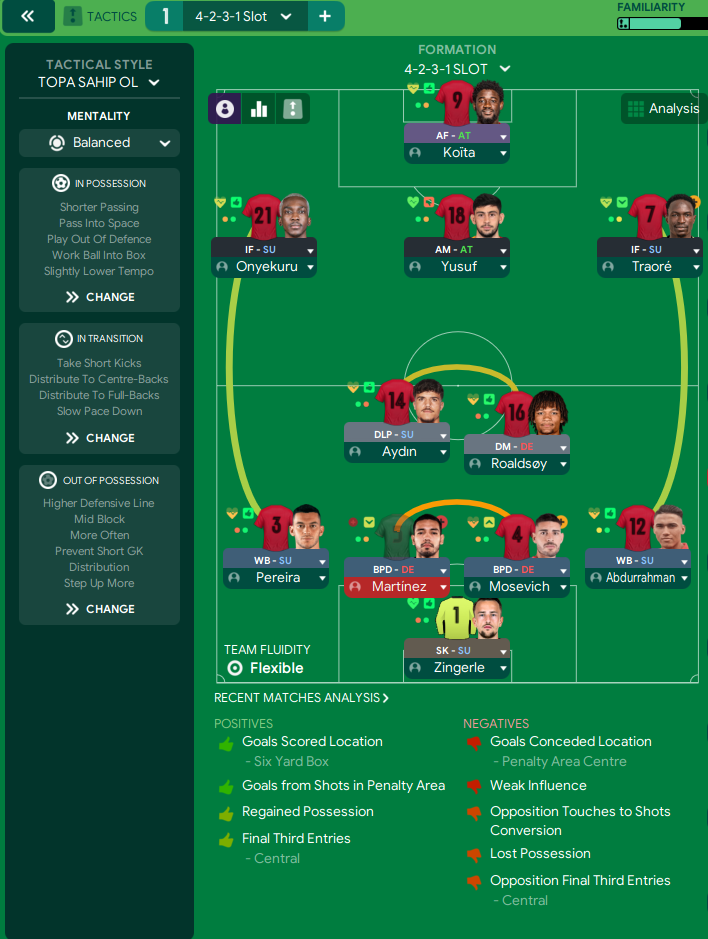
Formation & Style
Tactical Style:TOPA SAHIP OL
Mentality:Balanced
Formation:4-2-3-1 Slot
Team Fluidity:Flexible
In Possession
Shorter Passing
Pass Into Space
Play Out Of Defence
Work Ball Into Box
Slightly Lower Tempo
In Transition
Take Short Kicks
Distribute To Full-Backs
Out of Possession
Higher Defensive Line
Mid Block
Prevent Short GK Distribution
Team Shape Without Ball
Shape:4-2
Description:Defensive shape consisting of four defenders and two midfielders who can cover ground and support.
Evidence:DM-D at [3,3] and CM-D at [4,3] providing shielding for the defensive line.
Team Shape With Ball
Shape:3-2-1
Description:Attacking shape focusing on spreading the ball out wide with inside forwards cutting in, allowing the advanced forward to exploit central areas.
Evidence:Inside Forwards at [5,2] and [5,4] supporting the AF at [6,3].
Phase Description
Attacking Play
The team looks to transition quickly into attack, utilizing shorter passing and a focus on penetrating through the central areas while maintaining fluidity in midfield.
Defensive Transition
Upon losing possession, the team is structured to regain the ball quickly, utilizing a mid-block to disrupt transitional play from opponents.
Main Focus
Creating spaces in the final third while maintaining a cohesive structure defensively.
Key Strengths
Goals Scored Location
The majority of goals scored are from inside the six-yard box, showcasing effective attacking play.
Regained Possession
The team's ability to regain possession quickly indicates an effective counter-press strategy.
Dynamic Attack
The use of inside forwards alongside an advanced forward allows for a diverse attacking threat.
Conflicting Directions
Weak Defensive Influence
The mid-block may not be controlling the space effectively, leading to vulnerabilities.
Lost Possession
Players may be too eager to press without appropriate positioning, leading to easily lost possessions.
Central Overload
The team is heavily reliant on central plays, which may become predictable.
Tactical Suggestions
Enhance Width in Attack
Introduce more width in attacking plays to stretch opposing defenses and create spaces centrally.
Adjust Defensive Line
Consider lowering the defensive line to mitigate vulnerabilities in the penalty area.
Utilize Playmaker Effectively
Encourage the deep-lying playmaker to take more risks with passes to enhance creativity.
Ask Questions About Your Lineup
Guides for this formation
The tactical theory behind the 4-2-3-1 Slot: roles, instructions, and the trade-offs that decide whether the system holds up.
Player pairings
Midfield Pairs in 4-2-3-1 and 4-4-2
Double pivots and flat pairs in 4-2-3-1 and 4-4-2: when each pairing works, when it collapses, and the AMC unicorn that rescues both.
Read guide
Playing styles
Gegenpressing: A Full Guide
Klopp-style gegenpressing in FM, including squad profile, line-and-press pairing, sustainable workload, and the antipatterns to avoid.
Read guide