Uploaded Tactic
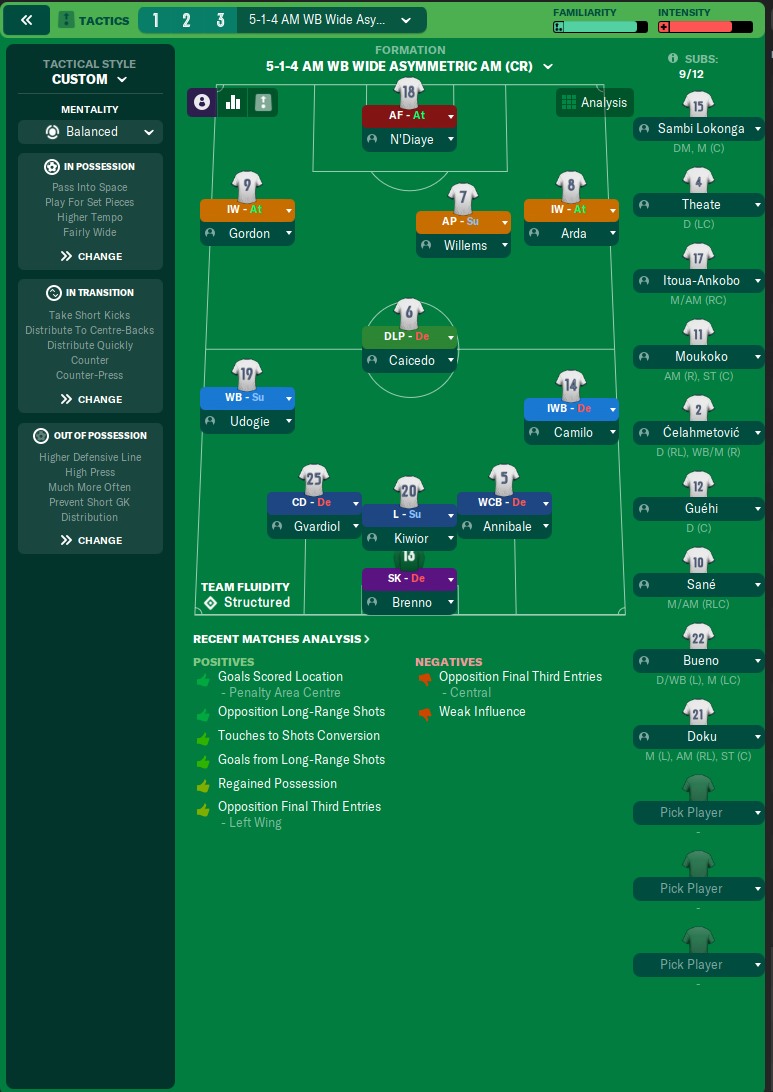
Formation & Style
Tactical Style:Custom
Mentality:Balanced
Formation:5-1-4 AM WB Wide Asymmetric
Team Fluidity:Structured
In Possession
Pass Into Space
Play For Set Pieces
Higher Tempo
Fairly Wide
In Transition
Take Short Kicks
Distribute To Centre-Backs
Distribute Quickly
Counter
Counter-Press
Out of Possession
Higher Defensive Line
High Press
Much More Often Prevent Short GK Distribution
Team Shape Without Ball
Shape:5-4-1
Description:Compact defensive line with fullbacks tucking inside to support the centre-backs.
Evidence:CD-D at [2,3], WCB-S at [2,4], WB-S at [2,5] supporting a solid backline.
Team Shape With Ball
Shape:4-1-4-1
Description:Fluid attacking movement, leveraging width provided by the inside forwards and an advanced playmaker.
Evidence:IF-A at [6,1], AP-S at [5,2], and IF-A at [5,4] create various attacking threats.
Phase Description
Attacking Play
Utilizes width to create opportunities, focusing on penetration through wide areas and utilizing the deep-lying playmaker to unlock the defense.
Defensive Transition
Quickly transition to pressing, aiming to regain possession high up the pitch.
Main Focus
Create numerical superiority in wide areas while maintaining solidity in defense.
Key Strengths
Penetration Through Wings
Inside forwards contribute to creating width, stretching the opposition and generating goal-scoring opportunities.
Defensive Solidity
A well-structured defensive unit minimizes goal-scoring opportunities for the opponent.
Midfield Control
A deep-lying playmaker contributes to possession and helps transition the ball from defense to attack.
Conflicting Directions
Pressing and Defensive Shape
High pressing can sometimes leave gaps in a 5-1-4 formation, potentially exposing the defensive line.
Wide Play Vulnerability
With a wide attacking shape, there’s a risk of being vulnerable to counter-attacks down the flanks.
Overdependence on Width
Relying heavily on wide areas may lead to stagnation if the opposition adequately counters.
Tactical Suggestions
Increase Central Play
Encourage more central movement from players to balance the extreme width strategy.
Adapt Defensive Lines
Consider lowering the defensive line against faster attacking teams to reduce vulnerability.
Utilize More Set Pieces
With a focus on set pieces, ensure that players such as the tall CD and WCB capitalizes on these opportunities.
Ask Questions About Your Lineup
Guides for this formation
The tactical theory behind the 5-1-4 AM WB Wide Asymmetric: roles, instructions, and the trade-offs that decide whether the system holds up.