Uploaded Tactic
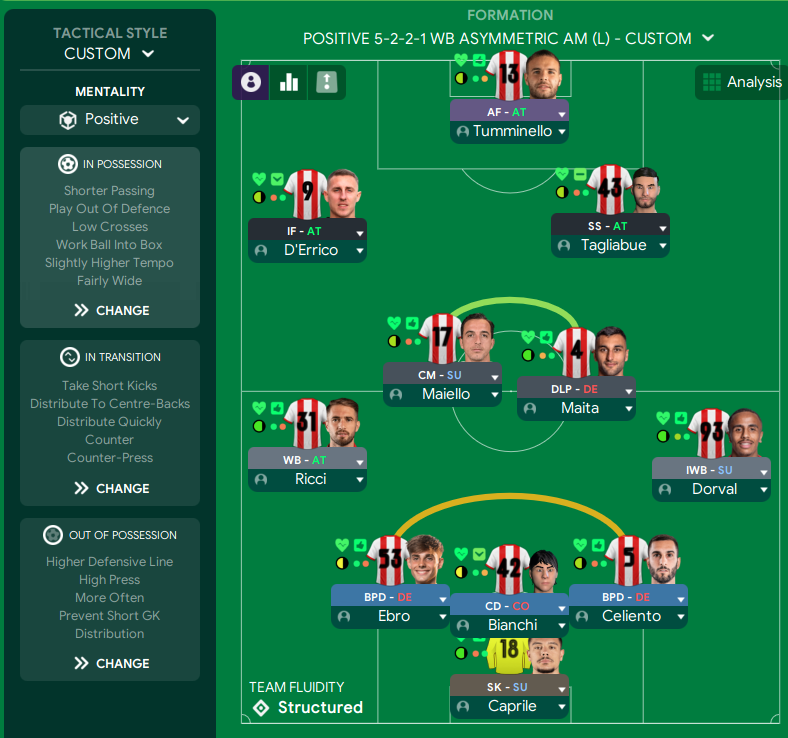
Formation & Style
Tactical Style:Custom
Mentality:Positive
Formation:5-2-2-1 WB Asymmetric AM (L)
Team Fluidity:Structured
In Possession
Shorter Passing
Play Out Of Defence
Low Crosses
Work Ball Into Box
Slightly Higher Tempo
Fairly Wide
In Transition
Take Short Kicks
Distribute To Centre-Backs
Distribute Quickly
Counter
Counter-Press
Out of Possession
Higher Defensive Line
High Press
More Often Prevent Short GK Distribution
Team Shape Without Ball
Shape:5-4-1
Description:A compact defensive unit that allows the team to press effectively and regain possession quickly.
Evidence:BPD-D at [2,2], BPD-D at [2,3], CD-C at [2,4], complemented by wing-backs providing cover.
Team Shape With Ball
Shape:3-2-5
Description:Aggressive attacking shape with players positioned to exploit spaces in wide areas and create scoring opportunities.
Evidence:IF-A at [6,1], AF-A at [6,2], and SS-A at [6,3], supported by a dynamic midfield.
Phase Description
Attacking Play
Focuses on quick transitions with shorter passing, utilizing wing-backs for width and inside forwards for cutting inside.
Defensive Transition
The team aims to counter-press immediately to recover possession high up the pitch.
Main Focus
Fluid attacking movements through the wings and central area, while maintaining a solid defensive base.
Key Strengths
Width and Support
The use of wing-backs provides width, stretching the opposition and creating space for inside forwards.
Adaptability in Transition
Quick distribution to centre-backs followed by counter-pressing setup allows for effective transition from defence to attack.
Strong Central Play
Central midfield combination allows for effective ball retention and distribution into attacking areas.
Conflicting Directions
High Press vs. Defensive Solidity
Using a high press can leave the backline vulnerable if the team fails to recover possession quickly.
Wing-Backs' Vulnerability
Excessive attacking responsibilities on wing-backs might expose the flanks if transitions are not executed properly.
Overloading the Central Areas
With two inside forwards and a shadow striker, congested central areas may lead to ineffective buildup.
Tactical Suggestions
Adjust Wing-Back Roles
Consider varying the duties of wing-backs to cover the defensive flanks more effectively.
Balance Pressing Intensity
A more balanced pressing strategy may prevent gaps in midfield that opponents can exploit.
Exploit Flanks More
Utilizing wing-backs to overlap and create more width in attack could create better chances.
Ask Questions About Your Lineup
Guides for this formation
The tactical theory behind the 5-2-2-1 WB Asymmetric AM (L): roles, instructions, and the trade-offs that decide whether the system holds up.