Direct, Vertical Football
Long-ball football done well. When direct play is the right choice and what Direct Passing TI does.
By John Brawner · Updated May 1, 2026
Direct Is Not the Same as Counter
Direct, vertical football has a worse reputation than it deserves. Most managers use the words "long-ball" and "counter-attack" interchangeably, but they describe different plans. A counter-attack is a transition tactic. You absorb pressure, win the ball, and break before the opposition can reorganise. Direct play is a build-up tactic. You can be in possession, in the opposition's half, and still choose to skip the midfield with one vertical pass to a target up front. The two often co-exist, but they don't depend on each other.
The simplest way to feel the distinction: a counter-attack ends after the first wave clears. Direct football repeats the move all match, possession or not. Sam Allardyce's Bolton sides spent long stretches with the ball at home, and still hit Kevin Davies on the chest from the centre-backs because that was the plan. That isn't counter-attacking. It's a chosen vertical build-up that bypasses a midfield they didn't trust to dominate.
In Football Manager, this distinction matters because passing directness behaves independently of mentality and transition instructions. You can play direct on Attacking mentality with Counter-Press on, or on Cautious with Regroup on. Direct Passing is its own lever. Treat it that way.
When Direct Is the Right Call
- • Your midfield is technically inferior to the opposition's
- • You have a genuine target man in the squad
- • Pitch is heavy, weather is poor, ball won't run cleanly
- • Opposition presses high (a long ball voids the press)
- • You're chasing a goal and short build-up isn't producing chances
- • Defending a lead and need to relieve pressure with one pass
- • Your squad has pace runners off a target rather than circulators
- • Set-piece volume matters and direct play creates more of them
What Direct Passing Appears to Do
Direct Passing sits at the more-vertical end of the passing-directness dial (Much Shorter / Shorter / Standard / Direct / Much More Direct), and in our testing it appears to be one of the cleaner direct effects in FM. It appears to shift the average pass length your players choose under pressure and the threshold at which they attempt a vertical ball over a horizontal one. With Direct Passing on, a centre-back with two short options and one 40-yard ball into the target's chest tends to pick the long one more often than not. On Shorter Passing, the same player tends to recycle to the full-back almost every time.
What it does not appear to do is force any particular pass on any particular touch. Decision-making attributes still mediate the choice. A centre-back with Decisions 8 and Vision 6 set to Direct Passing will still sometimes lump it pointlessly into a four-on-one zone, while one with Decisions 16 will pick the right vertical ball when it's on and the safe one when it isn't. Direct Passing reads as a thumb on the scale, not a hardcoded behaviour.
The other thing to know: Direct Passing interacts with Tempo. Higher Tempo plus Direct Passing tends to produce a chaos style: quick, vertical, occasionally brilliant, regularly turnovers. Lower Tempo plus Direct Passing tends to read as the classic English deep build: patient possession with a sudden vertical switch. Pick the pairing deliberately; Much Higher Tempo is rarely the right answer here.
The Target-Man Profile
Direct play depends on a forward who can receive the ball with their back to goal, hold off a defender, and either lay it off cleanly or win the second-ball contest. Without that player, the long pass is a turnover and the plan doesn't survive the first 20 minutes. The target-man profile is the floor: these are the attribute thresholds the receiving forward needs to clear for the system to work at all.
Required (the floor)
- • Strength 14+: holds defenders off a chest-trap
- • Heading 14+: wins the duel on the long ball
- • Jumping Reach 14+: pairs with Heading; physical contests
- • Hold Up Play (PPM): keeps the ball alive
- • Bravery 12+: willingness to absorb the contact
Strongly preferred
- • First Touch 12+: chest-control under pressure
- • Teamwork 13+: selfless lay-offs to runners
- • Decisions 12+: knows when to hold vs. release
- • Balance 12+: stays upright in the contact
- • Off the Ball 11+: finds space for the second ball
A forward who clears the floor on Strength, Heading, and Hold-Up but is short on First Touch and Teamwork is still useful, but they'll win the long ball and lose it again on the lay-off. That's the bottleneck: the long ball succeeds physically and fails technically. If your target is built that way, lean on runners arriving in the box for second-ball headers rather than expecting a clean lay-off and overlap. That's the Crouch-at-Stoke version of the role.
The Target Forward role is the obvious starting point, but it isn't the only fit. A Pressing Forward on Support with the right attributes can absorb long balls almost as well, and tracks back into the press when possession turns. The Complete Forward and Deep-Lying Forward also work with strong enough hold-up attributes. The role label matters less than the attribute floor.
Roles and Duty Distribution
Direct play needs runners. The target wins the ball; somebody has to be arriving onto the lay-off. The most common duty mistake is leaving the target on Attack duty alone with three Support runners who all hold their position. The lay-off goes to nobody.
Up top
Target on Support is the meat-and-potatoes choice. Pair them with one Attack runner (Advanced Forward, Inside Forward, or an Attack-duty winger) who gets in behind on the lay-off. Two Attack-duty forwards together rarely works in a direct system because both are running away from the target, not onto them.
Midfield
A box-to-box runner is invaluable here. Box-to-Box on Support gets the second-ball arrival into the area. In FM24 a Mezzala on Support reads as the same idea; in FM26 the closest equivalent is Channel Midfielder, which inherits the half-space attacking shape with revised mechanics. Pair either with one anchor (Defensive Midfielder on Defend or a Ball-Winning Midfielder) to clean up when the long ball doesn't stick. Avoid the Deep-Lying Playmaker; they want the ball at their feet, which contradicts the plan.
Wide players
Inverted Wingers and Inside Forwards both work; they cut inside onto the lay-off line. Wide Midfielders on Attack also fit, especially in an old-style 4-4-2. Full-backs should be Support or Defend; you don't want overlapping runs from deep when the long ball is bouncing somewhere in the centre circle.
Team Instructions
Set These
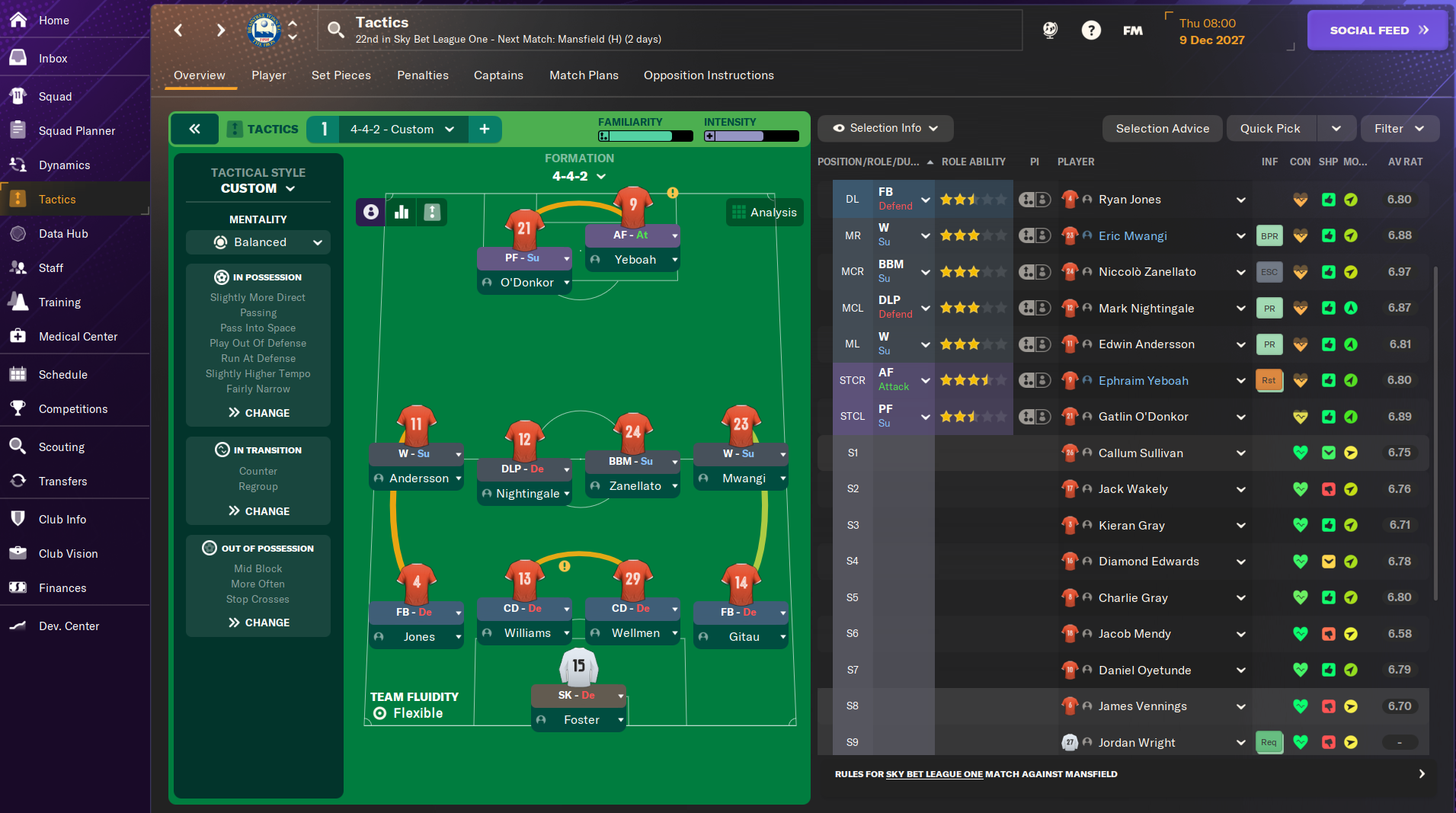
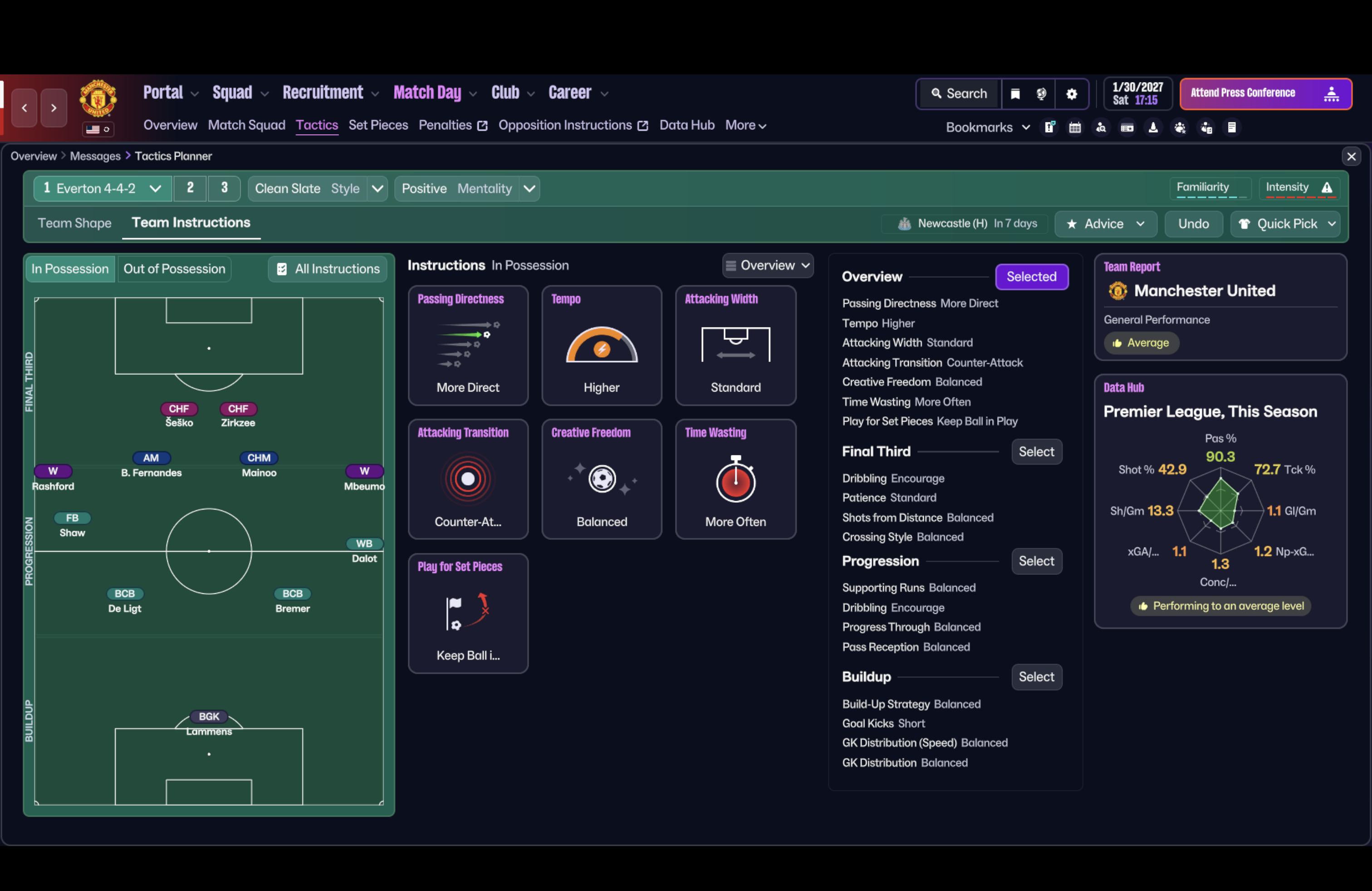
- • Passing: Direct Passing
- • Tempo: Standard (Higher Tempo only with technical runners)
- • Width: Standard or Narrower (Wider only with two strikers and elite physical wide players)
- • Mentality: Balanced (Positive only when chasing a goal)
- • Defensive Line: Standard or Lower
- • GK Distribution: Prevent Short GK Distribution (forces the keeper long)
- • Get Stuck In
Avoid These
- • Play Out of Defence: contradicts the long ball
- • Shorter Passing: kills the system entirely
- • Work Ball Into Box: the goal is direct entries
- • Much Higher Tempo: every loose ball turns into chaos
- • Underlap: pulls runners off the lay-off line
- • Pass Into Space: wrong for target-man direct (the long ball is aimed at a body, not a space). Pass Into Space + Direct Passing only works in the runner-based heavy-counter variant covered in the Width, Compactness & Tempo guide.
Real-World Examples
Four reference points, each showing a different reading of the same idea.
Sam Allardyce's Bolton, 1999-2007. The reference Premier League example. A 4-4-2 that fed Kevin Davies (in FM, his archetype wants Strength and Heading north of 18; in real life he was simply one of the league's hardest aerial duellists) directly from the centre-backs and Jaaskelainen's distribution. Davies was the lay-off; Stelios arrived in 2003, with Diouf and Nakata coming through across 2004-06 onto the second ball. Bolton finished sixth in 2004-05 with that group, which qualified them for the 2005-06 UEFA Cup. Anelka arrived in August 2006 and was central to the 2006-07 side that finished seventh and went into the 2007-08 UEFA Cup run. The budget that produced those finishes should have had them mid-table at best. That gap (between what the squad's possession numbers said and what the system actually produced) is the entire idea.
Allardyce's England, 2016 (one match). A useful negative example. Allardyce got one match before the Telegraph sting ended his tenure. England played Slovakia and won 1-0 with a direct setup that produced very little, because the squad had no genuine target man. Harry Kane is a modern complete forward; he's not a Kevin Davies. The plan needs the player. A direct system without the target receiver is just hopeful punting, and the Slovakia match showed what that looks like even with a positive result.
Tony Pulis at Stoke (Premier League era, 2008-2013). The most famous "anti-football" version, and unfairly maligned. Pulis returned to Stoke in June 2006 and got the club promoted in 2008. He combined direct play with one of the most effective set-piece programmes in Premier League history. Rory Delap's long throws were an extension of the same system, treating every throw-in as a set-piece delivery. The early iconic Stoke side was built around Ricardo Fuller, Mama Sidibe, Kenwyne Jones, and Jon Walters as target and second runner. Peter Crouch arrived in 2011, five years into the run, and brought a more technical lay-off variation onto the same template. Stoke stayed up every season, beat the top six regularly at home, and were genuinely difficult to play against because the plan was coherent end-to-end: direct entries, second balls, set-pieces won from those second balls, set-piece goals.
Brentford under Thomas Frank, 2021-2025. The modern, technically respectable version. Frank's Brentford played direct from the goalkeeper through Ivan Toney, then Yoane Wissa after Toney's ban and departure, without anyone calling it long-ball football, because the lay-offs found Mbeumo and a tucked-in winger rather than just second-ball pinball. The point is that direct football has modernised: the long pass is more accurate, the runners are more technical, the build-up looks deliberate rather than panicked. The principle hasn't changed. The execution has.
In FM terms, the Brentford build is roughly: Toney as a Target Forward on Support (or Complete Forward on Support if his attribute spread is more rounded than pure target), Mbeumo as an Inside Forward on Attack arriving onto the lay-off line, a tucked-in left winger as Inverted Winger on Support, a Box-to-Box Midfielder on Support for second-ball arrival, a Ball-Winning Midfielder on Defend behind them to clean up, and full-backs on Support rather than overlapping Attack. Prevent Short GK Distribution goes on the keeper to force the long ball; the outfield runs Direct Passing on Balanced mentality.
Frequently Asked Questions
Is direct football the same as long-ball football?
Roughly the same idea, with a tone difference. "Long-ball" implies hopeful punting; "direct" implies a deliberate vertical plan. In FM the in-game instruction is Direct Passing. Applied to a coherent system, it's direct football; applied to a system that doesn't fit, it's long-ball football. The setting is the same; the design around it is what makes the difference.
Can I play direct without a true target man?
Not really, no. The whole system depends on someone winning the long ball. If your forward is a 6'0" pace-and-finishing type, Direct Passing will mostly produce turnovers. The workaround is to drop into a deep build-up (Standard passing, lower line of engagement) and only switch to direct in specific game-states (chasing a goal, defending a lead). Treat it as a contextual tool rather than a default.
Direct Passing or Prevent Short GK Distribution: what's the difference?
Direct Passing is a team-wide instruction governing every player's pass selection. Prevent Short GK Distribution is a goalkeeper-specific instruction governing only goal-kicks and keeper distribution. They pair naturally (if your outfield is on Direct Passing, your keeper should be on Prevent Short GK Distribution) but they're independent. You can play short from the back on goal-kicks and direct in open play, or vice versa.
Does direct football work at the top level?
Yes, situationally. Brentford under Frank were a recent Premier League proof point; Atlético Madrid have used direct switches for years on top of a compact 4-4-2 mid block. The trick is that top-level direct football usually means occasionally direct, not always direct: a vertical switch when the press is committed, then back to compact mid-block defending. Always-direct works in the Championship, less reliably in the Premier League, rarely in the Champions League.
What's the most common direct-football mistake in FM?
Setting Direct Passing without a target. Managers click the instruction because it sounds simple, leave a Pressing Forward on Attack with no Strength or Heading attributes, and watch every long ball get headed straight back. The fix is the squad, not the instruction. Either find a target man or take Direct Passing back to Standard. The instruction never overcomes a missing role.
Conclusion
Direct, vertical football is a real plan with a real squad profile. It isn't counter-attacking and it isn't cowardice; it's a deliberate choice to skip the midfield and let a target receive, because the squad and the matchup say that works better than circulation. The non-negotiables are the target's attribute floor and a runner arriving onto the lay-off; the team instructions follow from those. Allardyce, Pulis, and Frank all read the same engine differently, but the underlying plan, Direct Passing plus a target plus a runner, is the same one across all three eras. Build that, and the long ball stops being a punt.
Related guides
Keep exploring the tactical library. These go well with the topic above.
Understanding the 4-3-3 Formation
Master the classic 4-3-3: player roles, tactical variations, and the trade-offs that decide whether it sings or stalls.
Possession-Based Tactics in Football Manager
Build the patient, control-the-tempo style without watching your opponents counter through the gaps you leave behind.
Counter-Attacking Excellence
Sit deep, win the ball, and break in three passes. The roles, instructions, and squad profile that make it work.