Uploaded Tactic
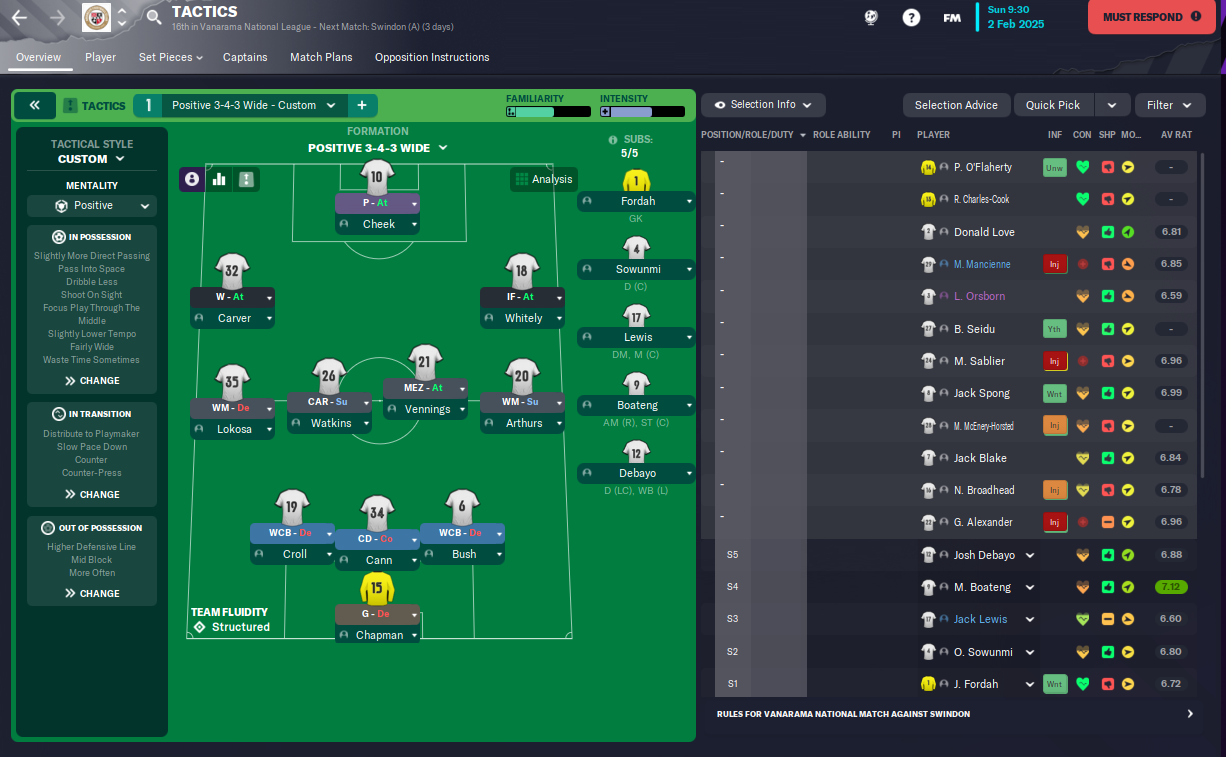
Formation & Style
Tactical Style:Custom
Mentality:Positive
Formation:3-4-3 Wide
Team Fluidity:Structured
In Possession
Slightly More Direct Passing
Pass Into Space
Shoot On Sight
Focus Play Through The Middle
Slightly Lower Tempo
Fairly Wide
Waste Time Sometimes
In Transition
Distribute to Playmaker
Slow Pace Down
Counter
Counter-Press
Out of Possession
Higher Defensive Line
Mid Block
Press More Often
Team Shape Without Ball
Shape:3-4-3
Description:Three central defenders provide strong coverage and allow wing-backs to push forward, creating width when transitioning to attack.
Evidence:CBs at [2,2], [2,3], [2,4] with WBs at [3,1], [3,5] supporting wide defence.
Team Shape With Ball
Shape:3-1-3
Description:The attacking line features a central striker supported by a central attacking mid and wing-forwards creating a dynamic approach to attack.
Evidence:P-At at [6,3], IF-At at [5,2], WM-Su at [5,1]; supporting AM at [4,3].
Phase Description
Attacking Play
The team aims to utilize width through the wing-backs while relying on the midfield to create chances, focusing on direct and quick transitions.
Defensive Transition
Upon losing possession, the team utilizes a counter-press to quickly regain the ball and transitions into a slower build-up.
Main Focus
Leveraging wide play through wing-backs and quick transitions to exploit spaces left by opponents.
Key Strengths
Wide Play Utilization
Effective wing play through wing-backs and inside forwards enhances the attack and stretches the opposition's defensive structure.
Solid Defensive Setup
The formation offers a robust defensive line with three CBs, minimizing space for opposing forwards.
Direct Attacking Approach
The tactics promote direct passing and shooting opportunities, increasing chances created per match.
Conflicting Directions
High Defensive Line with Slow Build-Up
A high defensive line may leave gaps if the team adopts a slow build-up, leading to counter-attacking vulnerabilities.
Mid Block with High Press
The combination of a mid block with an aggressive press may lead to player positioning conflicts causing disorganization.
Conflicting Wing Strategies
Encouraging both wing play and central focus might dilute the effectiveness of each strategy, leading to overcrowding in specific areas.
Tactical Suggestions
Adjust Defensive Line Height
Consider lowering the defensive line to prevent potential gaps being exploited by fast counter-attacks.
Increase Midfield Support
Add a Ball-Winning Midfielder to enhance defensive stability and support for the attack.
Refine Width Usage
Balance the use of width by ensuring wing-backs have clear instructions to either stay wide or support centrally.
Ask Questions About Your Lineup
Guides for this formation
The tactical theory behind the 3-4-3 Wide: roles, instructions, and the trade-offs that decide whether the system holds up.
Playing styles
Direct, Vertical Football
Long-ball football done well in FM. When direct, vertical play is the right choice, and what the Direct Passing TI actually changes.
Read guide
Playing styles
Possession-Based Tactics in Football Manager
Build the patient, control-the-tempo style without watching your opponents counter through the gaps you leave behind.
Read guide