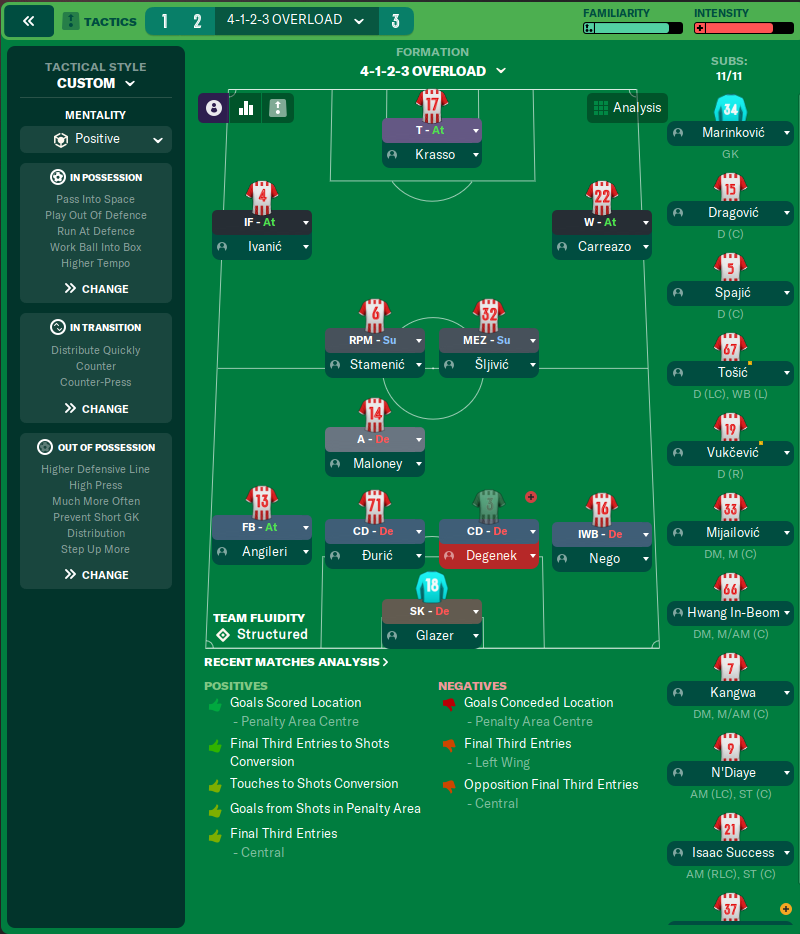
4-1-2-3 Overload
The combination of wingers and inside forwards stretches the opposition defense, creating space for penetrating runs.
Loading tactical analysis...
Custom
Positive
4-1-2-3 Overload
Structured
Pass Into Space
Play Out Of Defence
Run At Defence
Work Ball Into Box
Higher Tempo
Distribute Quickly
Counter-Press
Higher Defensive Line
High Press
Much More Often
Prevent Short GK Distribution
Step Up More
ST
Target Man
Attack
IF
Inside Forward
Attack
W
Winger
Attack
RPM
Raumdeuter
Support
MEZ
Mezzala
Support
A
Advanced Playmaker
Defend
FB
Full-Back
Attack
CD
Central Defender
Defend
IWB
Inverted Wing-Back
Defend
GK
Sweeper Keeper
Defend
The combination of wingers and inside forwards stretches the opposition defense, creating space for penetrating runs.
With a Raumdeuter and Mezzala, the midfield can interchange positions effectively, disrupting defensive lines.
Having an Advanced Playmaker defend could lead to a lack of support during transitions, isolating the striker.
A high defensive line coupled with a counter-press strategy might leave space behind, causing vulnerabilities.
How effectively are you able to transition from defense to attack?
Are your full-backs supporting the wingers effectively during overlaps?
How often do you find yourself getting caught on the counter?
Is your Target Man receiving adequate support from midfield?
How well is your pressing strategy working in recent matches?
Are there sufficient passing lanes for your midfielders inward from the wings?
The tactical theory behind the 4-1-2-3 Overload: roles, instructions, and the trade-offs that decide whether the system holds up.
Holder, runner, creator: the role distribution rule for three-man midfields, the AMC variants, and the antipatterns that break them.
The five seconds after losing the ball decide most matches. Counter-press, drop-and-recover, and how to know which one you should be doing.
Routines, takers, and target picks. How to turn corners and free-kicks into a reliable third of your goal output.