Uploaded Tactic
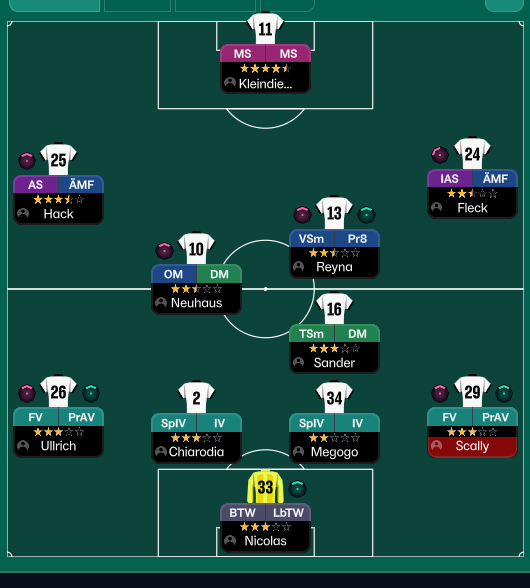
Formation & Style
Tactical Style:Possession
Mentality:Positive
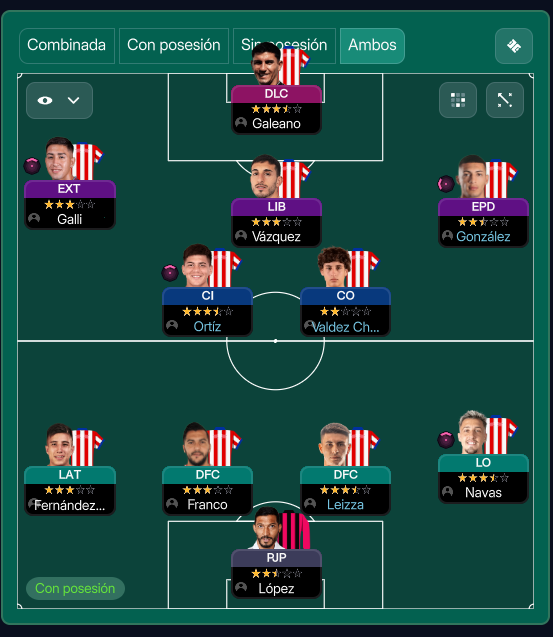
Formation:4-2-3-1
Team Fluidity:Fluid
In Possession
Shorter Passing
Play Out Of Defence
Work Ball Into Box
Focus Play Through Middle
In Transition
Counter-Press
Counter
Out of Possession
High Defensive Line
More Urgent Pressing
Team Shape Without Ball
Shape:4-2-3-1
Description:The team forms a compact shape in defense, with two holding midfielders reinforcing the back four.
Evidence:DM-D at [3,3] and DM-S at [3,4] support the centre-backs, creating a solid line against opposition attacks.
Team Shape With Ball
Shape:4-1-4-1
Description:Transitioning from defense to a more fluid attacking shape with a clear focus on width provided by the wing-backs.
Evidence:WBs at [2,2] and [2,4] support the wide play, while the attacking midfielders exploit space centrally.
Phase Description
Attacking Play
Focused on maintaining possession through careful buildup, utilizing short, purposeful passes to break through the opposition.
Defensive Transition
Quickly transitioning to a compact shape during losses of possession to minimize counter-attacking risks.
Main Focus
Controlling the game through possession and creating chances through a fluid attacking front.
Key Strengths
Fluid Attack
The positioning of multiple attacking midfielders allows for fluid movement and interchanging positions.
Possession Control
Shorter passing and a focus on working the ball into the box enhances midfield control.
Defensive Stability
A solid defensive lineup with DM roles bolsters the backline against counterattacks.
Conflicting Directions
Over-Reliance on Wide Play
While width can be an asset, it may stretch the team too thin and reduce central impact.
Vulnerability to Quick Counters
High defensive line and pressing may expose gaps for quick transitions from the opponents.
Midfield Lacks Physicality
The midfield may struggle against physically dominant opposition.
Tactical Suggestions
Introduce a More Defensive Midfielder
Adding a Ball-Winning Midfielder could enhance physical presence in midfield.
Consider Variation in Attacking Width
Allowing for adaptive width between wing-backs and attackers could confuse defenses.
Manage Defensive Line Height
Adjusting the high line slightly lower could mitigate counterattacking threats.
Ask Questions About Your Lineup
Related Tactics
More Possession tactics
Guides for this formation
The tactical theory behind the 4-2-3-1: roles, instructions, and the trade-offs that decide whether the system holds up.
Player pairings
Midfield Pairs in 4-2-3-1 and 4-4-2
Double pivots and flat pairs in 4-2-3-1 and 4-4-2: when each pairing works, when it collapses, and the AMC unicorn that rescues both.
Read guide
Playing styles
Gegenpressing: A Full Guide
Klopp-style gegenpressing in FM, including squad profile, line-and-press pairing, sustainable workload, and the antipatterns to avoid.
Read guide