Uploaded Tactic
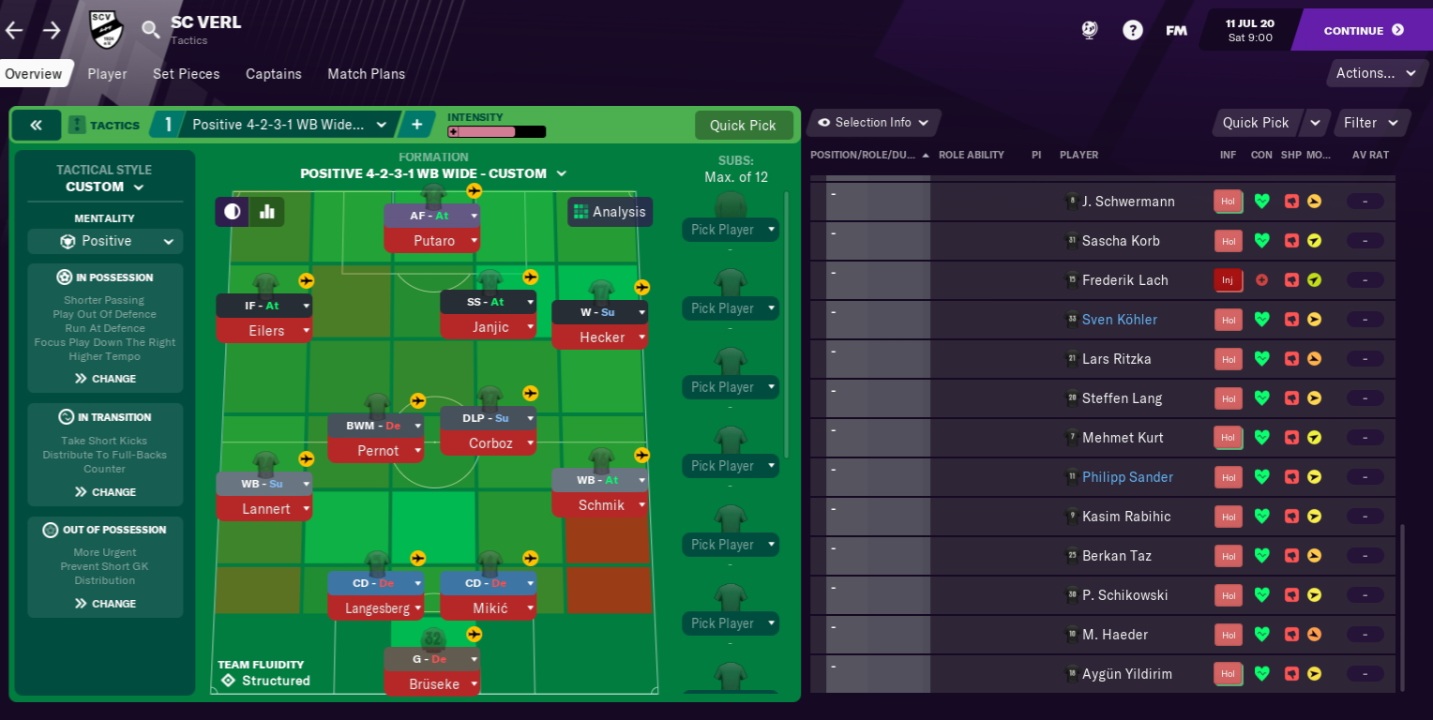
Formation & Style
Tactical Style:Custom
Mentality:Positive
Formation:4-2-3-1 WB Wide
Team Fluidity:Structured
In Possession
Shorter Passing
Play Out Of Defence
Run At Defence
Focus Play Down The Right
Higher Tempo
In Transition
Take Short Kicks
Distribute To Full-Backs
Counter
Out of Possession
More Urgent
Prevent Short GK Distribution
Team Shape Without Ball
Shape:4-2-3-1
Description:The team exhibits a compact defensive shape where the midfield supports the back line significantly.
Evidence:BWM-De at [3,2] and DLP-Su at [4,3] provide stability and transition opportunities.
Team Shape With Ball
Shape:4-2-3-1 Wide
Description:Attack utilizes width effectively with WB's making overlapping runs while the attacking midfielders penetrate centrally.
Evidence:W-At at [5,5], IF-At at [6,1], and AF-At at [6,3] enhance attacking variation.
Phase Description
Attacking Play
Focuses on getting width through the WB's and exploiting the right side with runners to create chances.
Defensive Transition
Aims to win the ball back quickly, with an emphasis on counter-attacking through the BWM and wide players.
Main Focus
Utilizing the left side for attacking opportunities while maintaining a balanced approach to defense.
Key Strengths
Wide Play
Utilizing wing-backs to provide additional width and depth in attack allows stretching the opponent's defense.
Midfield Combination
The BWM and DLP create a balanced midfield, offering both defensive security and attacking creativity.
Versatile Attack
The combination of an Inside Forward and Shadow Striker provides various attacking threats and movement.
Conflicting Directions
Over-Reliance on Right Wing
Focusing play predominantly down the right may make the team one-dimensional and predictable.
Vulnerability on Counter
While trying to recover the ball quickly, the team may leave spaces exposed during transitions.
Defensive Midfield Depth
Positioning a BWM may lead to gaps if he pushes too far forward, leaving the defense vulnerable.
Tactical Suggestions
Encourage Left Side Play
Promote attacking options on the left flank to balance the team's offensive structure.
Adjust Defensive Shape
Using a more compact defensive shape could help exploit opponent weaknesses and improve stability.
Rotate Offensively
Implement rotations among attacking players to keep defenders guessing and create more space.
Ask Questions About Your Lineup
Guides for this formation
The tactical theory behind the 4-2-3-1 WB Wide: roles, instructions, and the trade-offs that decide whether the system holds up.
Player pairings
Midfield Pairs in 4-2-3-1 and 4-4-2
Double pivots and flat pairs in 4-2-3-1 and 4-4-2: when each pairing works, when it collapses, and the AMC unicorn that rescues both.
Read guide
Playing styles
Gegenpressing: A Full Guide
Klopp-style gegenpressing in FM, including squad profile, line-and-press pairing, sustainable workload, and the antipatterns to avoid.
Read guide