Uploaded Tactic
Formation & Style
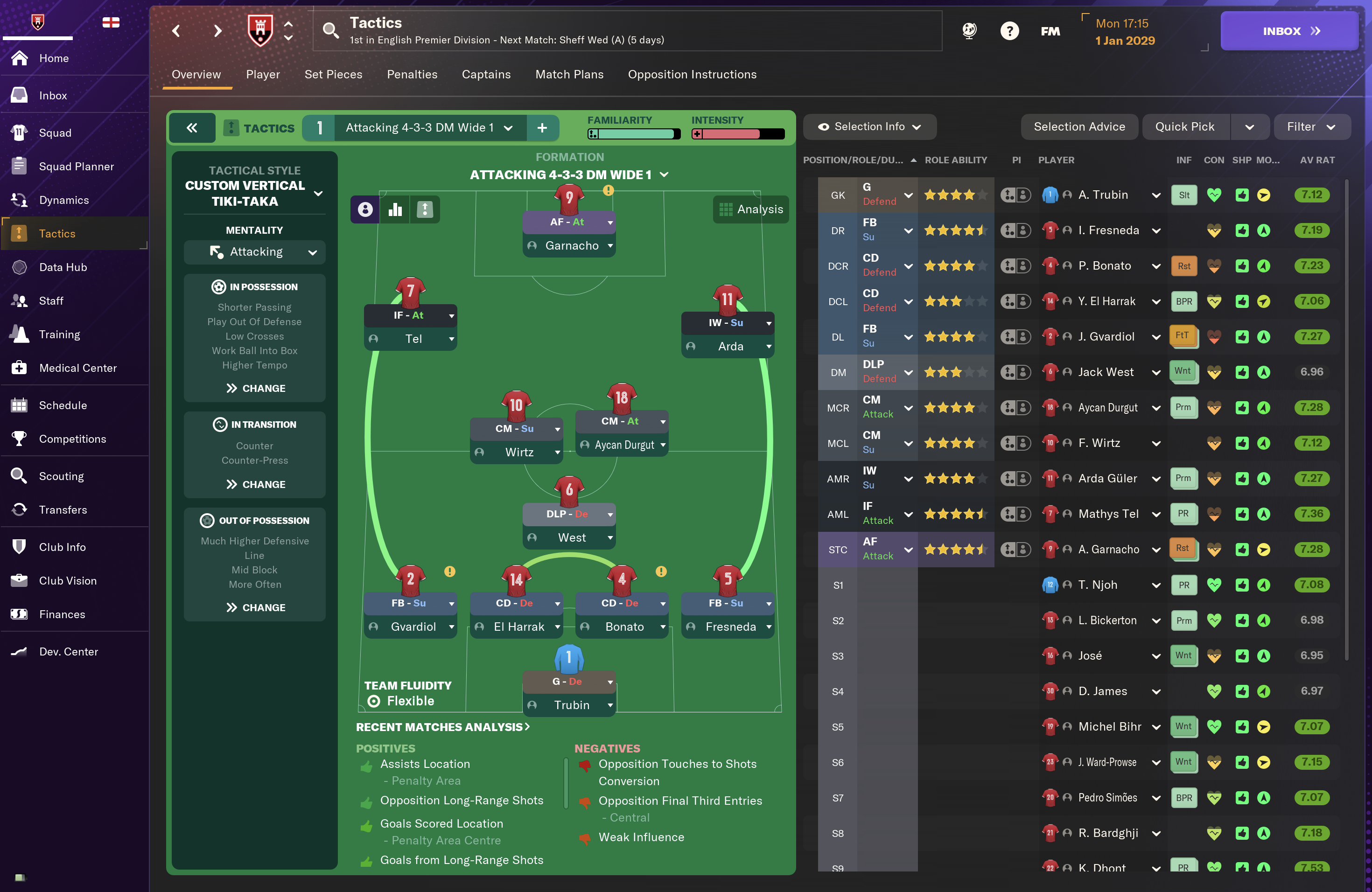
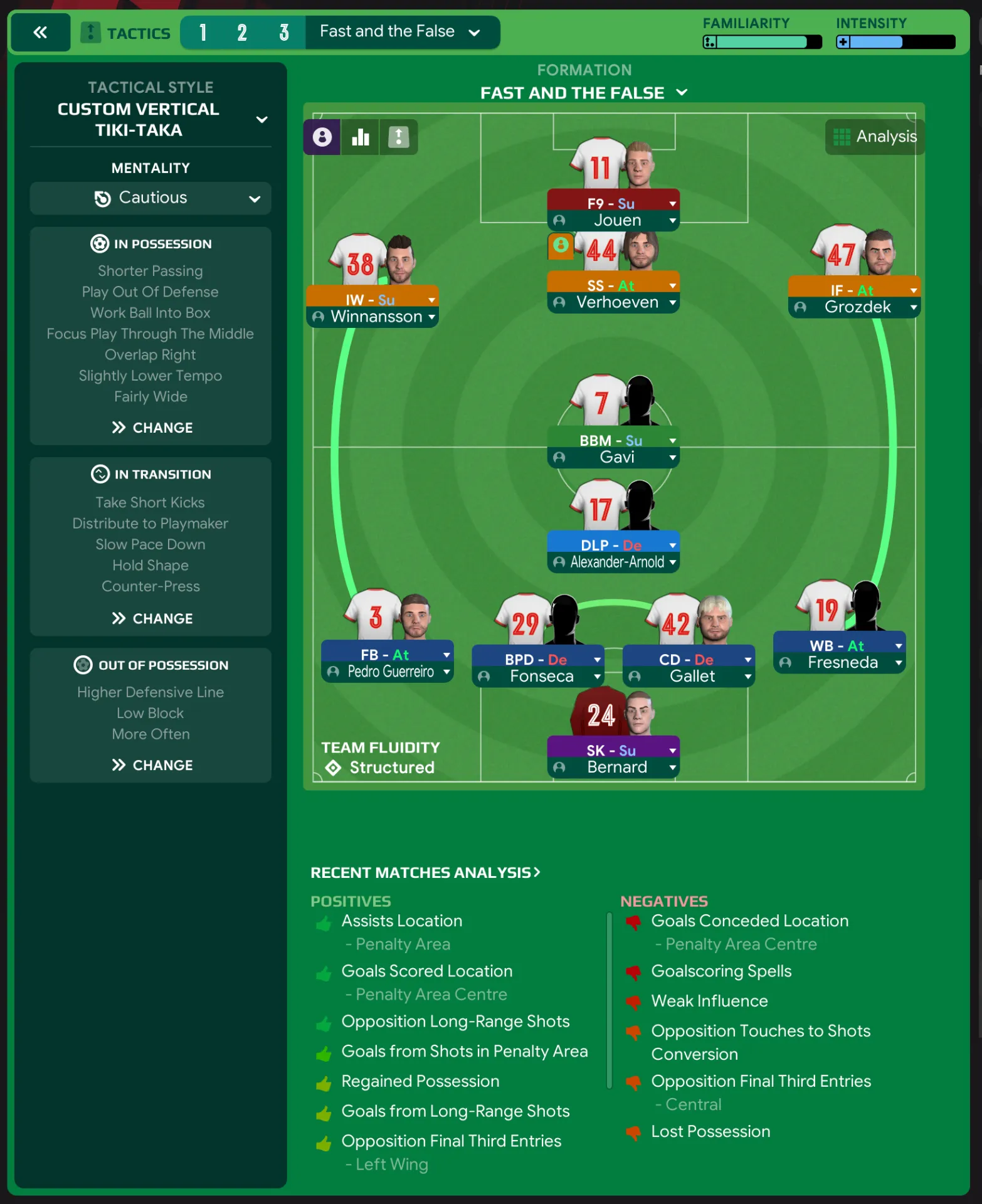
Tactical Style:Custom Vertical Tiki-Taka
Mentality:Attacking
Formation:4-3-3 DM Wide 1
Team Fluidity:Flexible
In Possession
Shorter Passing
Play Out Of Defence
Low Crosses
Work Ball Into Box
Higher Tempo
In Transition
Counter
Counter-Press
Out of Possession
Much Higher Defensive Line
Mid Block
More Often
Team Shape Without Ball
Shape:Compact and high line
Description:The team maintains a compact shape to press effectively, while full-backs push up to support clearly defined defensive lines.
Evidence:Much Higher Defensive Line and Mid Block.
Team Shape With Ball
Shape:Fluid attacking shape with width
Description:Full-backs pushing forward and inside forwards create overloads, leading to fluid movement.
Evidence:Utilization of FB-S at [2,1] and [2,5] combined with IF-A at [6,2] and IW-S at [6,4].
Phase Description
Attacking Play
The team attempts to maintain possession with shorter passes, centered around a deep-lying playmaker dictating the tempo.
Defensive Transition
After losing possession, the team engages in a counter-press to recover the ball quickly.
Main Focus
Utilizing width via the full-backs and inverted wingers while creating high-tempo gameplay.
Key Strengths
Possession Retention
The tactical setup emphasizes the importance of ball retention using shorter passing and encouraging plays from the back.
Attacking Width
The inclusion of full-backs and wingers stretches the opponent's defence, creating spaces for midfielders.
High Pressing
Counter-pressing allows for immediate ball recovery, establishing pressure on the opponent’s build-up.
Conflicting Directions
High Line vs Counter-Attacks
The much higher defensive line may leave vulnerabilities against fast counter-attacks.
Heavy Rotation in Midfield
Midfield roles with varied responsibilities may lead to confusion in defensive responsibilities.
Inverted Winger Productivity
Inverted wingers may become isolated if full-backs do not provide overlapping support.
Tactical Suggestions
Consider a More Balanced Midfield
Introducing a more defensive midfielder may enhance stability when transitioning to defense.
Enhance Full-Back Support
Encouraging full-backs to overlap could increase attacking threat and ensure that the wingers are supported.
Adjust Defensive Line Height
Lowering the defensive line slightly could make the defense more resilient against counter-attacks.
Ask Questions About Your Lineup
More Custom Vertical Tiki-Taka tactics
Guides for this formation
The tactical theory behind the 4-3-3 DM Wide 1: roles, instructions, and the trade-offs that decide whether the system holds up.
Foundations
Understanding the 4-3-3 Formation
Master the classic 4-3-3: player roles, tactical variations, and the trade-offs that decide whether it sings or stalls.
Read guide
Player pairings
Midfield Trios
Holder, runner, creator: the role distribution rule for three-man midfields, the AMC variants, and the antipatterns that break them.
Read guide
Playing styles
Gegenpressing: A Full Guide
Klopp-style gegenpressing in FM, including squad profile, line-and-press pairing, sustainable workload, and the antipatterns to avoid.
Read guide