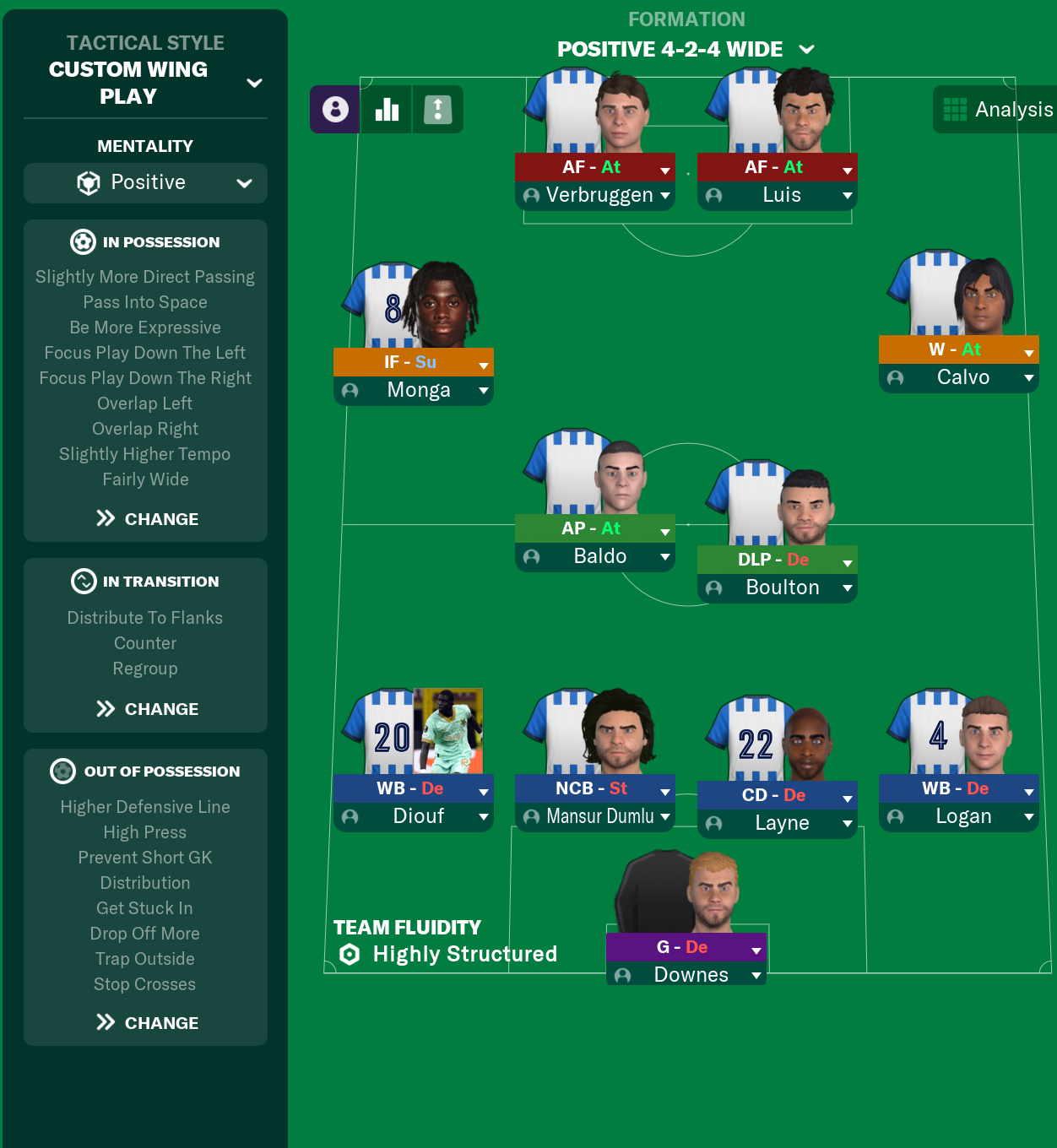
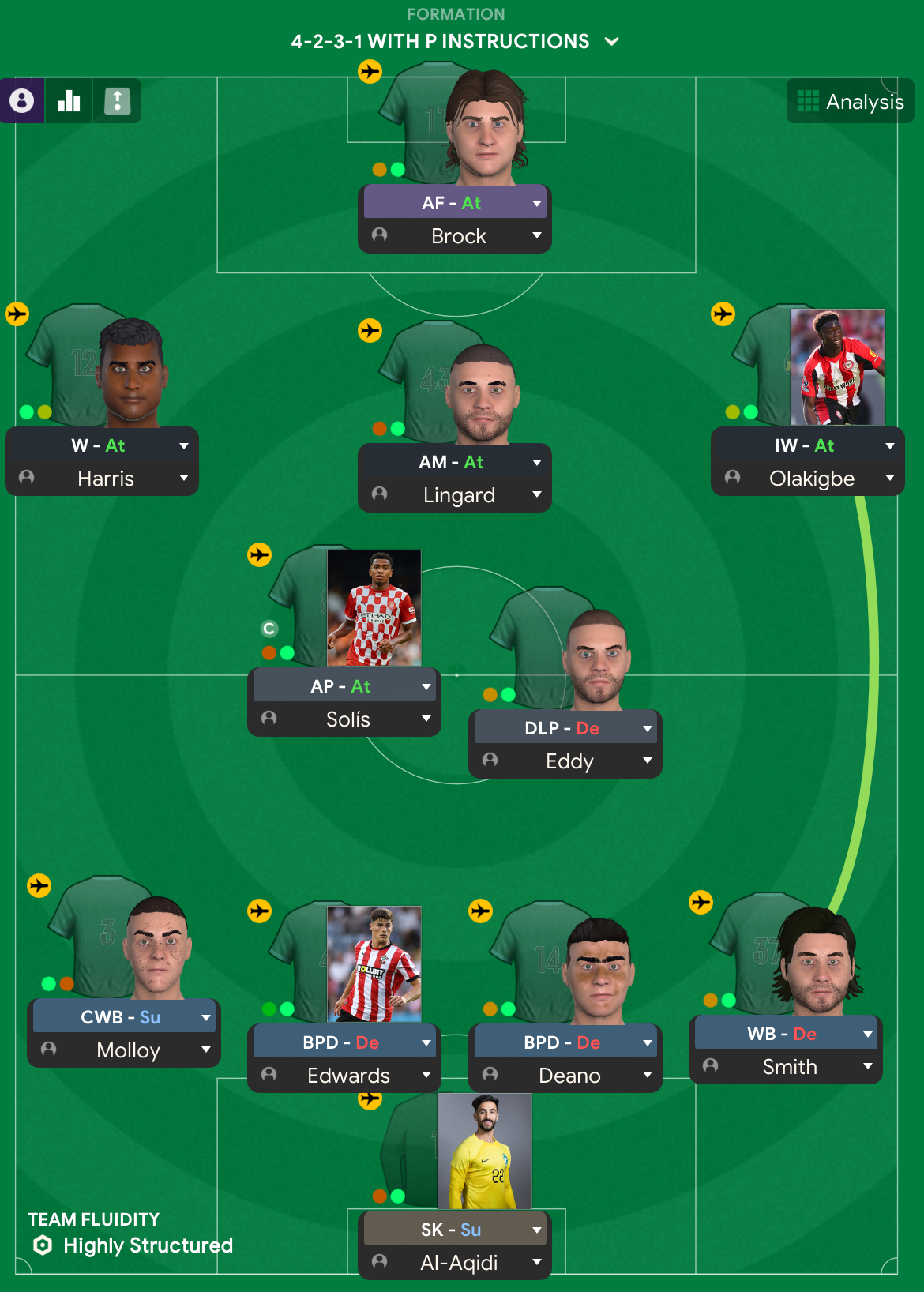
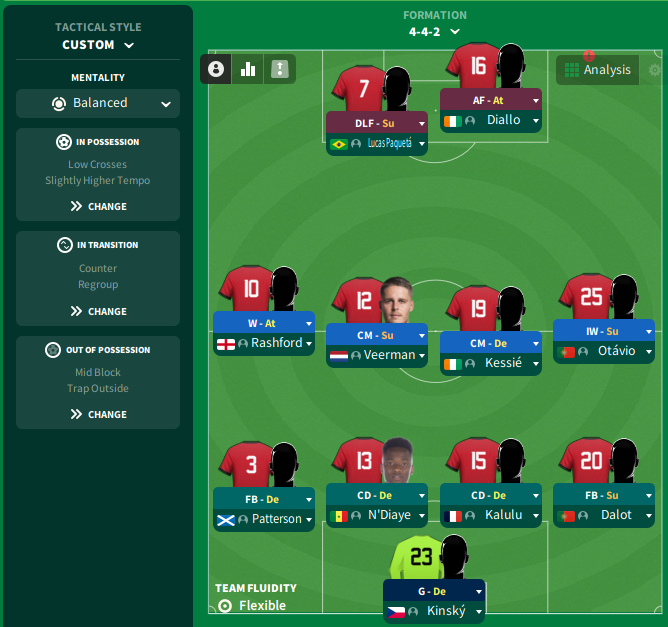
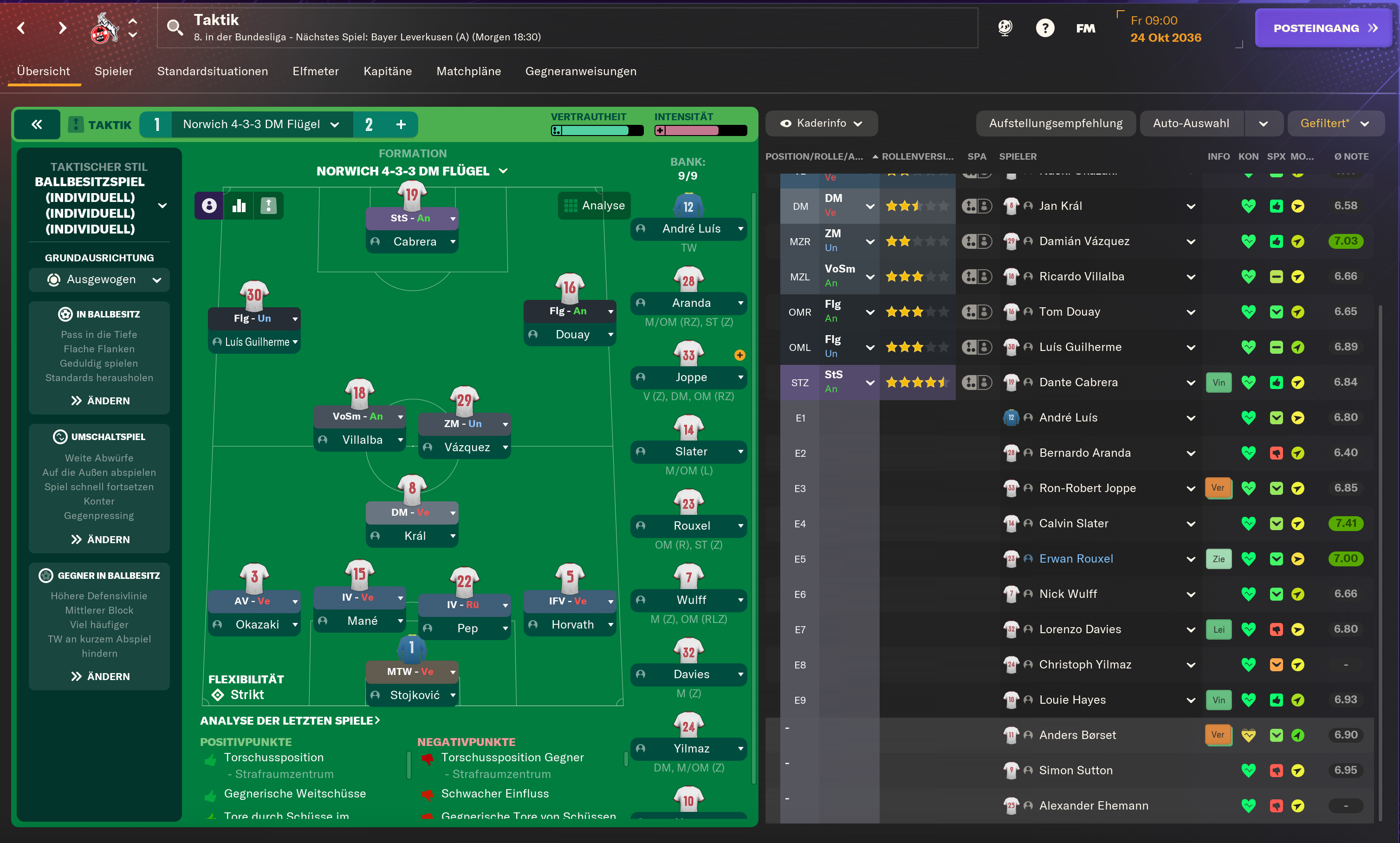
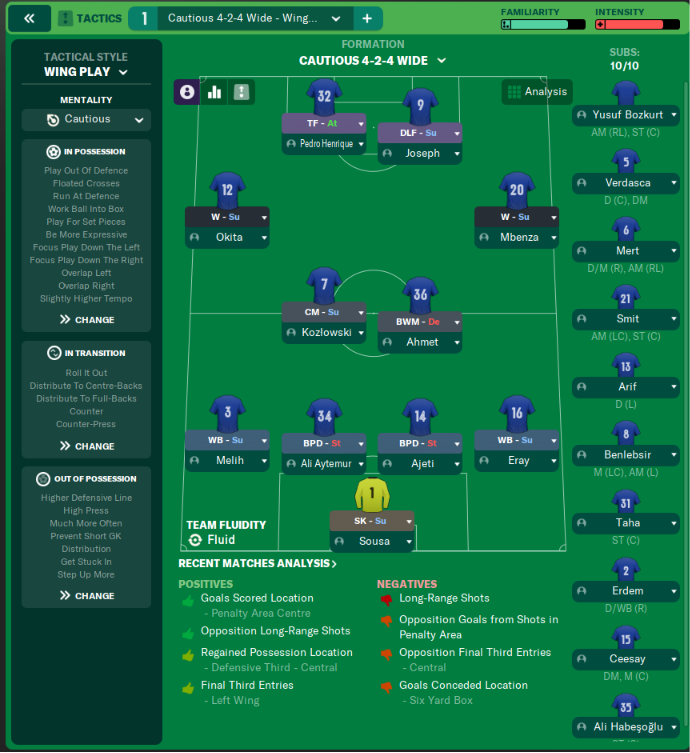
Cautious 4-2-4 Wide
Creation of chances through wide play and short passes in the final third. The formation is designed to exploit flanks, pulling opposition wide and…
Loading tactical analysis...
Wing Play
Cautious
Cautious 4-2-4 Wide
Fluid
Play Out Of Defence
Floated Crosses
Run At Defence
Work Ball Into Box
Be More Expressive
Focus Play Down The Left
Focus Play Down The Right
Overlap Left
Slightly Higher Tempo
Roll It Out
Distribute To Centre-Backs
Distribute To Full-Backs
Counter
Counter-Press
Higher Defensive Line
High Press
Prevent Short GK Distribution
Step Up More
GK
Sweeper Keeper
Support
DC
Ball-Playing Defender
Support
DC
Ball-Playing Defender
Support
WB
Wing-Back
Support
WB
Wing-Back
Support
CM
Central Midfielder
Support
CM
Ball-Winning Midfielder
Defend
AM
Wide Midfielder
Support
ST
Target Forward
Attack
ST
Deep-Lying Forward
Support
Utilizes wide play to create space for the forwards and focuses on crossing into the box.
Quick to regroup into a compact formation while pressing high.
Creation of chances through wide play and short passes in the final third.
2-2
Compact in the middle, with wing-backs covering the flanks.
The use of two central defenders and two central midfielders helps to close down central spaces.
4-2
Wide players stretch the opposition, providing spaces for the striker to operate.
Target Forward focuses on positioning while midfielders exploit space created.
The formation is designed to exploit flanks, pulling opposition wide and creating space.
Utilization of Wingers and Wing-Backs in attacking roles at [6,1], [6,5], [5,1], [5,5].
The double pivot ensures defensive stability while enhancing possession control.
BWM at [4,3] and CM at [4,2] provide support for defence and attack.
High defensive line may expose the team to long-range shooting opportunities.
Negatives indicate opposition goals from long-range shots.
Team may struggle to create opportunities if the opposition effectively neutralizes the wide areas.
Focus on overlap left and right may be countered by compact defensive units.
Defensive Transition
High pressing style can lead to quick counter-attacks if possession is lost.
Counter phases are included as team instructions.
Set Pieces
Vulnerabilities may arise during defending set pieces with a taller forward present.
Overreliance on physical players can be exploited by better coordinated set-piece teams.
BWM-De and CM-Su
Provides balance with a focus on ball recovery and linking play going forward.
BWM-De at [4,3] supports defensive duties, freeing CM-Su at [4,2] to push forward.
WB-Su with W-Su
Creates width and overlaps, stretching defense and providing crossing opportunities.
WB at [5,1] and W at [6,1] can create mismatches against defensive setups.
How can the midfield roles be adjusted for better control?
Is there a need for a more aggressive counter-pressing approach?
What adjustments can be made to mitigate the risk of long shots against?
The tactical theory behind the Cautious 4-2-4 Wide: roles, instructions, and the trade-offs that decide whether the system holds up.
The pairing rule for Defensive Line and Line of Engagement, all 9 combinations, and the gap that costs goals.
What Higher Tempo, Wider, and Narrower actually do in FM, plus the dial contradictions and antipatterns players run into most often.
Build through the wide areas or through the middle? A working framework for picking the right one for your squad.