Custom
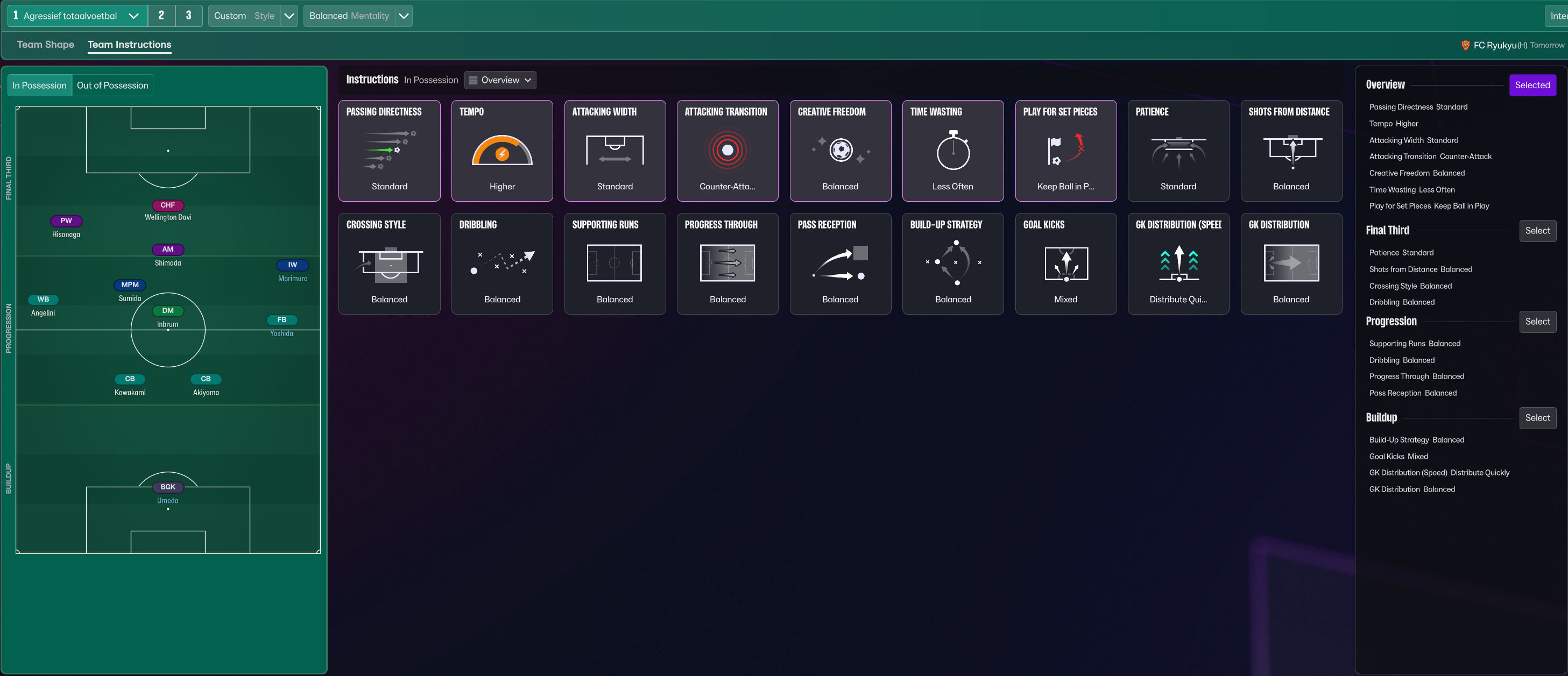
Quick central creativity and channel runs, with a screening DM as the main protection. A playmaker, an attacking midfielder and a playmaking winger give…
Loading tactical analysis...
Custom
Custom
Balanced
Clean Slate
1
3
Ball-Playing Goalkeeper
Goalkeeper
2
2
Centre-Back
Centre-Back
2
4
Centre-Back
Centre-Back
3
1
Wing Back
Full Back
3
3
Defensive Midfielder
Screening Defensive Midfielder
3
5
Full Back
Full Back
4
2
Midfield Playmaker
Central Midfielder
5
3
Attacking Midfielder
Central Midfielder
5
5
Inside Winger
Wide Midfielder
6
1
Playmaking Winger
Wide Midfielder
6
3
Channel Forward
Central Outlet Attacking Midfielder
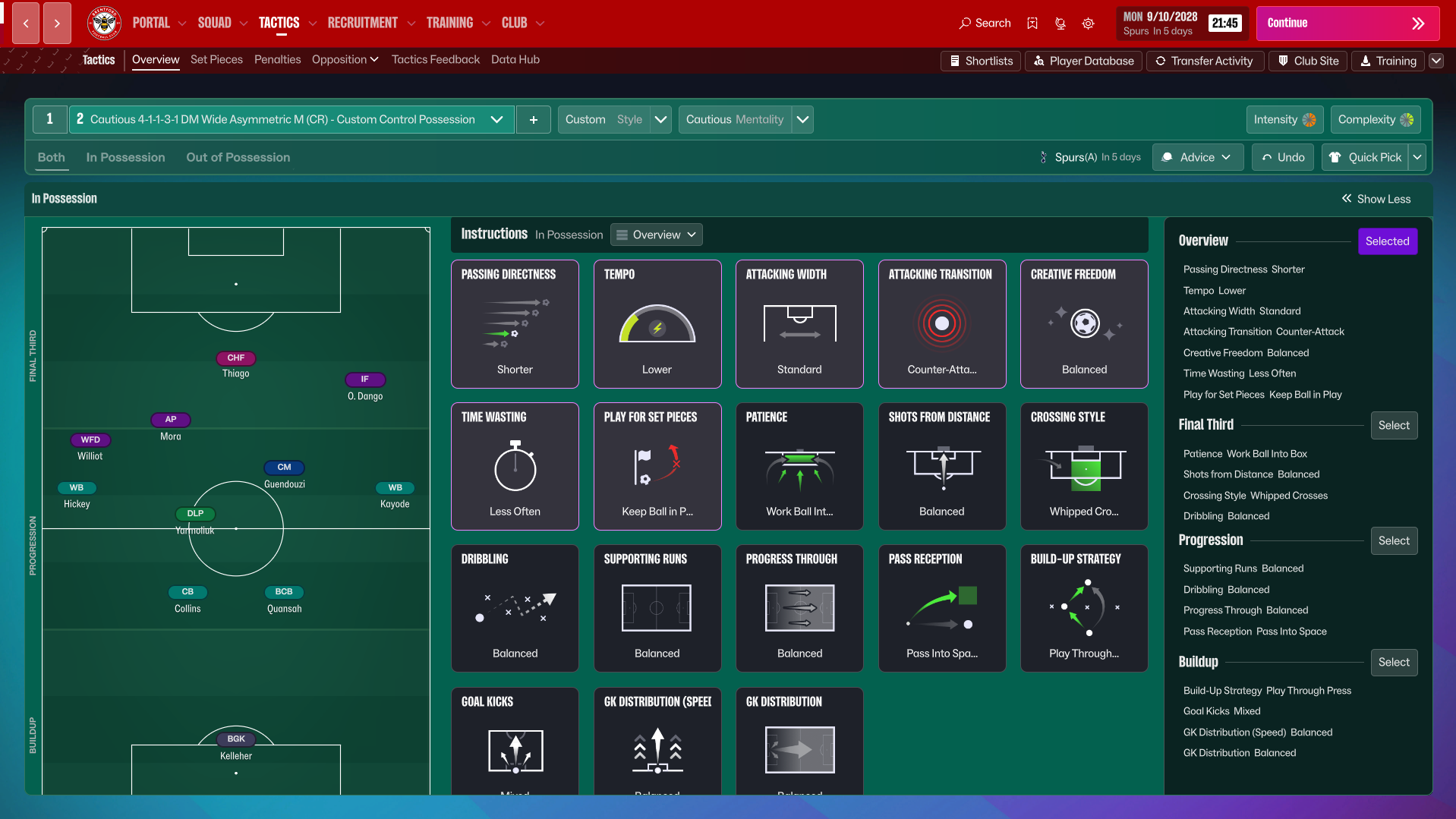
Standard
Higher
Standard
Counter-Attack
Balanced
Less Often
Keep Ball in Play
Standard
Balanced
Balanced
Balanced
Balanced
Balanced
Balanced
Balanced
Mixed
Distribute Quickly
Balanced
Overlap Balanced
Underlap Balanced
Mid Block
Standard
Balanced
Standard
Regroup
Get Stuck In
No
Balanced
Balanced
Balanced
A playmaker, an attacking midfielder and a playmaking winger give the side several ways to create chances, with a screening DM behind them.
Midfield Playmaker at [4,2], Attacking Midfielder at [5,3] and Playmaking Winger at [6,1] supply creativity, while Screening Defensive Midfielder at [3,3] covers.
A channel forward and an inside winger give penetration and a goal threat, and the higher tempo plus counter-attack transition suit them.
Channel Forward at [6,3] and Inside Winger at [5,5] attack the channels.
The attacking side wants to hit quickly after turnovers, but the team drops back to regroup when it loses the ball. Players are stretched forward and slow to win it back.
Inside Winger at [5,5] and Channel Forward at [6,3] push on while the team uses Regroup defensively.
Hard tackling pulls defenders out of position, which is risky behind a modest, uncompressed block.
Centre-Back at [2,2] and Centre-Back at [2,4] can be dragged out of position by Get Stuck In.
Right flank balance
The wing-back on the left and a plain full-back on the right, plus an inside winger, leave uneven width and cover on the right when possession is lost.
Full Back at [3,5] sits behind Inside Winger at [5,5], who becomes a Wide Midfielder out of possession.
medium
Midfield cover in transition
The advanced attackers and playmakers leave the lone DM exposed to counters when the ball is lost at higher tempo.
Screening Defensive Midfielder at [3,3] covers alone behind Midfield Playmaker at [4,2].
high
Midfield playmaker + attacking midfielder + channel forward
The playmaker feeds the AM, who links to a forward running the channels.
Midfield Playmaker [4,2], Attacking Midfielder [5,3], Channel Forward [6,3]
Do you want to counter quickly or control possession?
Is the right side meant to be less attacking than the left?
This is a balanced, clean-slate setup with creative midfield roles and a quick attacking style. Its main flaw is the mismatch between an aggressive attacking transition and a passive Regroup defensive transition, plus a thinly covered midfield. Switch to Counter-Press and tone down the tackling to make the tactic more coherent.
Higher tempo, standard width and standard directness, with a counter-attack transition and a creative midfield feeding the channel forward.
Regroup behind a mid block with hard tackling, which clashes with the attacking approach.
Quick central creativity and channel runs, with a screening DM as the main protection.
The tactical theory behind the Custom: roles, instructions, and the trade-offs that decide whether the system holds up.
Pass map, average position, xG, possession by zone: what each tablet panel tells you in FM and the tactical change it should trigger.
FM27 keeps FM26's tactic system. Here is what stays the same, the small changes that can catch you out, and what the new Tactical Effectiveness system asks of you.
How Mentality, Duty, and Role interact in FM, why duty trumps mentality every time, and the role-on-top-of-duty composition rules.