Custom
Wide overloads and quick counters balanced against a high line. Advanced wing-backs with a playmaking winger and an inside forward give width and a runner…
Loading tactical analysis...
Custom
5-2-1-2 DM WB
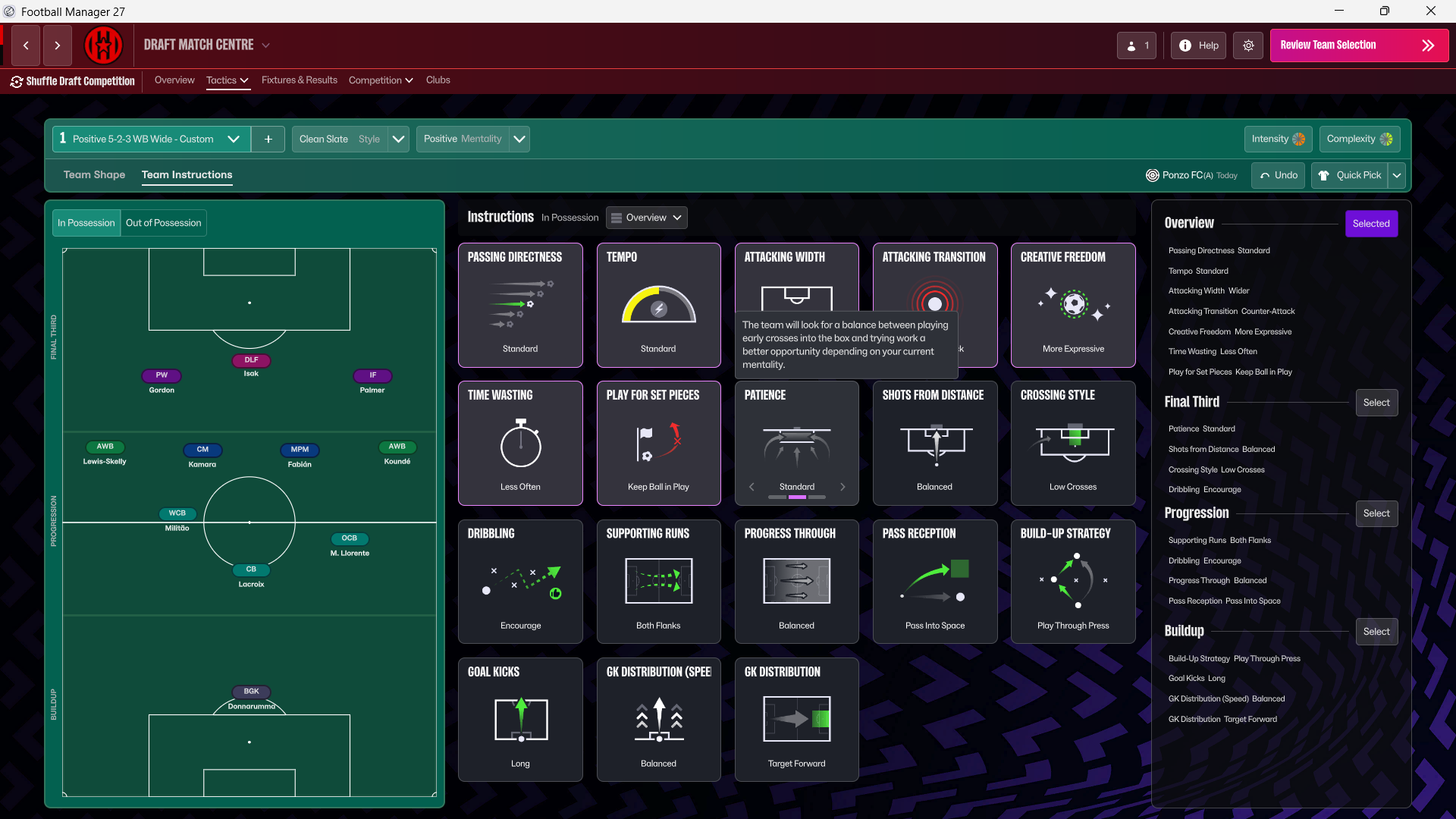
Positive 5-2-3 WB Wide - Custom
Positive
Clean Slate
1
3
Ball-Playing Goalkeeper
Goalkeeper
2
3
Centre-Back
Covering Centre-Back
2
2
Wide Center-Back
Covering Wide Centre-Back
2
4
Overlapping Center-Back
Stopping Wide Centre-Back
4
1
Advanced Wing-Back
Holding Wing-Back
4
5
Advanced Wing-Back
Holding Wing-Back
4
2
Central Midfielder
Pressing Central Midfielder
4
3
Midfield Playmaker
Screening Central Midfielder
5
1
Playmaking Winger
Tracking Wide Midfielder
5
5
Inside Forward
Tracking Wide Midfielder
6
3
Deep-Lying Forward
Central Outlet Centre Forward
Standard
Standard
Wider
Counter-Attack
More Expressive
Less Often
Keep Ball in Play
Standard
Balanced
Low Crosses
Encourage
Overlap Both Flanks
Encourage
Balanced
Pass Into Space
Play Through Press
Long
Balanced
Target Forward
Underlap Both Flanks
Mid Block
Higher
Step Up More
Standard
Standard
Standard
No
Balanced
Balanced
Balanced
Advanced wing-backs with a playmaking winger and an inside forward give width and a runner on each side, matching the wider width and overlap setting.
[4,1] Advanced Wing-Back and [4,5] Advanced Wing-Back with Playmaking Winger at [5,1] and Inside Forward at [5,5].
A three-man defence with a screening midfielder and holding wing-backs out of possession gives a five-man base to recover into.
Covering Centre-Back at [2,3], Screening Central Midfielder at [4,3], Holding Wing-Back at [4,1].
The team plays through the press with a ball-playing keeper and a playmaker, yet goal kicks are long and aimed at a deep-lying forward who is not an aerial target.
Ball-Playing Goalkeeper at [1,3] and Deep-Lying Forward at [6,3].
Counter-attack, encouraged dribbling and expressive freedom produce turnovers, while a higher line with step up more leaves a lone screen behind a stretched team.
Inside Forward at [5,5] and Screening Central Midfielder at [4,3].
Balls in behind
A higher line with step up more behind advanced wing-backs is exposed to through balls and counters.
Advanced Wing-Back at [4,1] and [4,5], Stopping Wide Centre-Back at [2,4].
high
Central midfield thin
Only two central midfielders cover the space left by advanced wing-backs and wide forwards.
Central Midfielder at [4,2] and Midfield Playmaker at [4,3].
medium
Deep-lying forward with inside forward and playmaking winger
The forward drops to link play and the wide players run beyond him, which suits pass into space.
Deep-Lying Forward [6,3], Inside Forward [5,5], Playmaking Winger [5,1].
Do your centre-backs have the pace to cover a higher line?
Do you have an aerial target for long goal kicks?
An attacking, wide 5-2-3 with good flank overloads and a sound five-man base, but undermined by mixed messages: short build-up roles with long kicks, and a counter-attack, expressive and dribble-heavy approach behind a higher line. Lower the line and align the goal kicks to make it coherent.
Wide play through advanced wing-backs and wingers, with a deep-lying forward linking and runs into space.
Standard transition from a mid block, with a higher line stepping up and tracking wide midfielders.
Wide overloads and quick counters balanced against a high line.
The tactical theory behind the Custom: roles, instructions, and the trade-offs that decide whether the system holds up.
Pass map, average position, xG, possession by zone: what each tablet panel tells you in FM and the tactical change it should trigger.
FM27 keeps FM26's tactic system. Here is what stays the same, the small changes that can catch you out, and what the new Tactical Effectiveness system asks of you.
How Mentality, Duty, and Role interact in FM, why duty trumps mentality every time, and the role-on-top-of-duty composition rules.