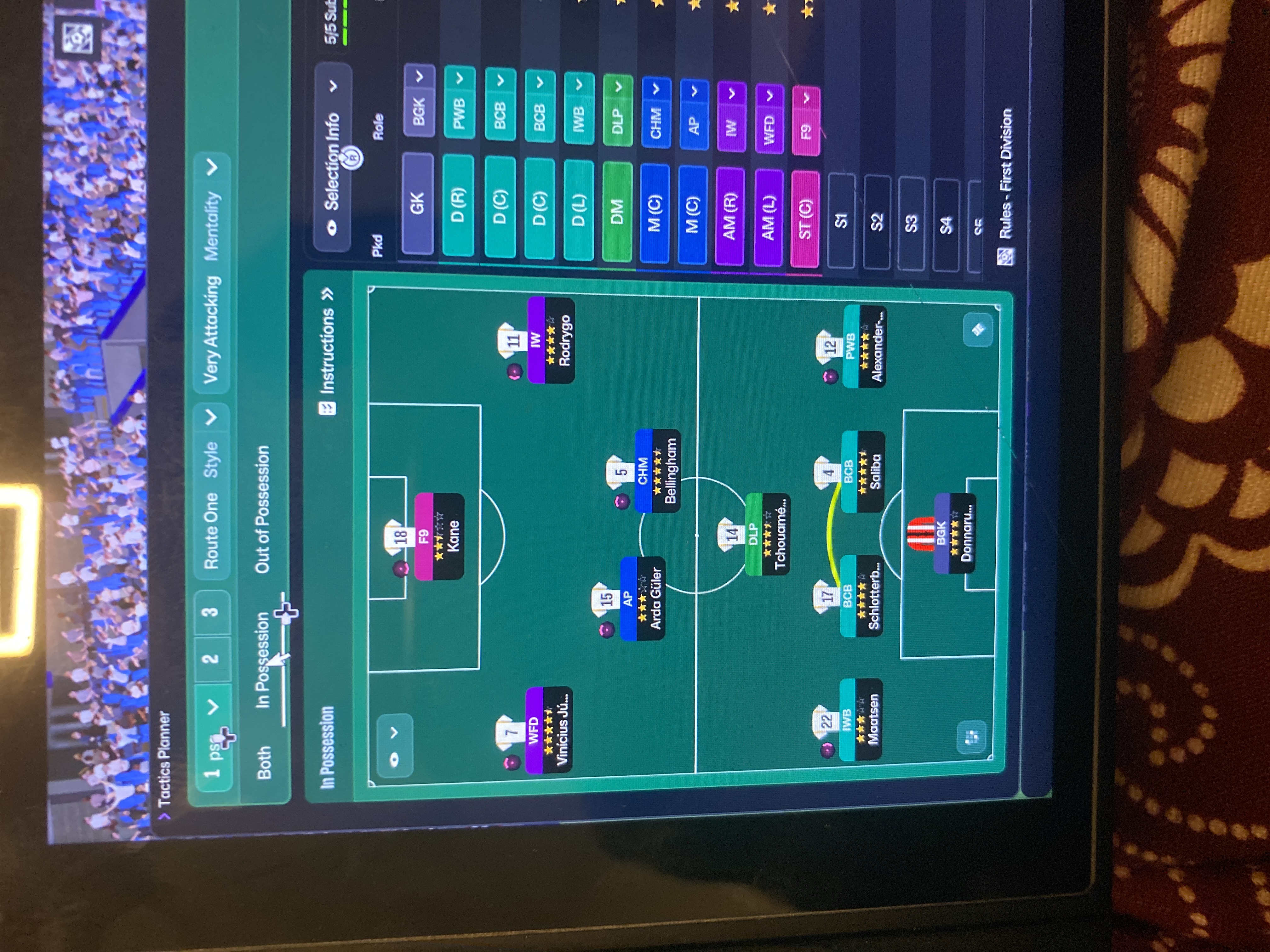
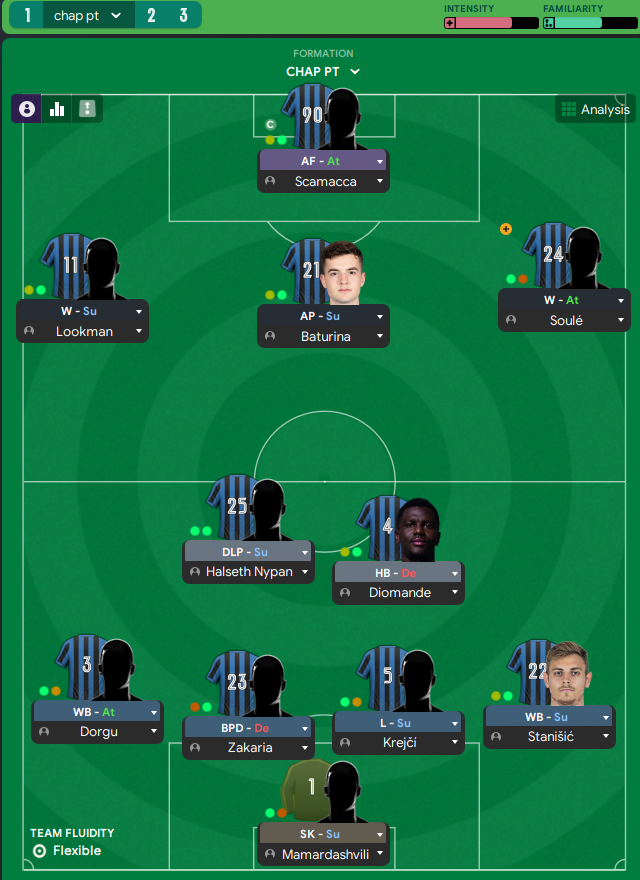
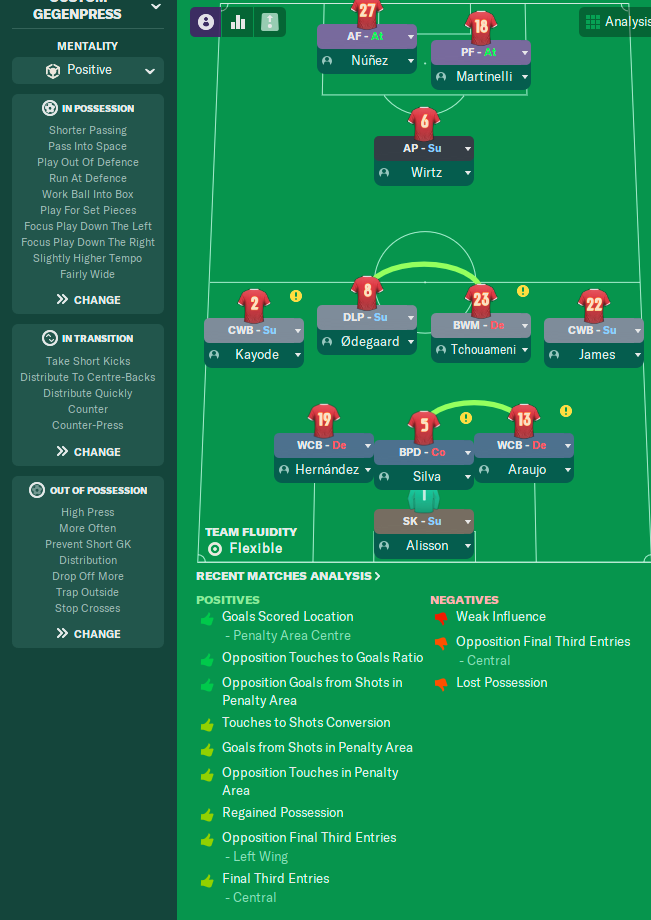
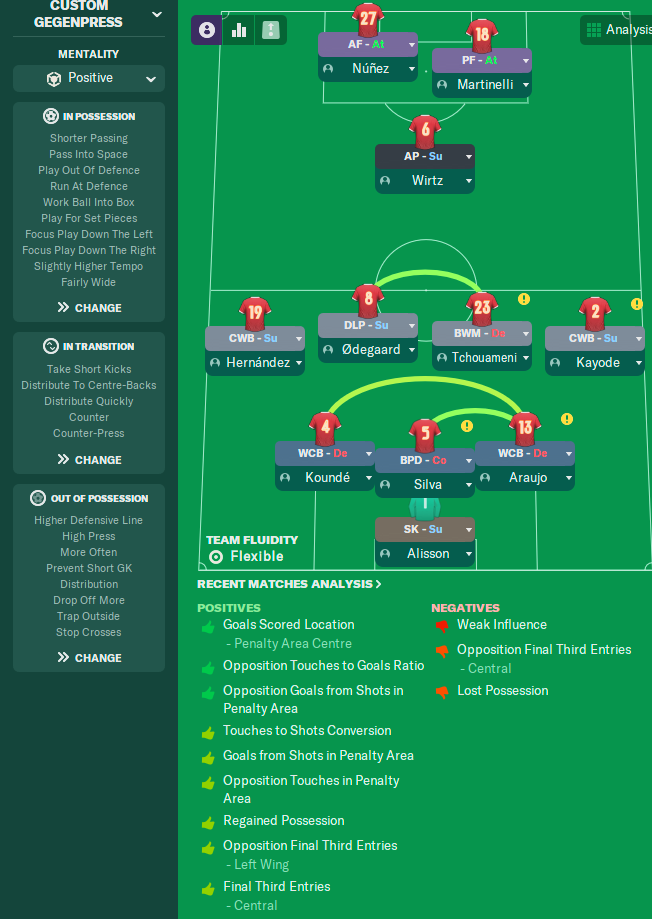
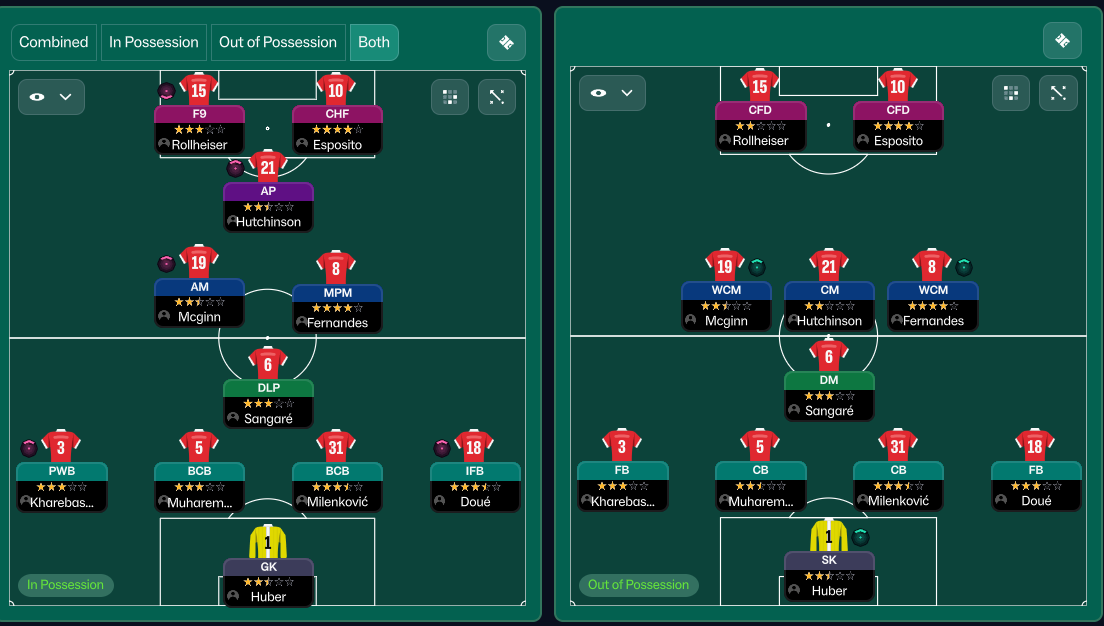
3-2-4-1
Utilizing width through wingers to stretch opponents and create passing lanes. With three central defenders and defensive midfield support, this setup is…
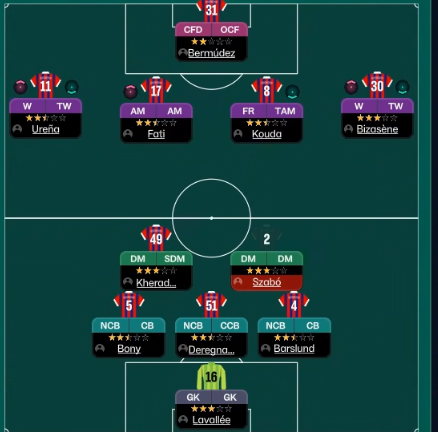
Loading tactical analysis...
3-2-4-1
Focus Play Down Both Flanks
Work Ball Into Box
Be More Expressive
Counter-Press
Counter
Higher Defensive Line
Much Higher Line of Engagement
Prevent Short GK Distribution
GK
Goalkeeper
Defend
CB
No-Nonsense Centre-Back
Defend
CB
No-Nonsense Centre-Back
Defend
CB
Centre-Back
Defend
DM
Defensive Midfielder
Support
DM
Defensive Midfielder
Defend
AM
Attacking Midfielder
Support
W
Winger
Attack
W
Wide Target Man
Attack
ST
Complete Forward
Attack
Quick ball movement combined with wide play facilitated by wingers, aiming to exploit spaces in opposition defenses.
Emphasis on regaining possession quickly through counter-press when losing the ball.
Utilizing width through wingers to stretch opponents and create passing lanes.
Compact
A compact shape that makes it hard for opponents to penetrate through the central areas.
No-Nonsense Centre-Back roles at [2,2] and [2,3] bolster the defense.
Direct
Direct approach focusing on quick transitions and wide play through wing options.
Winger at [6,1] and Wide Target Man at [6,5] indicate a strategy to make incisive runs behind defenses.
With three central defenders and defensive midfield support, this setup is hard to break down.
CB and NCB roles provide robust central defense at [2,2], [2,3], and [2,4].
Different attacking roles allow for adaptability in the final third.
Complete Forward at [6,3], Winger at [5,1] and Wide Target Man at [5,5] create varied attacking threats.
Too much reliance on wingers may lead to predictability in attack.
Instructions focused on feeding play to Winger and Wide Target Man.
If the two defensive midfielders are pulled wide, the central defense can be exposed.
DMs positioned at [3,2] and [3,3] may lack coverage centrally if wide.
Central Defense
Lack of width in defense may lead to vulnerability against teams exploiting the flanks.
Three central defenders might not cover flanks effectively against fast wingers.
Midfield Vulnerability
Two midfielders may struggle against a three-man opponent midfield setup.
Only two DMs at [3,2] and [3,3] can be overpowered by a numerical advantage.
Complete Forward and Attacking Midfielder
The Complete Forward can create space for the attacking midfielder to exploit gaps.
Their positioning, with AM at [5,3] and CF at [6,3], allows effective interplay.
Winger and Wide Target Man
The Winger can deliver crosses for the Wide Target Man to take advantage of aerial threats.
Play down the flanks can maximize creating scoring chances for the WTM.
How can we adapt our tactics to different opponents?
What roles can be adjusted for better synergy in attack?
How to improve central ball retention during matches?
The tactical theory behind the 3-2-4-1: roles, instructions, and the trade-offs that decide whether the system holds up.
Why circulation density and zonal occupation aren't the same thing in FM, and the half-space occupation rule that decides build-up.
Mentality, duty, role, instruction, sub. The change hierarchy from lightest to heaviest intervention, and 60th-minute patterns by game state.
Pass map, average position, xG, possession by zone: what each tablet panel tells you in FM and the tactical change it should trigger.