Uploaded Tactic
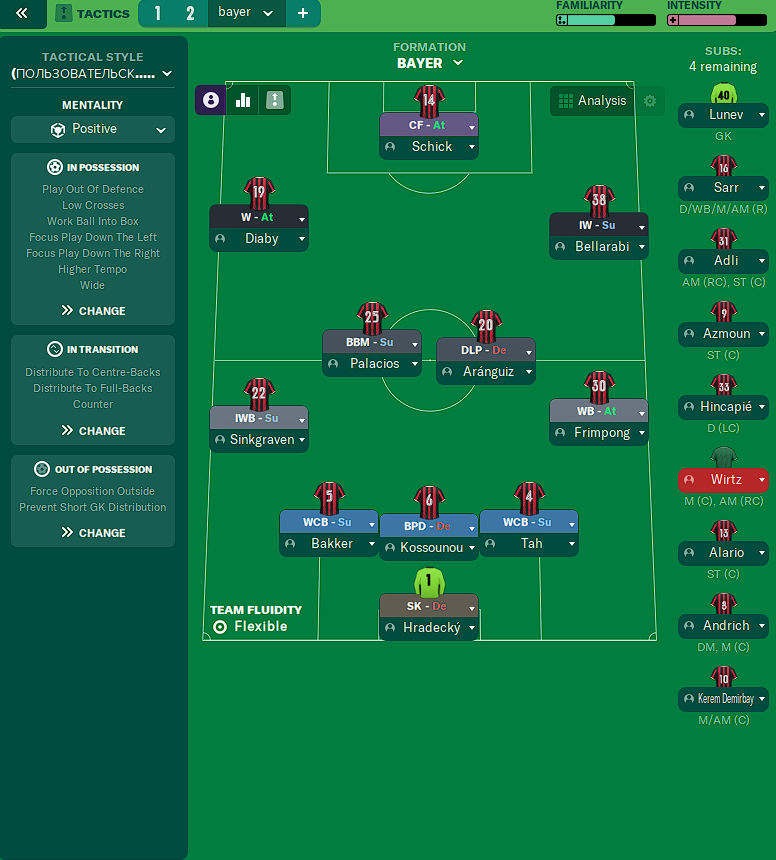
Formation & Style
Tactical Style:Flexible
Mentality:Positive
Formation:3-2-4-1
Team Fluidity:Flexible
In Possession
Play Out Of Defence
Low Crosses
Work Ball Into Box
Focus Play Down The Left
Focus Play Down The Right
Higher Tempo
Wider
In Transition
Distribute To Centre-Backs
Distribute To Full-Backs
Counter
Out of Possession
Force Opposition Outside
Prevent Short GK Distribution
Team Shape Without Ball
Shape:3-2-4-1
Description:Compact defensive structure with emphasis on width and forcing opposition into wide areas.
Evidence:WCB-S at [2,1] and [2,5] to provide defensive cover alongside a solid base of three centre-backs.
Team Shape With Ball
Shape:3-2-4-1
Description:Dynamic attacking shape with wing-backs pushing high to create width, while two AMs support Schick in the central role.
Evidence:WB-A at [5,1] and IWB-S at [5,2] provide overlap and width for wide plays.
Phase Description
Attacking Play
The team looks to utilize width and quick transitions, focusing on wide play to create space for the forward.
Defensive Transition
The structure remains balanced, quickly transitioning to defend against counter-attacks.
Main Focus
Utilizing wide players and wing-backs to stretch the opposition and create numerical superiority in attack.
Key Strengths
Dynamic Wide Play
Utilizing wide players and wing-backs to stretch the pitch effectively, creating space for central players.
Counter-Pressing Capability
Players are positioned to quickly transition from defence to attack and regain possession.
Combination Play in Midfield
Effective interplay between midfielders can overwhelm opposition midfields.
Conflicting Directions
Possession vs. Counter
High tempo and work ball into the box may conflict with quick countering style.
Width vs. Central Defense
While width is emphasized in attack, it could leave central areas vulnerable.
Wing-Backs Exhaustion Risk
High usage of wing-backs leads to fatigue, affecting overall team performance.
Tactical Suggestions
Balance Tempo
Consider lowering tempo to maintain composure and improve decision-making in the final third.
Increase Midfield Depth
Introduce a fourth midfielder to control central areas better and support wing-backs.
Adjust Width
Narrowing width could help mitigate defensive vulnerabilities centrally.
Ask Questions About Your Lineup
Related Tactics
More Flexible tactics
Guides for this formation
The tactical theory behind the 3-2-4-1: roles, instructions, and the trade-offs that decide whether the system holds up.