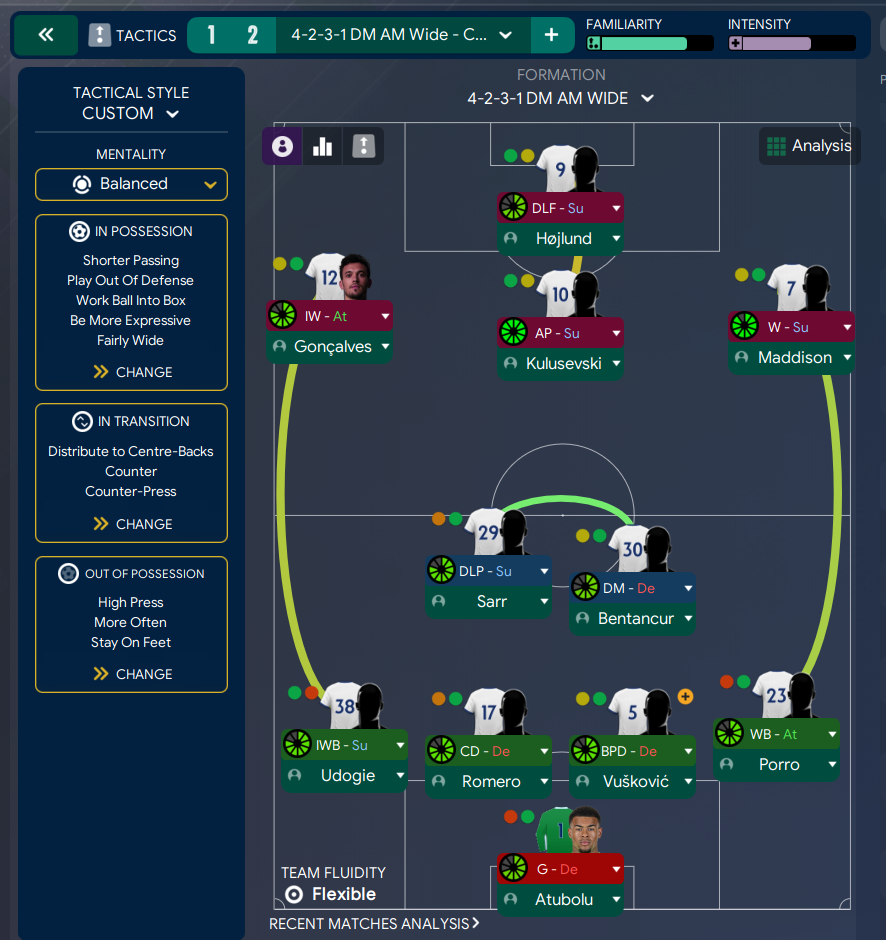
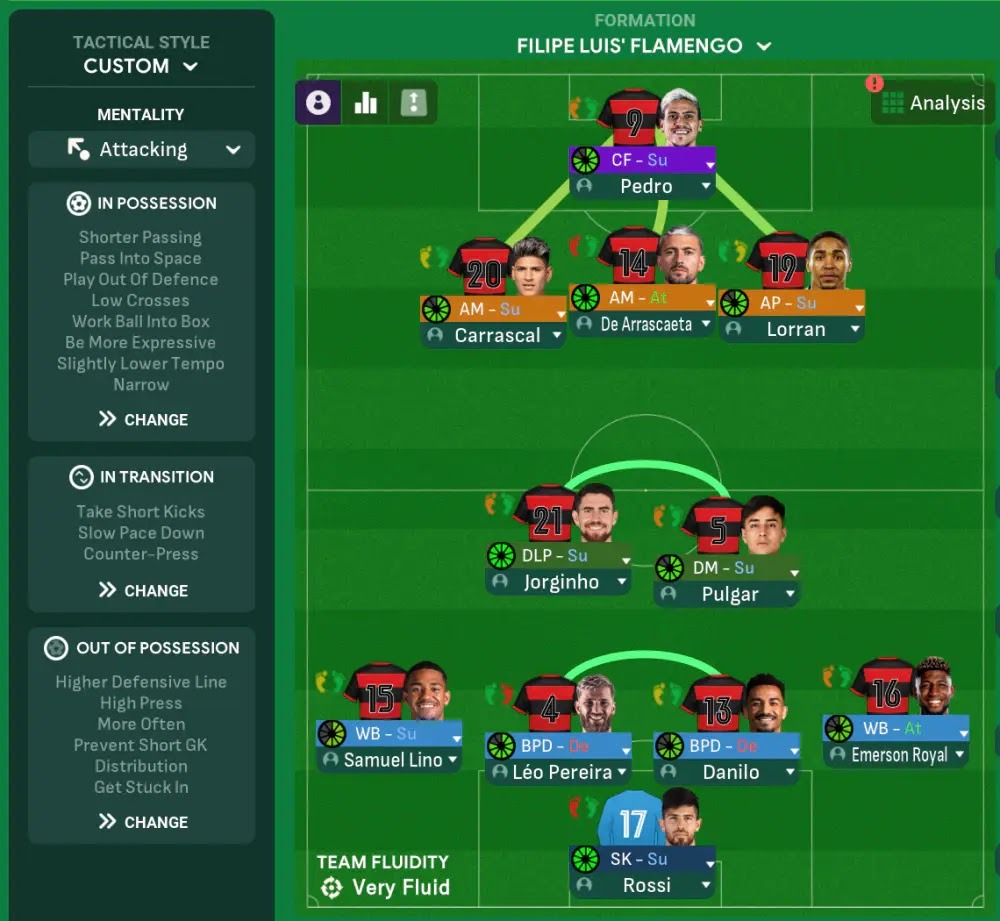
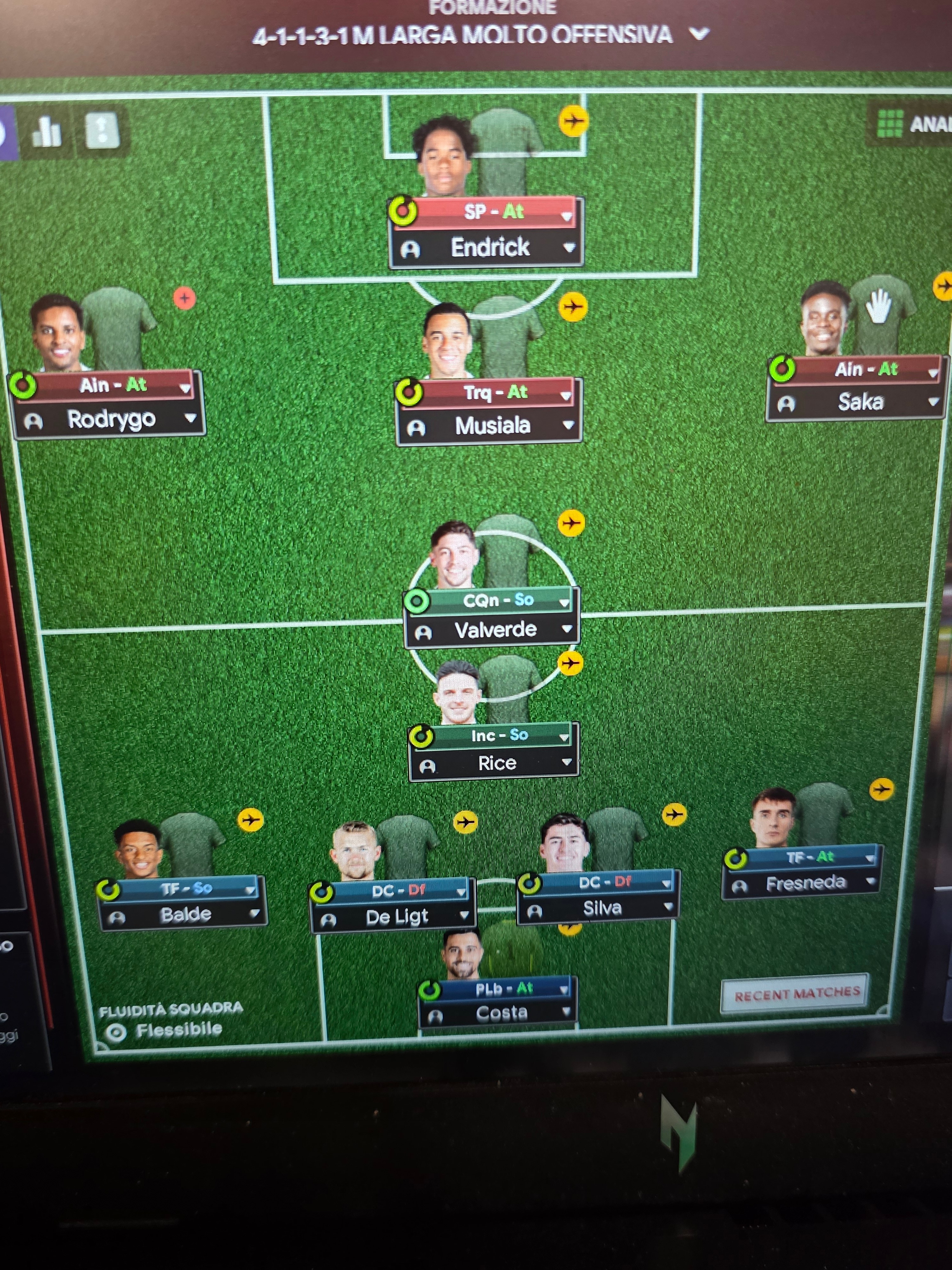
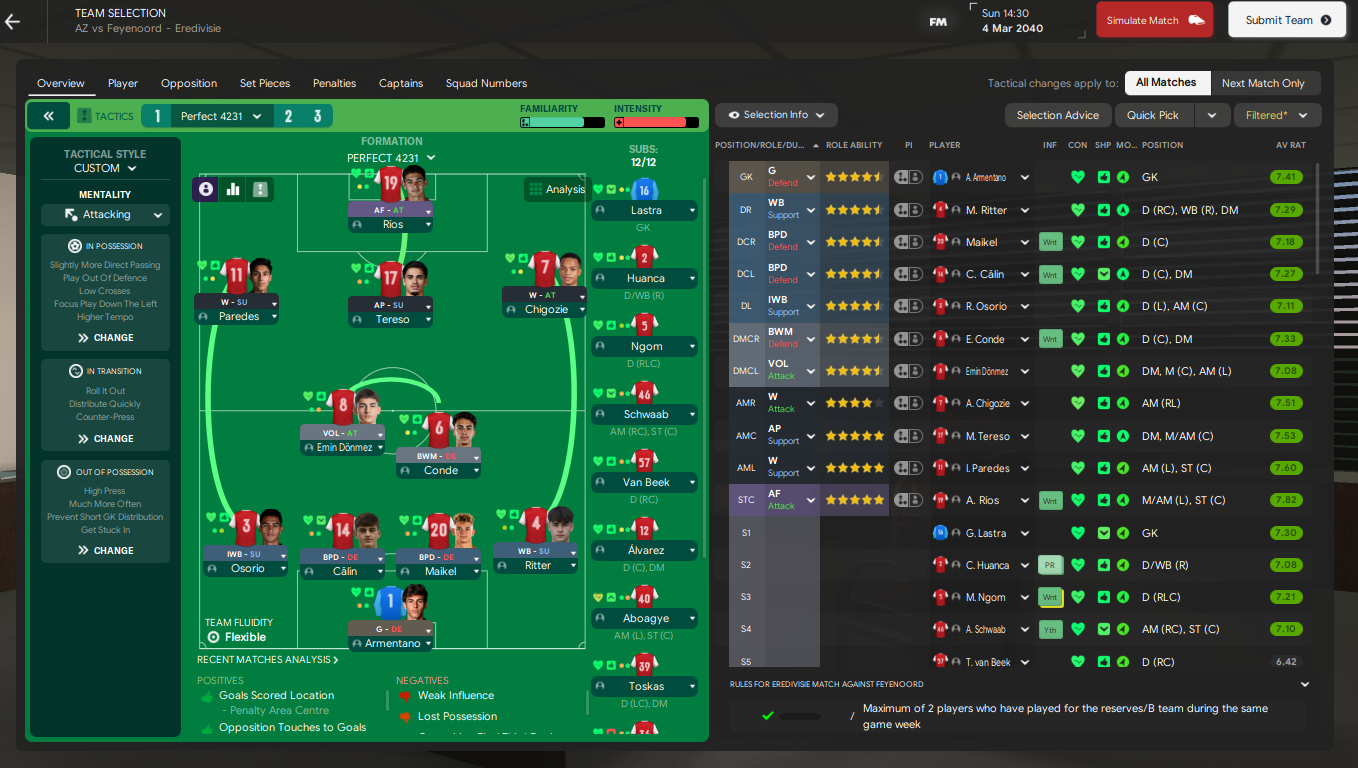
4-2-3-1
Controlled possession and fluid attacking movements. The combination of wingers and an advanced playmaker allows for dynamic attacking movements.
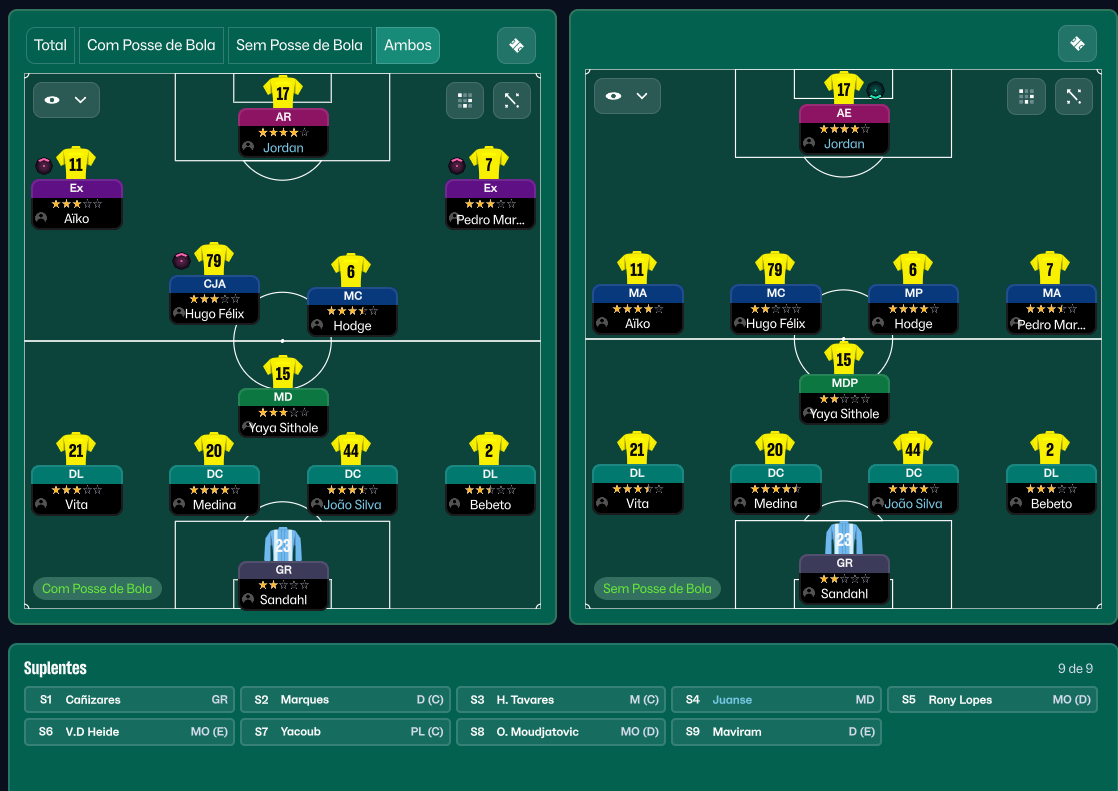
Loading tactical analysis...
4-2-3-1
Focus on short passing
Utilize width via wingers
Encourage overlapping runs from full-backs
Distribute quickly after winning possession
Counter-press immediately after losing the ball
Employ a high defensive line
Press aggressively to win back possession
GK
Goalkeeper
Defend
DC
Ball-Playing Defender
Defend
DC
Ball-Playing Defender
Defend
DL
Full-Back
Support
DR
Full-Back
Support
DM
Deep-Lying Playmaker
Support
MC
Central Midfielder
Support
AMC
Advanced Playmaker
Attack
MR
Winger
Attack
ML
Winger
Attack
ST
Advanced Forward
Attack
Focus on quick transitions and exploiting space down the flanks with overlapping full-backs and wingers.
Quick counter-press to regain possession and disrupt opposition attacks.
Controlled possession and fluid attacking movements.
Flat Block
Team maintains a compact shape defensively to limit space for opposition.
Evidence lies in the positioning of the defensive players and their balanced attributes.
Spread Out
Attacking players positioned to create width and varied options.
Utilization of wingers and an advanced playmaker to exploit spaces.
The combination of wingers and an advanced playmaker allows for dynamic attacking movements.
Winger-attack roles at [6,1] (ML) and [6,5] (MR) in tandem with AM-A at [6,3].
Double pivot provides stability in midfield while the back line remains solid.
DM role as DLP-S at [3,3] supports the defensive line effectively.
The focus on short passing may lead to prolonged buildup, risking losing cutting edge in attack.
Short passing and build-up emphasized with potential for slower transitions.
Full-backs may be exploited if they push too far forward without adequate cover.
FB-Support roles at [2,1] and [2,5], requiring awareness of defensive balance.
Defensive Transition
Team may be exposed during transitions if possession is poorly managed.
Inconsistent pressing tactics may let opponents exploit counter-attacks.
Stamina in Attack
Heavy reliance on wingers can tire them out quickly, impacting late-game performance.
Winger roles may require high stamina for both wing play and tracking back.
Winger and Advanced Playmaker
The interplay between wingers and the advanced playmaker creates overloads on the flanks.
Roles at [6,1] (Winger) and [6,3] (AP) facilitate quick combinations.
Ball-Playing Defenders and Deep-Lying Playmaker
Ball-playing defenders can initiate play from the back while the DLP connects midfield and attack.
BPD roles at [2,2] and [2,4] complement DLP's role at [3,3].
How can we improve transition play after winning possession?
Are there tactical adjustments needed to combat a three-man midfield?
What measures can ensure full-backs are balanced between attack and defense?
The tactical theory behind the 4-2-3-1: roles, instructions, and the trade-offs that decide whether the system holds up.
Klopp-style gegenpressing in FM, including squad profile, line-and-press pairing, sustainable workload, and the antipatterns to avoid.
Double pivots and flat pairs in 4-2-3-1 and 4-4-2: when each pairing works, when it collapses, and the AMC unicorn that rescues both.
Counter-Press, Regroup, Stand Off, Trigger Press: what each pressing instruction does in FM and how to pair them without contradicting.