Uploaded Tactic
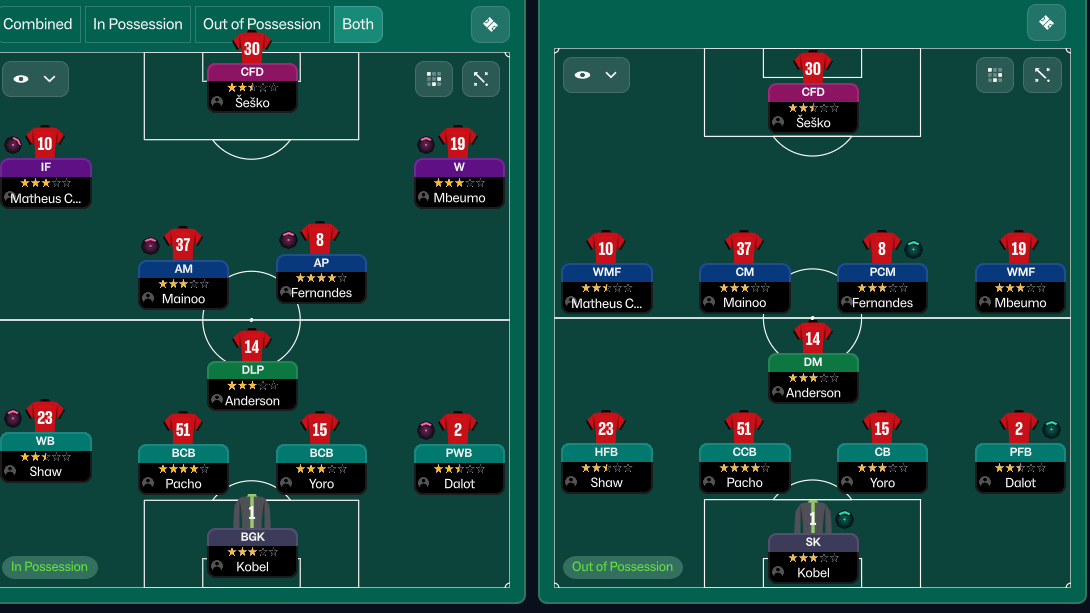
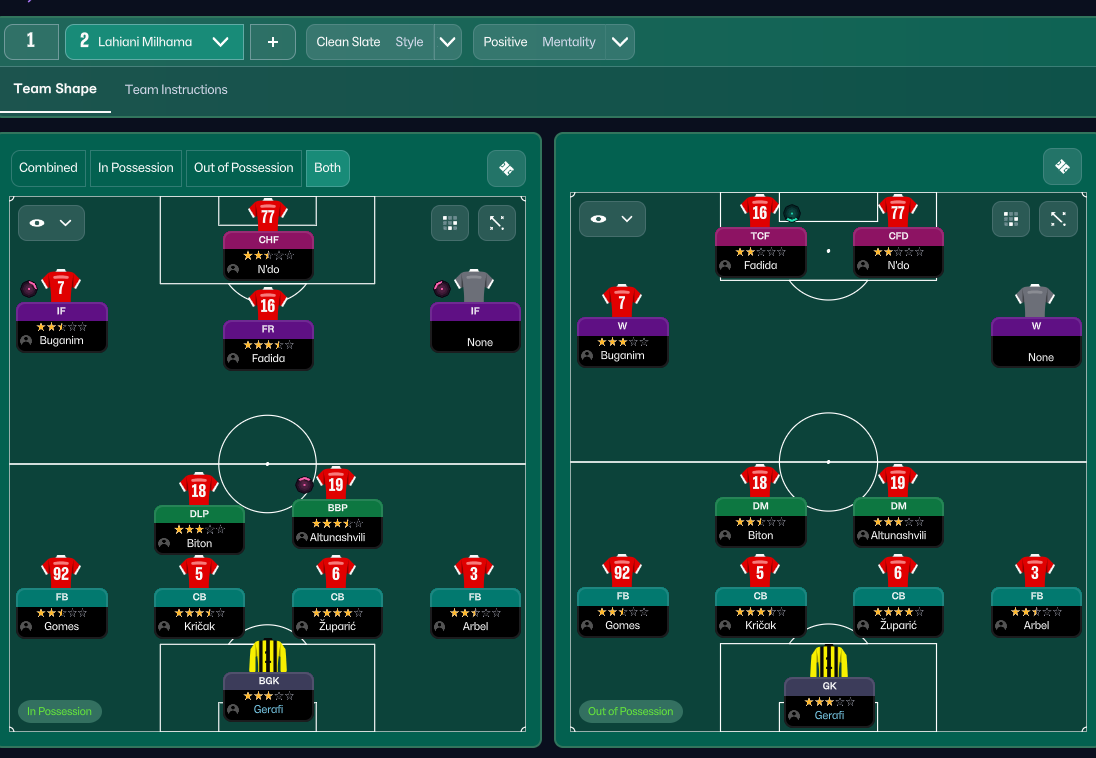
Formation & Style
Tactical Style:Balanced
Mentality:Positive
Formation:4-2-3-1
Team Fluidity:Structured
In Possession
Play Out of Defence
Shorter Passing
Look for Overlap
In Transition
Counter-Press
Counter
Out of Possession
Higher Line of Engagement
Higher Defensive Line
Prevent Short GK Distribution
Team Shape Without Ball
Shape:4-2
Description:A compact formation with two banks of four players providing defensive solidity.
Evidence:Two centre-backs (CB at [2,2],[2,3]) and a deep-lying midfielder (DM at [3,3]) support the defensive line.
Team Shape With Ball
Shape:4-3-3
Description:Dynamic attacking setup with wide players creating space and central players supporting the attack.
Evidence:Presence of an attack-minded CF (CF at [6,3]) flanked by an IF and W, with central support from an AM and AP.
Phase Description
Attacking Play
The team looks to maintain possession and build attacks through short passing and overlapping runs.
Defensive Transition
The team quickly regains shape and applies pressure in the opposition half, seeking to win back possession.
Main Focus
A balanced approach with emphasis on both defensive organization and attacking fluidity.
Key Strengths
Attacking Width
Utilizing wide players (IF and W) stretches the opposition, creating space for central runners.
Midfield Control
The combination of DLP, CM, and AM in midfield facilitates transitions and ball control.
Versatile Forward Play
The CF role (Šeško) complements the attacking midfielders, leading to varied attacking strategies.
Conflicting Directions
High Line Vulnerability
A high defensive line can expose the team to counter-attacks if possession is lost.
Dependence on Wing Play
Relying heavily on wide players may be ineffective against teams with strong central defenses.
Midfield Dependency
The team relies on a cohesive midfield for maintaining possession and attacking flow.
Tactical Suggestions
Adjust Defensive Line
Consider lowering the defensive line to avoid gaps against fast counter-attacks.
Incorporate a Secondary Playmaker
Introducing another midfield playmaker could enhance creative options in tight situations.
Utilize the Central Spaces
Encourage central players to exploit spaces between opposition lines to create goal-scoring chances.
Ask Questions About Your Lineup
Related Tactics
Guides for this formation
The tactical theory behind the 4-2-3-1: roles, instructions, and the trade-offs that decide whether the system holds up.
Player pairings
Midfield Pairs in 4-2-3-1 and 4-4-2
Double pivots and flat pairs in 4-2-3-1 and 4-4-2: when each pairing works, when it collapses, and the AMC unicorn that rescues both.
Read guide
Playing styles
Gegenpressing: A Full Guide
Klopp-style gegenpressing in FM, including squad profile, line-and-press pairing, sustainable workload, and the antipatterns to avoid.
Read guide