Uploaded Tactic
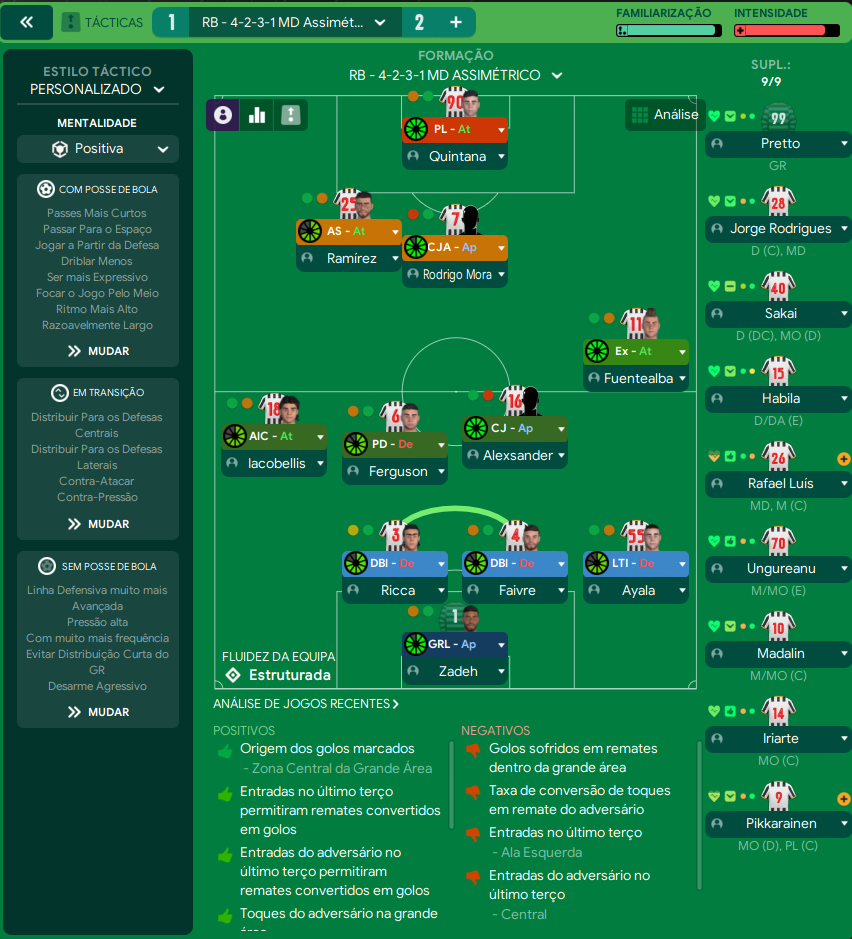
Formation & Style
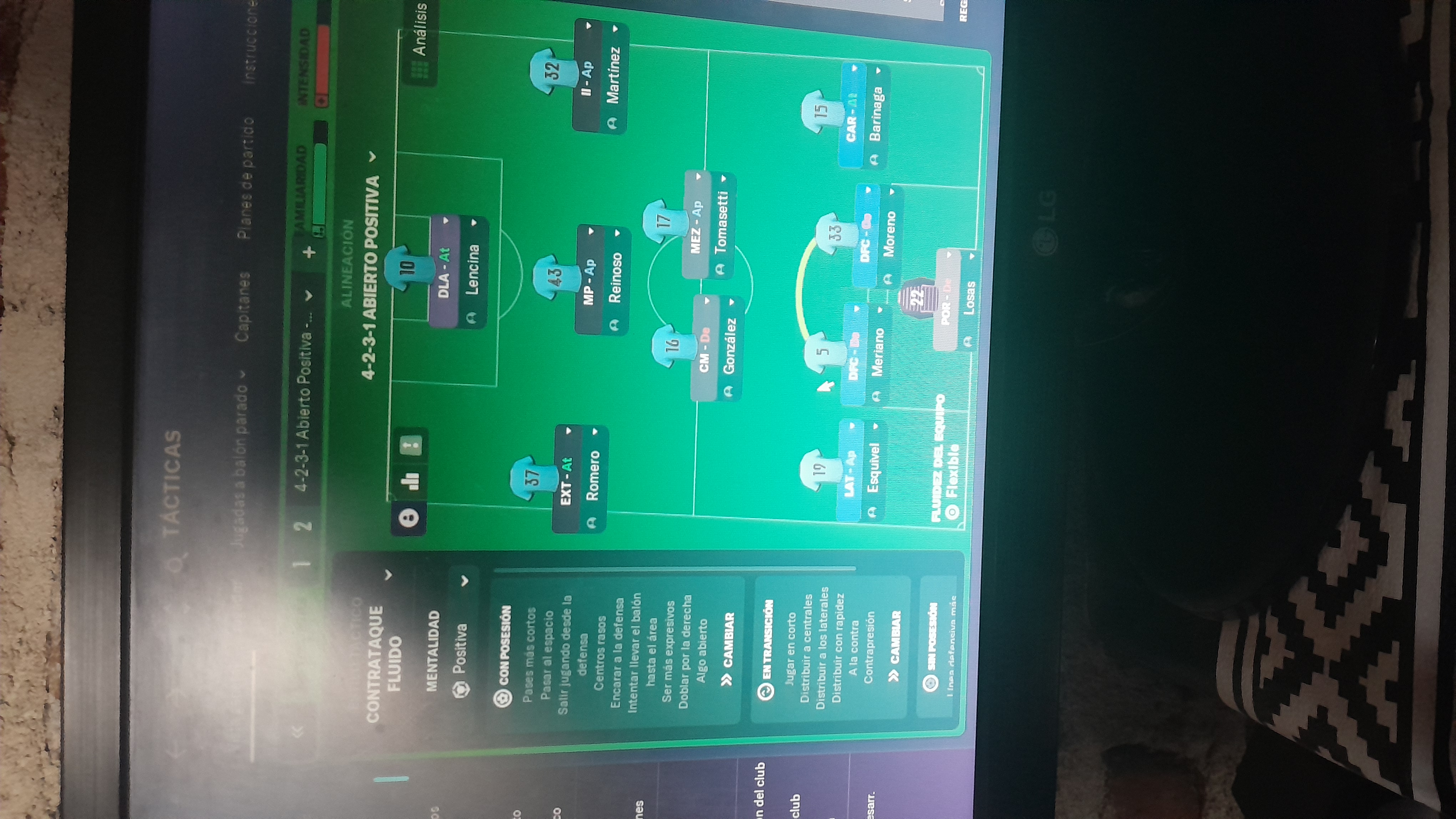
Tactical Style:Asymmetrical 4-2-3-1
Mentality:Positive
Formation:4-2-3-1
Team Fluidity:Structured
In Possession
Shorter Passing
Play Out of Defence
More Expressive
Focus Play Through Middle
Fairly Wide
In Transition
Distribute to Central Defenders
Distribute to Wide Defenders
Counter-Attack
Counter-Press
Out of Possession
Much Higher Defensive Line
Higher Defensive Line
More Often Pressing
Avoid Distribution to Goalkeeper
Team Shape Without Ball
Shape:4-2-3-1
Description:Compact four-man defensive line supporting a central midfield duo, retaining a solid structure against counter attacks.
Evidence:Defensive Midfielder (DM-D) at [3,1] providing support, alongside two Central Defenders (CB) at [2,2] and [2,4].
Team Shape With Ball
Shape:4-3-3 Asymmetrical
Description:Four attackers with dynamic movement and fluidity, where wing-backs push high to overload opponents.
Evidence:Advanced Playmaker (AP-A) at [6,1] and Inside Forward (IF-A) at [6,5] creating width with a Shadow Striker (SS) at [5,3] offering options.
Phase Description
Attacking Play
Utilizes width through wing-backs and attacking midfielders, with a strong focus on combinations in central areas.
Defensive Transition
Quickly regroup and press the opponent to regain possession, maintaining high pressure.
Main Focus
Create goal-scoring opportunities through coordinated attacks, emphasizing short passes and intelligent movement.
Key Strengths
Fluid Attack
The asymmetrical setup allows for creative and varied attacking patterns.
Strong Midfield Presence
Two central midfielders provide both defensive cover and attacking support.
High Pressing Ability
The setup incorporates high pressing and quick ball recovery strategies.
Conflicting Directions
Defensive Vulnerability
Higher defensive line may expose the team to counter-attacks.
Possible Overcommitment
Wing-backs pushing forward can leave gaps defensively.
Reliance on Key Players
The tactic heavily depends on the performance of the attacking midfielders.
Tactical Suggestions
Adjust Defensive Width
Consider narrowing the defensive width to avoid gaps for opposition attackers.
Retain Midfield Balance
Ensure the midfielders are not too aggressive, maintaining defensive stability.
Utilize Full-Backs Effectively
Encourage full-backs to time their runs and be more strategic in positioning.
Ask Questions About Your Lineup
Related Tactics
Guides for this formation
The tactical theory behind the 4-2-3-1: roles, instructions, and the trade-offs that decide whether the system holds up.
Player pairings
Midfield Pairs in 4-2-3-1 and 4-4-2
Double pivots and flat pairs in 4-2-3-1 and 4-4-2: when each pairing works, when it collapses, and the AMC unicorn that rescues both.
Read guide
Playing styles
Gegenpressing: A Full Guide
Klopp-style gegenpressing in FM, including squad profile, line-and-press pairing, sustainable workload, and the antipatterns to avoid.
Read guide