Uploaded Tactic
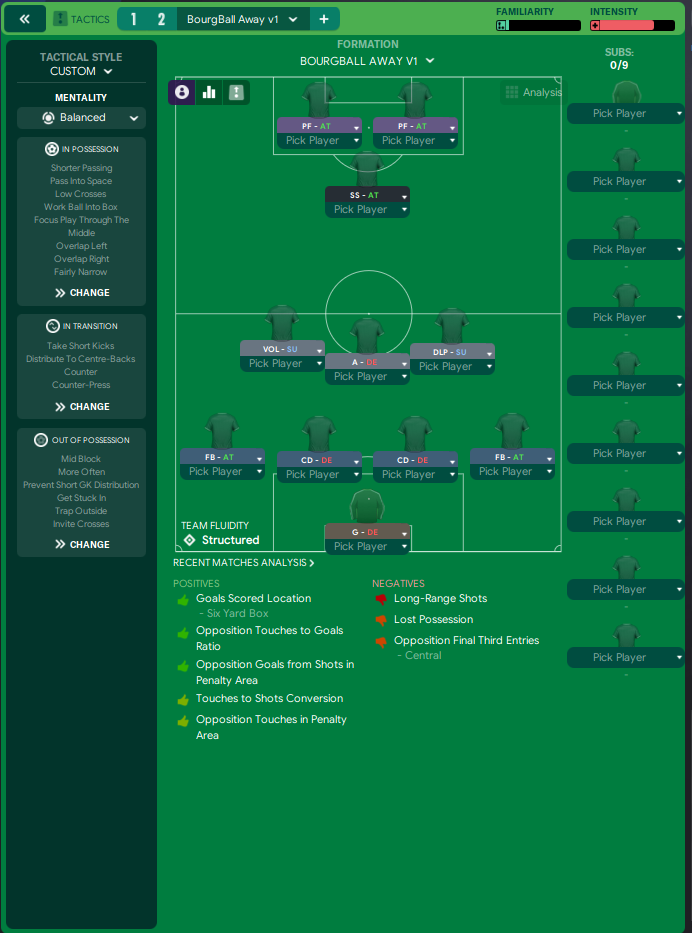
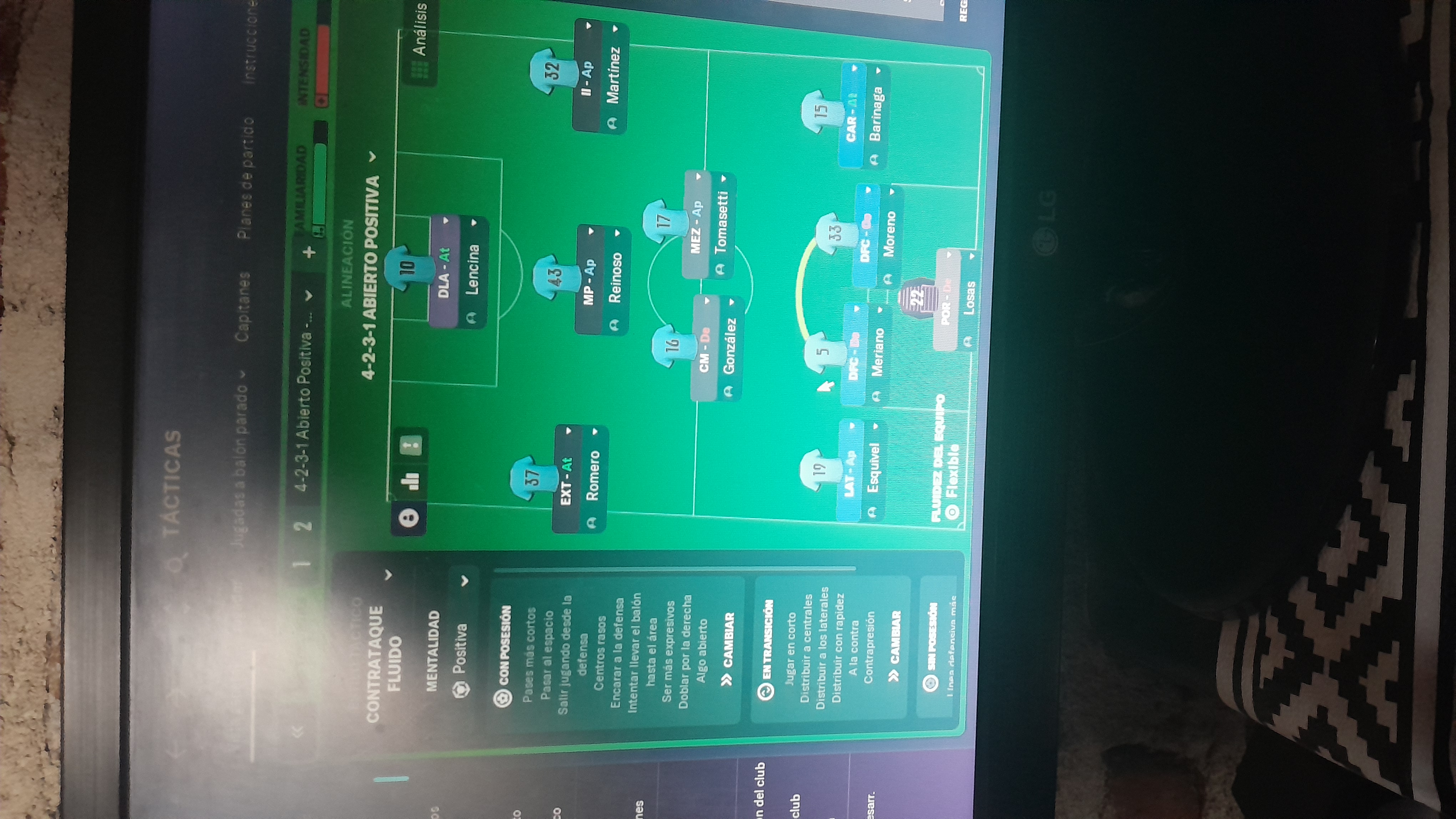
Formation & Style
Tactical Style:Custom
Mentality:Balanced
Formation:4-2-3-1
Team Fluidity:Structured
In Possession
Shorter Passing
Pass Into Space
Low Crosses
Work Ball Into Box
Focus Play Through The Middle
Overlap Left
Overlap Right
In Transition
Take Short Kicks
Distribute To Centre-Backs
Counter
Out of Possession
Mid Block
More Often Prevent Short GK Distribution
Get Stuck In
Trap Outside
Invite Crosses
Team Shape Without Ball
Shape:Mid Block
Description:The team maintains a compact shape, limiting spaces for the opponent while pressing higher up the pitch.
Evidence:Mid Block with 'Get Stuck In' suggests increased physicality within defensive action.
Team Shape With Ball
Shape:Structured Attack with Width
Description:Emphasis on overlapping full-backs and inside forwards, creating dynamism in offensive phases.
Evidence:Use of 'Overlap Left' and 'Overlap Right' highlights the need for width in the attacking approach.
Phase Description
Attacking Play
Focused on structured build-up through midfield, utilizing short passing and space exploitation. The team looks to create scoring opportunities close to the penalty area.
Defensive Transition
Attempts to recover possession quickly, utilizing high pressing and counter-pressing to limit opposition options.
Main Focus
Maximizing goal-scoring chances by utilizing width and attacking overloads.
Key Strengths
Effective Goal Scoring
Scored goals are primarily from close range, capitalizing on penalty area opportunities and reducing distance to goal.
High Touch Efficiency
Maintaining possession close to the opposition goal increases scoring chances.
Quality Set-Up for Shots
Potential for high conversion rate given the positioning within the penalty area.
Conflicting Directions
Long-Range Shot Vulnerability
Team may concede more goals from distance with current defensive shape, which lacks pressure on the ball.
Loss of Possession
High-risk passing options could lead to turnovers that compromise defensive stability.
Central Entry Vulnerability
Lack of defensive cover in central areas may allow friction in transition against teams with midfield strength.
Tactical Suggestions
Adjust Defensive Cover
Consider employing a Defensive Midfielder in place of one of the CM to increase defensive stability.
Focus on Counter-Pressing
Increase pressing intensity to regain possession higher up the pitch.
Exploit Width More Aggressively
Encourage more frequent overlapping runs to stretch opposing defences.
Ask Questions About Your Lineup
Related Tactics
Guides for this formation
The tactical theory behind the 4-2-3-1: roles, instructions, and the trade-offs that decide whether the system holds up.
Player pairings
Midfield Pairs in 4-2-3-1 and 4-4-2
Double pivots and flat pairs in 4-2-3-1 and 4-4-2: when each pairing works, when it collapses, and the AMC unicorn that rescues both.
Read guide
Playing styles
Gegenpressing: A Full Guide
Klopp-style gegenpressing in FM, including squad profile, line-and-press pairing, sustainable workload, and the antipatterns to avoid.
Read guide