Uploaded Tactic
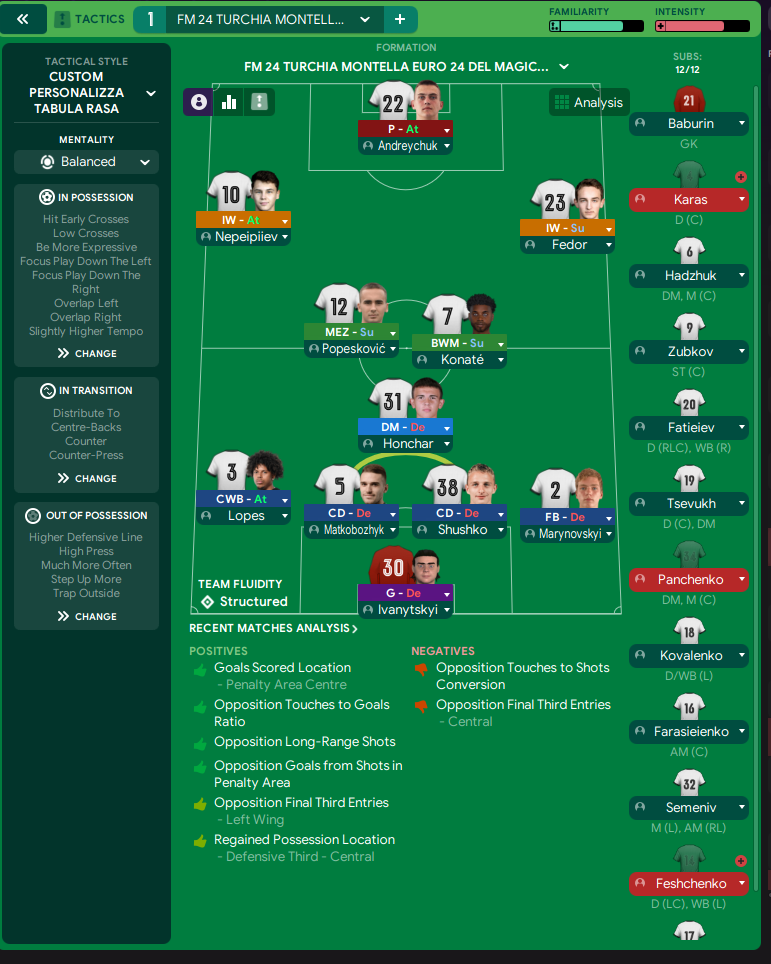
Formation & Style
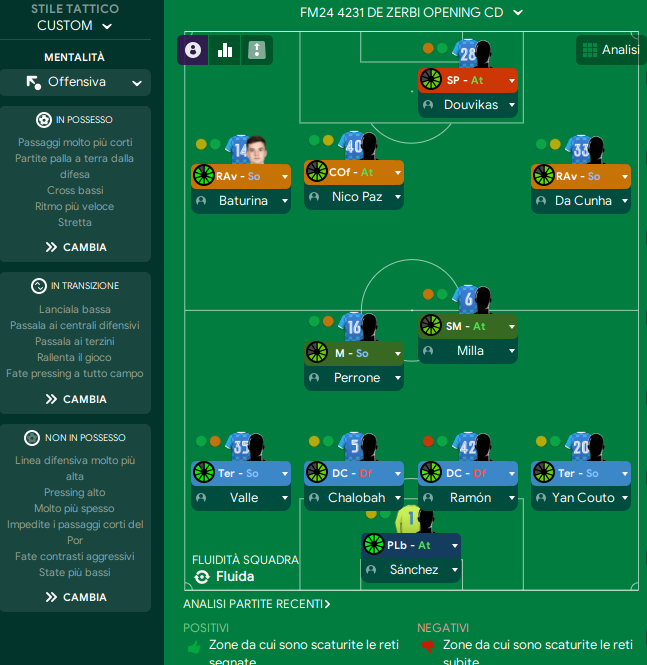
Tactical Style:Custom
Mentality:Balanced
Formation:4-2-3-1
Team Fluidity:Structured
In Possession
Hit Early Crosses
Low Crosses
Be More Expansive
Focus Play Down The Left
Overlap Left
Slightly Higher Tempo
In Transition
Distribute To Centre-Backs
Counter
Counter-Press
Out of Possession
Higher Defensive Line
High Press
Much More Often Prevent Short GK Distribution
Trap Outside
Team Shape Without Ball
Shape:Compact Central Block
Description:The team's higher defensive line ensures pressure is applied further up the pitch, limiting opposition space.
Evidence:Higher Defensive Line + CD, CD at [2,2] to [2,4]
Team Shape With Ball
Shape:4-2-3-1
Description:With two wide players supported by a trequartista, the team aims to create overloads on the flanks.
Evidence:IF-A at [5,2] and IW-S at [5,3] creating width and options for the ST
Phase Description
Attacking Play
The focus on early and low crosses, particularly from the left wing, aims to exploit wide spaces and deliver cut-back opportunities.
Defensive Transition
The team looks to counter-press quickly, helping to regain possession high up the pitch.
Main Focus
Emphasis on using width to stretch the opposition and create space for central players.
Key Strengths
Attack via Flanks
Utilizing inside forwards allows for quick attacks and exploiting the opposition's wide areas.
Solid Central Defense
The three central defenders create a strong core, which is crucial for maintaining defensive integrity.
High Pressing and Regain
A high work rate in pressing situations allows the team to recover the ball quickly.
Conflicting Directions
Defensive Fragility
Higher defensive line may expose the back line to counter-attacks, especially if the team loses possession in advanced areas.
Overreliance on Left Side
Heavy focus on left-side play may lead to predictability and allow opponents to block passing lanes.
Midfield Outnumbering
Against teams with three or more midfielders, the double pivot may struggle to impose themselves.
Tactical Suggestions
Adjust Mentality
Consider a more attacking mentality to enhance goal-scoring opportunities against weaker teams.
Explore Right-side Play
Encourage right-sided player movement to reduce predictability from the left.
Foster Defensive Rigor
Consider deeper defensive lines to reduce vulnerability from counter-attacks.
Ask Questions About Your Lineup
Related Tactics
Guides for this formation
The tactical theory behind the 4-2-3-1: roles, instructions, and the trade-offs that decide whether the system holds up.
Player pairings
Midfield Pairs in 4-2-3-1 and 4-4-2
Double pivots and flat pairs in 4-2-3-1 and 4-4-2: when each pairing works, when it collapses, and the AMC unicorn that rescues both.
Read guide
Playing styles
Gegenpressing: A Full Guide
Klopp-style gegenpressing in FM, including squad profile, line-and-press pairing, sustainable workload, and the antipatterns to avoid.
Read guide