Uploaded Tactic
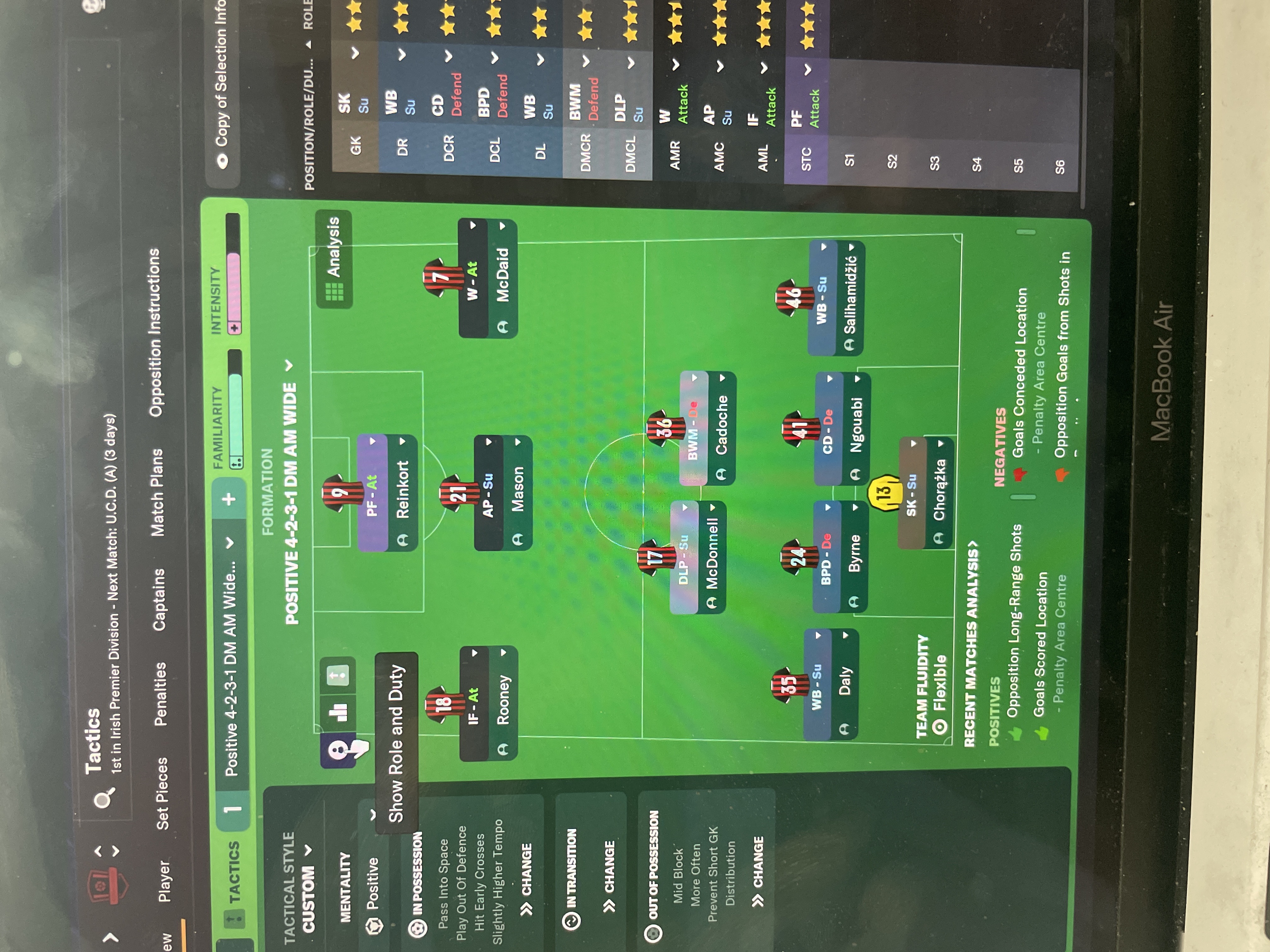
Formation & Style
Tactical Style:Positive
Mentality:Positive
Formation:4-2-3-1 Wide
Team Fluidity:Flexible
In Possession
Pass Into Space
Play Out Of Defence
Hit Early Crosses
Slightly Higher Tempo
In Transition
Mid Block
Prevent Short GK Distribution
Out of Possession
Mid Block
Team Shape Without Ball
Shape:4-2-3-1
Description:Defensive structure is compact, allowing for quick recovery on counter-attacks.
Evidence:BPD-De and No-Nonsense CBs at [2,2], [2,3], and [2,4] assist in maintaining solidity.
Team Shape With Ball
Shape:4-2-3-1
Description:Utilizes width from wing-backs and inside forwards to stretch defenses.
Evidence:AM-R (IF-A) at [5,2] and AM-L (W-A) at [5,4] create space for advanced playmaker (AP-S) at [5,3].
Phase Description
Attacking Play
Utilizes width effectively with inside forwards and a playmaker facilitating the attack.
Defensive Transition
Transitional play aims for immediate pressure on the ball, using a mid-block to force opponents wide.
Main Focus
To create goal-scoring opportunities through swift transitions and overlapping wing-play.
Key Strengths
Effective Wing Play
Utilizing WBs and IFs allows swift transitions and space exploitation.
Solid Defensive Core
Having BPD and NCB enhances defensive capability.
Dynamic Midfield Roles
Versatile midfielders adapt between defending and supporting transitions.
Conflicting Directions
Risk of Overreliance on Width
The attack may become predictable if overly reliant on WBs and IFs.
Vulnerability on Counter-Attacks
High attacking emphasis may leave gaps in defense.
Pressing Strategy Needs Refinement
Pressing may not be uniform, leading to gaps when the ball is lost.
Tactical Suggestions
Incorporate a CM Role
Adding a Box-to-Box Midfielder can enhance midfield dynamism.
Adjust Width in Attack
Introduce options to cut inside to counter defensive adjustments from opponents.
Introduce More Defensive Stability
Consider using a Half Back to provide support during transitions.
Ask Questions About Your Lineup
Related Tactics
More Positive tactics
Guides for this formation
The tactical theory behind the 4-2-3-1 Wide: roles, instructions, and the trade-offs that decide whether the system holds up.
Player pairings
Midfield Pairs in 4-2-3-1 and 4-4-2
Double pivots and flat pairs in 4-2-3-1 and 4-4-2: when each pairing works, when it collapses, and the AMC unicorn that rescues both.
Read guide
Playing styles
Gegenpressing: A Full Guide
Klopp-style gegenpressing in FM, including squad profile, line-and-press pairing, sustainable workload, and the antipatterns to avoid.
Read guide