Uploaded Tactic
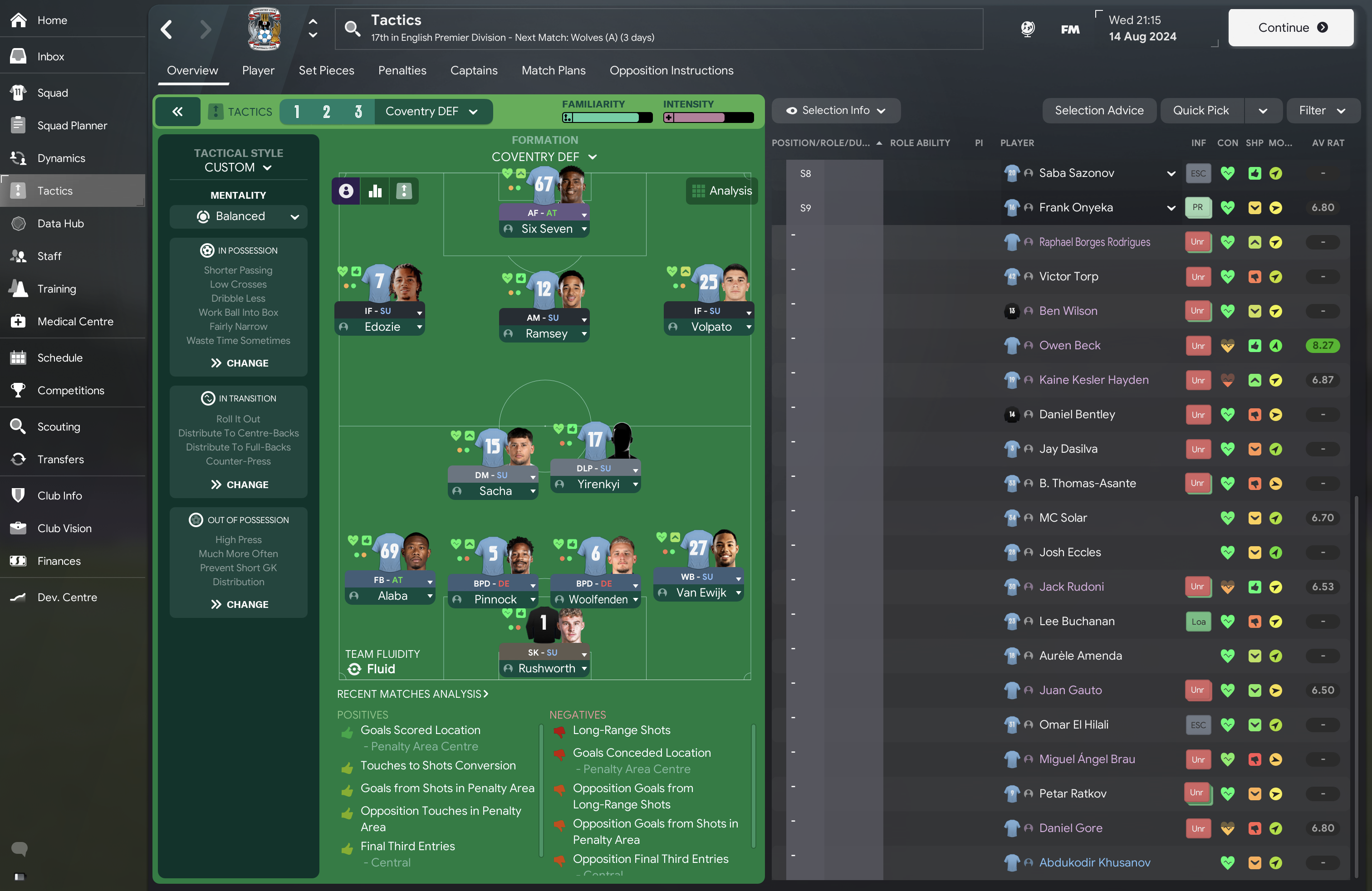
Formation & Style
Tactical Style:Custom
Mentality:Balanced
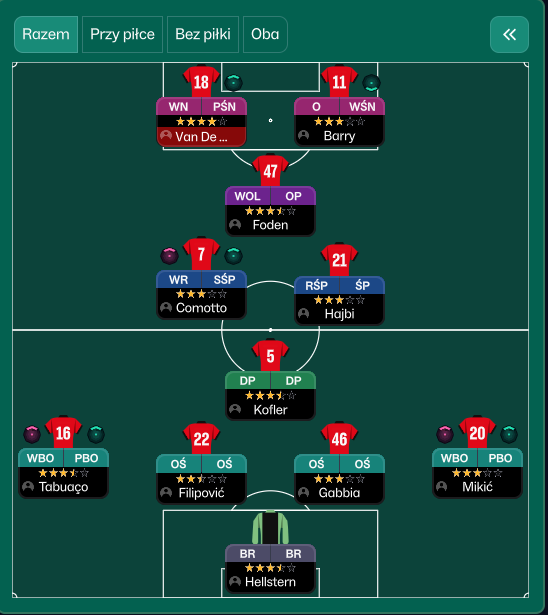
Formation:4-2-3-1 Wide
Team Fluidity:Fluid
In Possession
Shorter Passing
Low Crosses
Dribble Less
Work Ball Into Box
Fairly Narrow
Waste Time Sometimes
In Transition
Roll It Out
Distribute To Centre-Backs
Distribute To Full-Backs
Counter-Press
Out of Possession
High Press
Much More Often
Prevent Short GK Distribution
Team Shape Without Ball
Shape:4-2
Description:A compact two-tier defensive structure, focusing on closing down spaces.
Evidence:BPD at [2,2] and [2,4] with DM-S at [3,1], [3,2] aiding recovery.
Team Shape With Ball
Shape:4-3
Description:Three attacking midfielders providing width and creativity with support from the striker.
Evidence:AM-S at [5,3], IF-S at [5,2] and [5,4] with AF-A at [6,3].
Phase Description
Attacking Play
Focus on building from the back with shorter passing, utilizing width from wing-backs and inside forwards.
Defensive Transition
Quick counter-press to regain possession high up the pitch.
Main Focus
Build-up play through controlled possession and creating goal-scoring opportunities in the final third.
Key Strengths
Ball-Playing Defenders
Defensive players capable of initiating play from the back, aiding ball retention in midfield.
Flexibility in Attack
Players capable of switching positions and creating overloads in wide areas.
Effective Counter-Press
Ability to quickly regain possession after losing the ball, disrupting opposition transitions.
Conflicting Directions
Narrow Formation Limitations
While the formation offers central dominance, it may constrain options against wide teams.
Transition Vulnerability
The team may be susceptible to quick transitions if caught out of shape.
Overcommitment in Attacking Phase
With three forwards, there is a risk of being vulnerable to counter-attacks if possession is lost.
Tactical Suggestions
Increase Midfield Stability
Consider utilizing a third central midfielder to enhance control and cover.
Balance Wing Play
Ensure full-backs balance their play to not overextend going forward.
Adjust Mentality
Consider a more positive mentality to maximize offensive potential when in possession.
Ask Questions About Your Lineup
Related Tactics
Guides for this formation
The tactical theory behind the 4-2-3-1 Wide: roles, instructions, and the trade-offs that decide whether the system holds up.
Player pairings
Midfield Pairs in 4-2-3-1 and 4-4-2
Double pivots and flat pairs in 4-2-3-1 and 4-4-2: when each pairing works, when it collapses, and the AMC unicorn that rescues both.
Read guide
Playing styles
Gegenpressing: A Full Guide
Klopp-style gegenpressing in FM, including squad profile, line-and-press pairing, sustainable workload, and the antipatterns to avoid.
Read guide