Uploaded Tactic
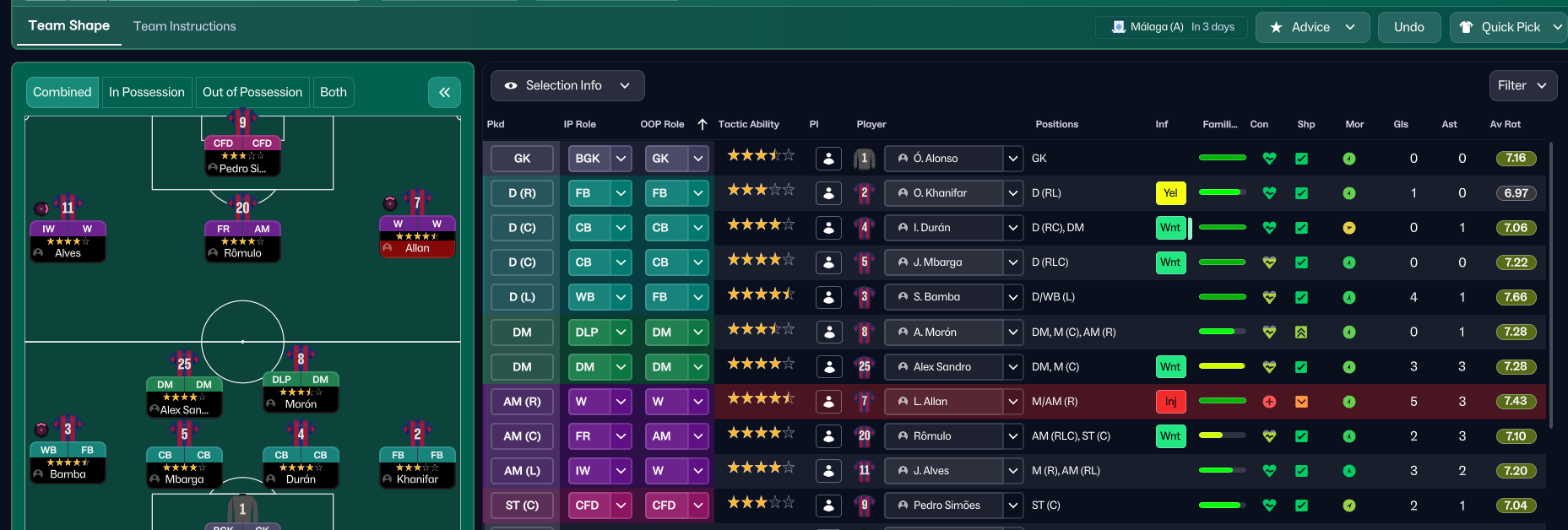
Formation & Style
Tactical Style:Balanced
Mentality:Positive
Formation:4-2-3-1 Wide
Team Fluidity:Structured
In Possession
Play Out Of Defence
Focus Play Down Left
Work Ball Into Box
In Transition
Counter
Counter-Press
Out of Possession
High Press
Much More Often Prevent Short GK Distribution
Team Shape Without Ball
Shape:Flat Back Four
Description:A compact backline that aims to limit space for opposition attackers.
Evidence:Two CBs and two FBs positioned at [2,2], [2,3], [2,4], and [2,1] or [2,5].
Team Shape With Ball
Shape:4-2-3-1
Description:Utilizes width via wingers and central playmaking to overload defensive lines.
Evidence:Wingers at [6,1] and [6,5] with central AM and dual CFs.
Phase Description
Attacking Play
The team focuses on maintaining possession and patiently building attacks, utilizing the width provided by wingers and overlapping full-backs.
Defensive Transition
On losing possession, the team quickly reorganizes to apply a high press, with a focus on regaining control swiftly.
Main Focus
The primary objective is to exploit the flanks, creating crossing opportunities while controlling the midfield.
Key Strengths
Width and Flexibility
The wide players create space and stretch the opposition, allowing for effective crossing opportunities.
Controlled Midfield
The presence of a DLP and a DM allows tactical flexibility in both defence and possession, enhancing ball security.
High Pressing Ability
The tactical choice for a high press with counter-pressing can disrupt opponents' build-up play.
Conflicting Directions
Defensive Compactness
High pressing may lead to gaps at the back if transitioned poorly, leaving the defence exposed.
Attacking Depth
The reliance on width from the wingers may reduce presence in central areas when attacking.
Overlap Risks
Full-backs overlapping frequently may leave the centre-backs isolated, especially against teams with quick wingers.
Tactical Suggestions
Adjust Full-Back Duties
Consider changing at least one full-back to a more conservative role (e.g., FB-D) to maintain defensive stability.
Enhance Central Play
Introduce a more attacking role or duty in central midfield to create better link-up play and goal-scoring chances.
Balance Pressing and Structure
Consider adopting a more mid-block style to balance pressing and maintaining defensive structure.
Ask Questions About Your Lineup
Related Tactics

Guides for this formation
The tactical theory behind the 4-2-3-1 Wide: roles, instructions, and the trade-offs that decide whether the system holds up.
Player pairings
Midfield Pairs in 4-2-3-1 and 4-4-2
Double pivots and flat pairs in 4-2-3-1 and 4-4-2: when each pairing works, when it collapses, and the AMC unicorn that rescues both.
Read guide
Playing styles
Gegenpressing: A Full Guide
Klopp-style gegenpressing in FM, including squad profile, line-and-press pairing, sustainable workload, and the antipatterns to avoid.
Read guide