
4-2-3-1 Wide
Exploit spaces on the flanks and create numerical advantages. Wingers stretch the opposition, creating space for central players.
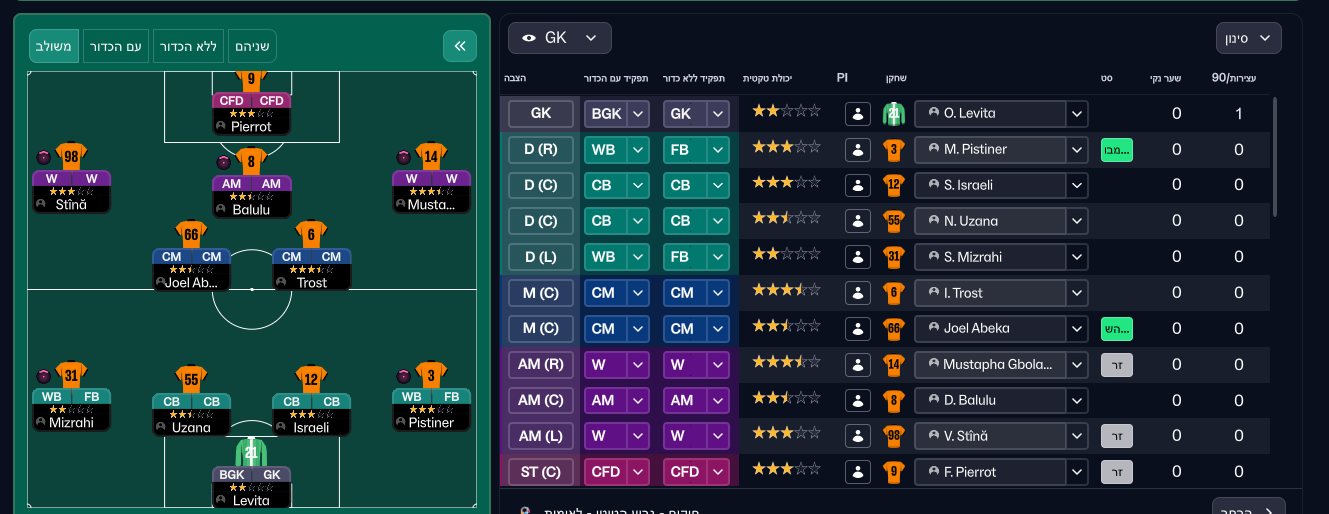
Loading tactical analysis...
4-2-3-1 Wide
Attacking Width: Wide
Pass Into Space
Work Ball Into Box
Counter-Press
Counter
Higher Defensive Line
More Urgent Press
GK
GK
D
RB
WB
S
CB
CB
D
CB
CB
D
LB
FB
S
CM
CM
S
CM
CM
S
AM
AM
S
AM
W
A
FW
CF
D
Focus on utilizing the wings for width while central players support the attack.
Quickly recover possession with a counter-press when the ball is lost.
Exploit spaces on the flanks and create numerical advantages.
4-4-2 Block
Maintaining a solid defensive block with compactness in midfield.
CBs at [2,2] and [2,3] maintain central solidity, supported by two CMs.
4-2-3-1 Transition
Supports quick transitions with width from wingers.
Winger position at [6,1] and [6,5] allows for wide penetration.
Wingers stretch the opposition, creating space for central players.
W at [6,1] and W at [6,5] provides wide options.
Flat back four provides defensive solidity.
CB at [2,2] and [2,3] paired with supportive fullbacks.
Wingers may become isolated if central players do not support.
W at [6,1] may struggle if no midfield support from CM or AM.
High defensive line may expose backline to fast attackers.
Higher Defensive Line without sufficient cover could lead to pace disadvantage.
Defensive Transitions
Vulnerable during transitions if possession is lost.
Counter-Press might be ineffective if players are out of position.
Central Midfield Weakness
Lack of depth in central areas can be exploited.
CMs at [3,3] and [3,4] may lack defensive cover during counter.
CB + FB
Fullbacks can provide width while being supported by center-backs.
FB at [2,1] and CB at [2,2] create strong lateral coverage.
CMs + AM
Midfielders can feed the attacking midfielder quickly.
CMs at [3,3] and [3,4] supporting AM at [5,3] enhances forward play.
How can we better integrate our midfielders in attacking plays?
What adjustments can enhance our defensive stability against fast teams?
Should we modify our pressing strategy based on opponents?
The tactical theory behind the 4-2-3-1 Wide: roles, instructions, and the trade-offs that decide whether the system holds up.
Double pivots and flat pairs in 4-2-3-1 and 4-4-2: when each pairing works, when it collapses, and the AMC unicorn that rescues both.
Klopp-style gegenpressing in FM, including squad profile, line-and-press pairing, sustainable workload, and the antipatterns to avoid.
How Mentality, Duty, and Role interact in FM, why duty trumps mentality every time, and the role-on-top-of-duty composition rules.







