Uploaded Tactic
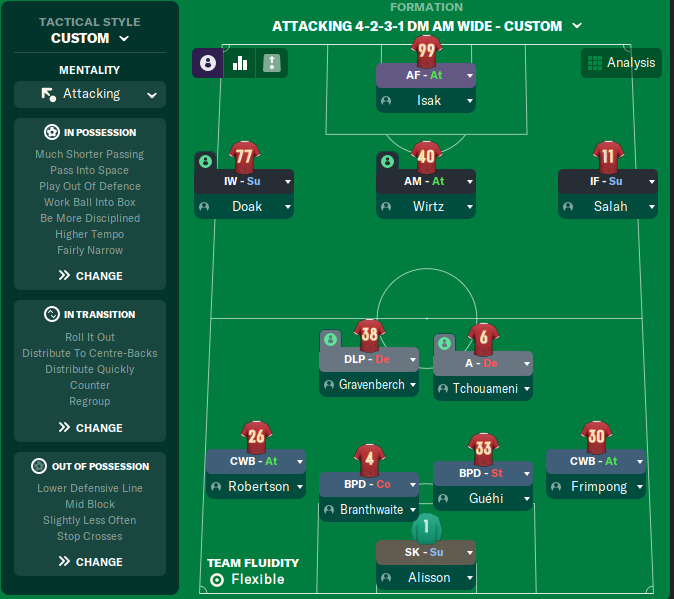
Formation & Style
Tactical Style:Custom
Mentality:Attacking
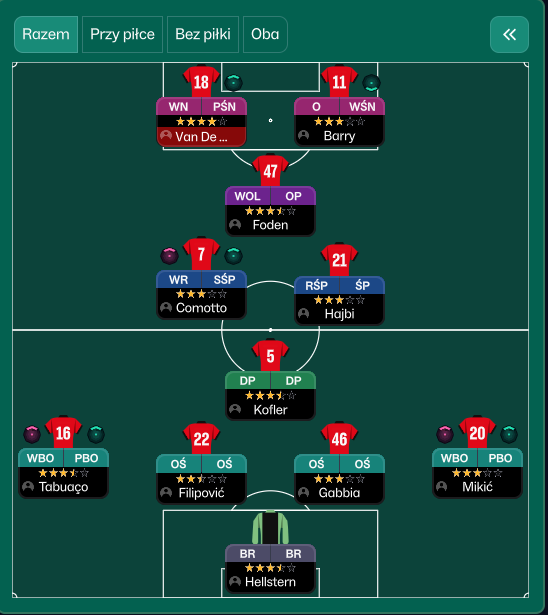
Formation:4-2-3-1 Wide
Team Fluidity:Flexible
In Possession
Much Shorter Passing
Pass Into Space
Play Out Of Defence
Work Ball Into Box
Be More Disciplined
Higher Tempo
Fairly Narrow
In Transition
Roll It Out
Distribute To Centre-Backs
Distribute Quickly
Counter
Regroup
Out of Possession
Lower Defensive Line
Mid Block
Slightly Less Often
Stop Crosses
Team Shape Without Ball
Shape:4-2-3-1
Description:Mid-block defensive structure with flexibility in player positioning, aimed to hinder opponent progress.
Evidence:Lower Defensive Line with a Mid Block indicates a focus on organization and maintaining structure.
Team Shape With Ball
Shape:4-2-3-1
Description:Fluid attacking shape that emphasizes width and penetration through central plays.
Evidence:The presence of Inside Forwards and a Complete Wing-Back aims to stretch opposition defense.
Phase Description
Attacking Play
Focus on fluid attacking movements with quick interchanges, utilizing inside forwards and overlapping wing-backs.
Defensive Transition
Quick regrouping with the midfielders covering the gaps while the forwards press from the front.
Main Focus
Create goal-scoring opportunities through width provided by the wing-backs and the playmaking capabilities of the central players.
Key Strengths
Dynamic Attack
Utilization of Inside Forwards and an Advanced Forward can exploit defensive gaps.
Enhanced Playmaking
Deep-Lying Playmaker can dictate the tempo and transition play effectively.
Width and Depth
Complete Wing-Backs provide additional support in both defensive and attacking phases.
Conflicting Directions
High Defensive Line
Might expose the defence if it moves too high against quick counter-attack teams.
Discipline vs. Creativity
Being more disciplined may slow down the attacking pace.
Stop Crosses
Stopping crosses may limit the ability to defend against wide attacks.
Tactical Suggestions
Adjust Pressing Intensity
Consider increasing pressing intensity to enhance defensive recovery.
Focus on Width
Encourage wing-backs to overlap more frequently to create numerical advantages.
Player Roles Review
Evaluate the impact of Inside Forward and potentially switch to Wingers for a different dynamic.
Ask Questions About Your Lineup
Related Tactics
Guides for this formation
The tactical theory behind the 4-2-3-1 Wide: roles, instructions, and the trade-offs that decide whether the system holds up.
Player pairings
Midfield Pairs in 4-2-3-1 and 4-4-2
Double pivots and flat pairs in 4-2-3-1 and 4-4-2: when each pairing works, when it collapses, and the AMC unicorn that rescues both.
Read guide
Playing styles
Gegenpressing: A Full Guide
Klopp-style gegenpressing in FM, including squad profile, line-and-press pairing, sustainable workload, and the antipatterns to avoid.
Read guide