
4-2-3-1 Wide
Utilizes attackers’ pace and positioning to exploit defenses and create scoring opportunities.
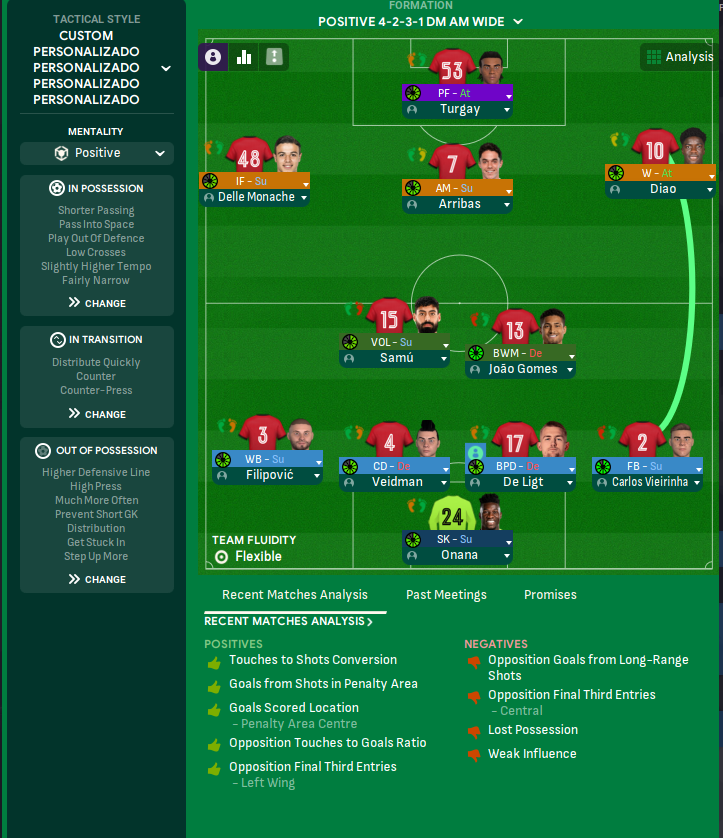
Loading tactical analysis...
Custom
Positive
4-2-3-1 Wide
Flexible
Shorter Passing
Pass Into Space
Play Out Of Defence
Slightly Higher Tempo
Low Crosses
Distribute Quickly
Counter
Counter-Press
Higher Defensive Line
High Press
Prevent Short GK Distribution
Get Stuck In
Step Up More
PF
Target Forward
Attack
IF
Inside Forward
Support
AM
Attacking Midfielder
Support
W
Winger
Attack
VOL
Volante
Support
BWM
Ball Winning Midfielder
Defend
WB
Wing Back
Support
CD
Central Defender
Defend
BPD
Ball Playing Defender
Defend
FB
Full Back
Support
SK
Sweeper Keeper
Support
Utilizes attackers’ pace and positioning to exploit defenses and create scoring opportunities.
Combination of Volante and BWM offers both creativity and defensive stability in the midfield.
While the high defensive line supports pressing, it may create vulnerability to quick counters.
Potential for positional conflict between the Inside Forward and Winger, limiting attacking options.
How effective is the current midfield balance in controlling the game?
Are the current width and roles creating enough space for the front three?
What adjustments can be made against teams with strong counter-attacking capabilities?
Is the current tempo facilitating effective build-up play?
How well are defenders coping with high pressure and maintaining possession?
Should player roles be revised to enhance synergy in attack?
The tactical theory behind the 4-2-3-1 Wide: roles, instructions, and the trade-offs that decide whether the system holds up.
Klopp-style gegenpressing in FM, including squad profile, line-and-press pairing, sustainable workload, and the antipatterns to avoid.
Double pivots and flat pairs in 4-2-3-1 and 4-4-2: when each pairing works, when it collapses, and the AMC unicorn that rescues both.
Counter-Press, Regroup, Stand Off, Trigger Press: what each pressing instruction does in FM and how to pair them without contradicting.







