
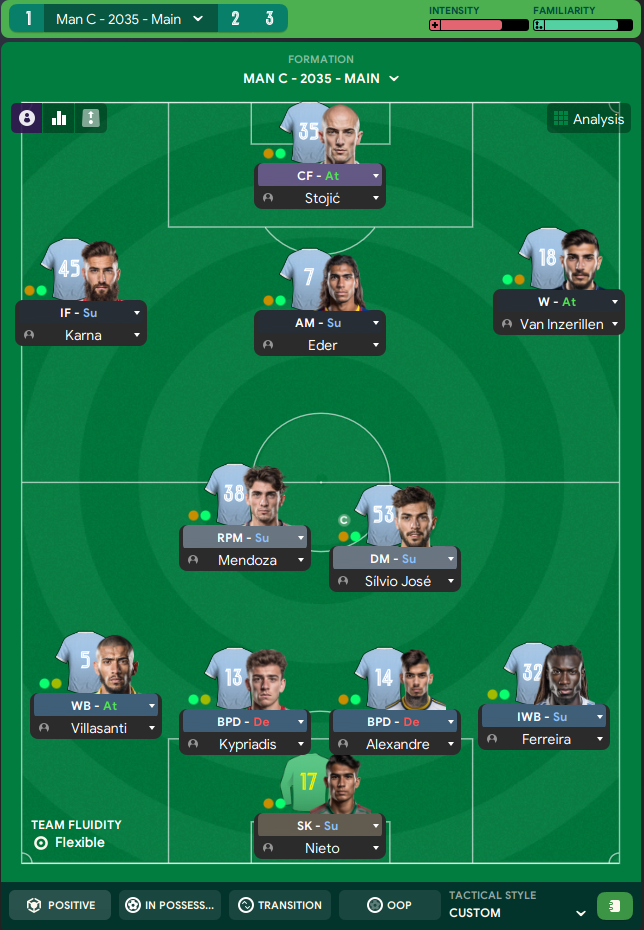
4-2-3-1 Wide
The use of wingers and an advanced forward allows fluidity in attack and multiple avenues for scoring.
Loading tactical analysis...
Custom
Positive
4-2-3-1 Wide
Flexible
Play out of defence
Work ball into box
Focus play down the wings
Counter-press
Counter
Higher defensive line
Use offside trap
Pressing intensity: More urgent
CF
Advanced Forward
Attack
AM
Shadow Striker
Support
W
Winger
Attack
RPM
Raumdeuter
Support
DM
Deep-Lying Playmaker
Support
BPD
Ball Playing Defender
Defend
SK
Sweeper Keeper
Support
The use of wingers and an advanced forward allows fluidity in attack and multiple avenues for scoring.
The combination of a raumdeuter and deep-lying playmaker provides creative options and support for both defense and attack.
The raumdeuter and winger may occupy similar spaces, potentially leading to confusion in attacking play.
If not coordinated, high pressing may lead to gaps in defense, especially between the ball-playing defenders.
How can we enhance link-up play between the winger and the advanced forward?
Which specific pressing triggers should be implemented to optimize recovery of possession?
Are there better alternatives for the raumdeuter role that could provide more stability?
How can the hybrid tactics be adjusted against lower-block defenses?
What adjustments should be considered if adjusting to a counterattack-focused opponent?
How can we optimize set-pieces considering the current player roles?
The tactical theory behind the 4-2-3-1 Wide: roles, instructions, and the trade-offs that decide whether the system holds up.
Double pivots and flat pairs in 4-2-3-1 and 4-4-2: when each pairing works, when it collapses, and the AMC unicorn that rescues both.
Klopp-style gegenpressing in FM, including squad profile, line-and-press pairing, sustainable workload, and the antipatterns to avoid.
Routines, takers, and target picks. How to turn corners and free-kicks into a reliable third of your goal output.







