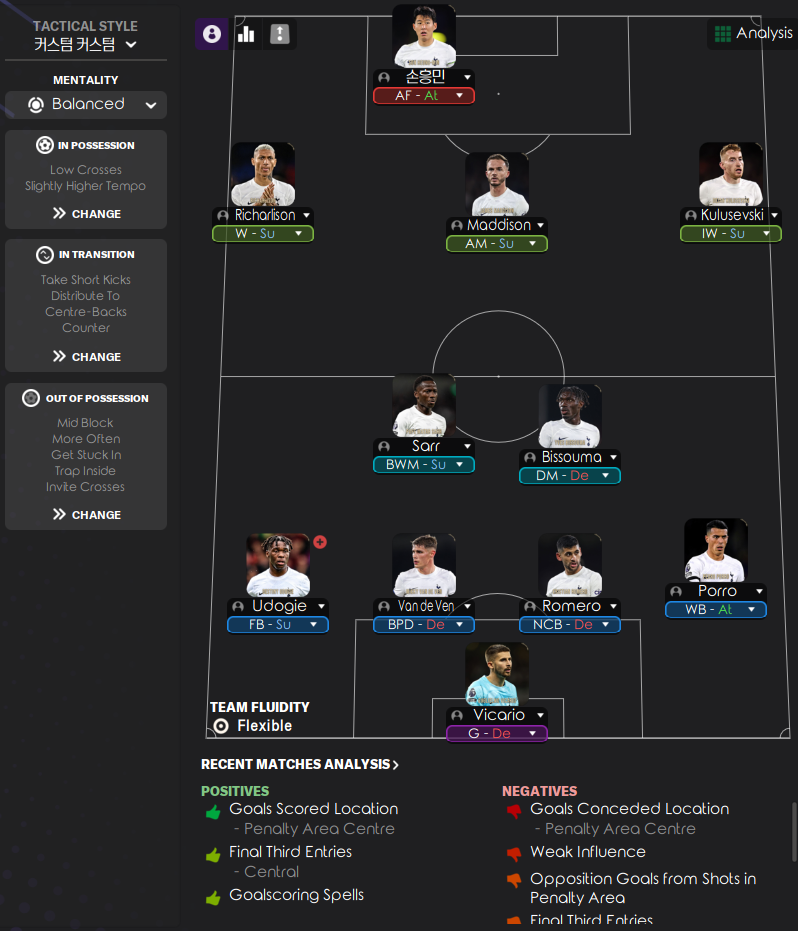
4-3-3-1 Asymmetric AM (L)
With an Advanced Forward and an Attacking Midfielder, the tactic allows for fluid movement and multiple goal-scoring opportunities.
Loading tactical analysis...
Balanced
Balanced
4-3-3-1 Asymmetric AM (L)
Structured
Run At Defence
Slightly Higher Tempo
Fairly Narrow
Roll It Out
Distribute To Centre-Backs
Distribute To Full-Backs
Counter
Higher Defensive Line
High Press
Less Often
Get Stuck In
ST
Advanced Forward
Attack
AM
Attacking Midfielder
Attack
DLP
Deep-Lying Playmaker
Defend
BWM
Ball-Winning Midfielder
Support
FB
Full-Back
Support
CD
Central Defender
Defend
G
Goalkeeper
Defend
With an Advanced Forward and an Attacking Midfielder, the tactic allows for fluid movement and multiple goal-scoring opportunities.
The combination of a Deep-Lying Playmaker and a Ball-Winning Midfielder provides both creativity and stability in the center.
The transition setup suggests a focus on the center, but asymmetric width may lead to disconnects if not balanced properly.
While a high defensive line can support pressing, it may leave gaps for counter-attacks if the team is caught out of shape.
How can we balance the attacking movements of our wing-backs with defensive responsibilities?
What adjustments can enhance our counter-pressing effectiveness?
Is the high defensive line appropriate given the pace of opposing forwards?
Should we consider varying the tempo based on specific opponents?
How can we better utilize our wingers to stretch the opposition?
Is the current midfield balance providing enough defensive cover against counters?
The tactical theory behind the 4-3-3-1 Asymmetric AM (L): roles, instructions, and the trade-offs that decide whether the system holds up.
Why circulation density and zonal occupation aren't the same thing in FM, and the half-space occupation rule that decides build-up.
Build the patient, control-the-tempo style without watching your opponents counter through the gaps you leave behind.
FM27 keeps FM26's tactic system. Here is what stays the same, the small changes that can catch you out, and what the new Tactical Effectiveness system asks of you.