
4-3-3 DM Brett
Maintaining ball possession and dictating the tempo. Short passing and buildup from defense lead to higher ball retention.
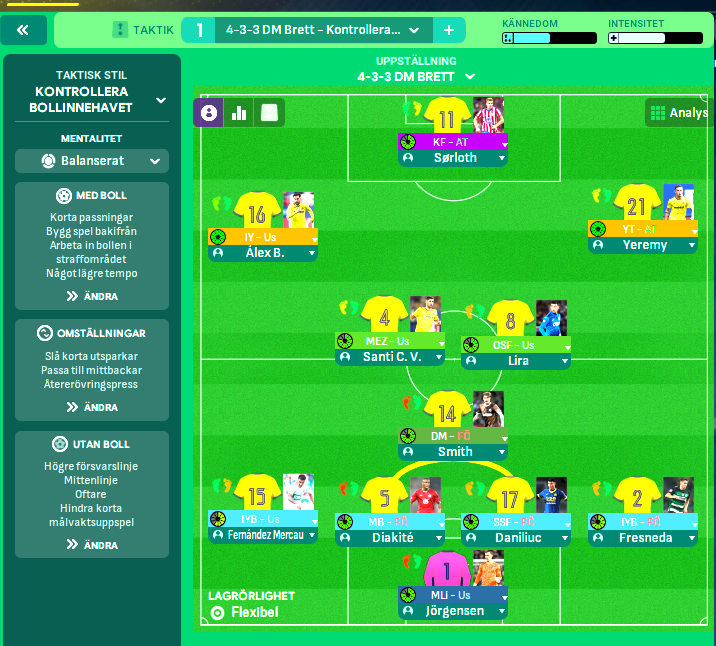
Loading tactical analysis...
Kontrollera Bollinnehavet
Balanserat
4-3-3 DM Brett
Flexibel
Korta passningar
Bygg spel bakifrån
Arbeta in bollen i straffområdet
Något lägre tempo
Slå korta uppspelsutsparkar
Passa till mittbackar
Återövringspress
Högre försvarslinje
Mittlinje
Oftare
Hindra korta målvaktsuppspel
GK
G
D
RB
IWB
S
CB
BPD
D
CB
BPD
D
LB
IWB
S
DM
DM
D
CM
MEZ
S
CM
QS
S
RW
IF
A
CF
KF
A
LW
YT
A
Utilization of wide players to stretch the opposition and create central spaces.
Quickly regaining possession with an emphasis on high pressing.
Maintaining ball possession and dictating the tempo.
4-1-4-1
While defending, the shape allows for compactness and support for full-backs.
DM at [3,3] with a defensive duty ensures a strong shield ahead of the back line.
4-3-3
With width provided by the wingers, it allows the center forward to exploit spaces.
Inside Forwards at [5,2] & [5,4] create diagonal runs for penetration.
Short passing and buildup from defense lead to higher ball retention.
DM (Smith) at [3,3] supports the backline with a 'Pass To Centre Backs' instruction.
Wingers stretch opposition defenses, creating space for central play.
Inside Forwards (Alex B. & Yeremy) at [5,1] and [5,5] utilize width effectively.
Increased defensive duties can stagnate attacking movement.
DM duty of Smith may limit offensive contributions from midfield.
High defensive line may lead to gaps against quick counter-attacks.
High defensive line with 'Hindra korta målvaktsuppspel' can create vulnerabilities.
Defensive Transition
Opposition may exploit spaces left by attacking full-backs.
High line combined with wing-back push could lead to counter-attacks.
Central Weakness
Dependence on DM may create vulnerabilities if out of position.
DM role could leave central areas exposed during aggressive pressing.
MEZ + QS combination
The versatility of these roles offers varied attacking options.
MEZ at [4,2] and QS at [4,3] can create dynamic overloads in central areas.
IWB functionality
Inverted Wing-Backs provide width while supporting central play.
IWB roles at [2,1] & [2,5] can be effective in both defense and attack.
How can the pressing intensity be optimized?
Should the balance between defensive and offensive duties be adjusted?
What adjustments can be made to enhance quick transitions after gaining possession?
The tactical theory behind the 4-3-3 DM Brett: roles, instructions, and the trade-offs that decide whether the system holds up.
Why circulation density and zonal occupation aren't the same thing in FM, and the half-space occupation rule that decides build-up.
Build the patient, control-the-tempo style without watching your opponents counter through the gaps you leave behind.
What Higher Tempo, Wider, and Narrower actually do in FM, plus the dial contradictions and antipatterns players run into most often.