Uploaded Tactic
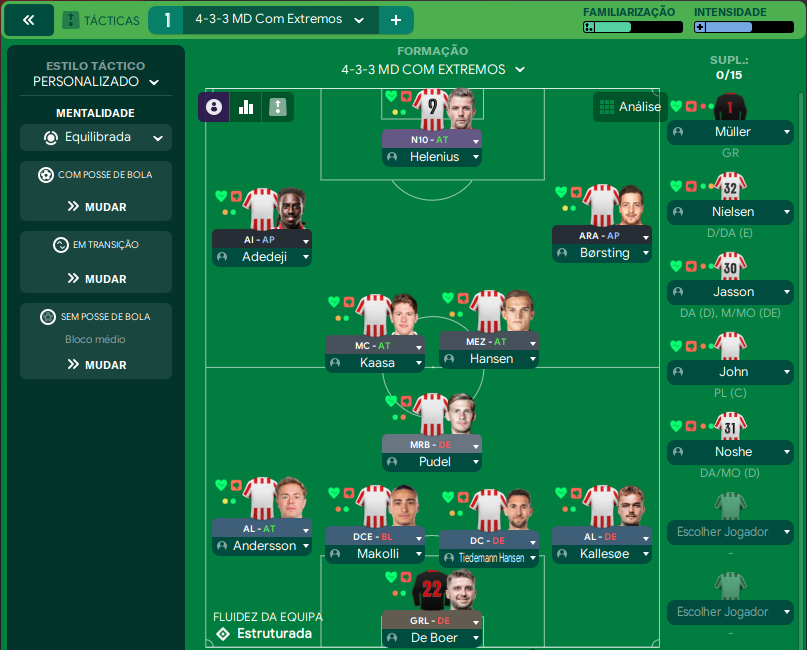
Formation & Style
Tactical Style:Equilibrada
Mentality:Equilibrada
Formation:4-3-3 MD Com Extremos
Team Fluidity:Estruturada
In Possession
Maximize width with wingers (AI-AP & AL-AT) stretching the play
Utilize the Advanced Playmaker (ARA-AP) to facilitate through balls
Encourage overlapping runs from Full-Backs (DCE-BL & DCE-DE)
In Transition
Counter upon regaining possession quickly
Pressing needs to be consistent to recover the ball swiftly
Out of Possession
Maintain a Middle Block to control central areas
Focus on compactness to limit opponent penetration
Team Shape Without Ball
Shape:4-3-3
Description:A solid midfield presence supports the backline while also enabling quick breaks.
Evidence:DCE-BL at [2,1] and DCE-DE at [2,5] provide width, and MC-AT and MEZ-AT at [3,3], [3,4] assist defensively.
Team Shape With Ball
Shape:4-3-3
Description:High attacking fluidity with overlapping full-backs and creative midfield roles.
Evidence:AI-AP at [5,1] and AL-AT at [5,4] widen the pitch, allowing N10-AT to exploit spaces centrally.
Phase Description
Attacking Play
Focus on quick transitions with an emphasis on using the pace of wingers during attacks.
Defensive Transition
Quick shift to a compact formation to prevent counter-attacks from opponents.
Main Focus
Utilize numerical superiority in midfield to control the game and dictate pace.
Key Strengths
Midfield Control
The formation allows for a strong midfield presence to dominate possession.
Attacking Versatility
Utilizes a combination of wingers and a central striker to create multiple attack channels.
Defensive Stability
The back four structure ensures protection against counter-attacks.
Conflicting Directions
Offensive Vulnerability
Over-reliance on attacking play may leave gaps defensively if not managed well.
Wide Play Risk
Overusing the flanks may limit central creative opportunities.
Pressing Issues
High pressing may tire players quickly without proper rotation.
Tactical Suggestions
Utilize Substitutes Effectively
Increasing squad depth may prevent fatigue in high-press scenarios.
Adjust Midfield Roles
Tweaking the duty of the MEZ to a more supportive role could balance attacking transitions.
Defensive Adjustments
Consider a slight drop in defensive line to avoid being caught out on the counter.
Ask Questions About Your Lineup
Related Tactics
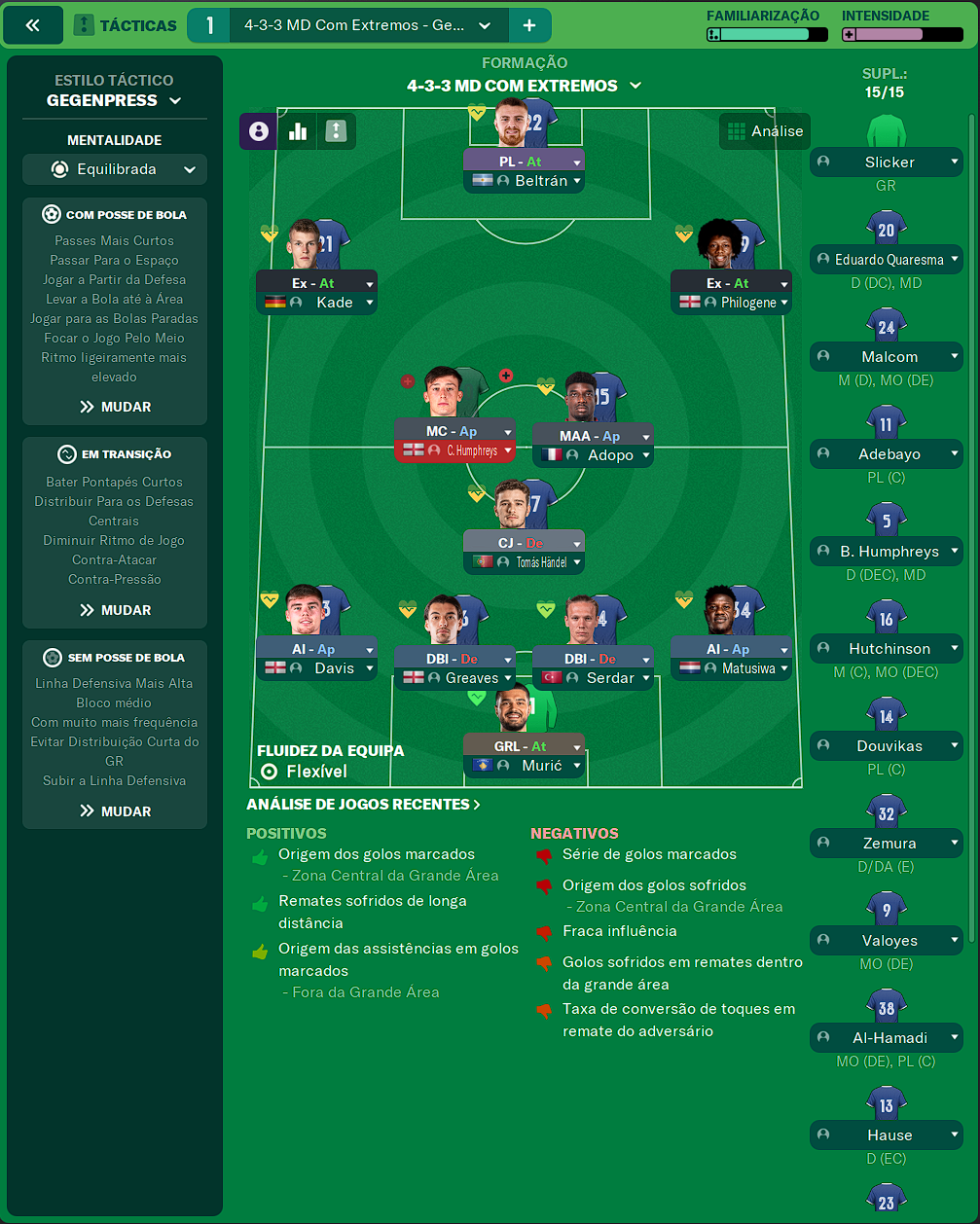
More Equilibrada tactics
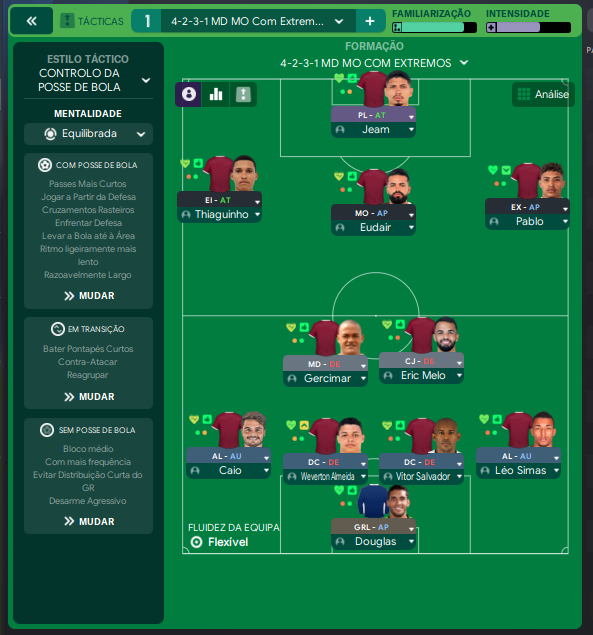
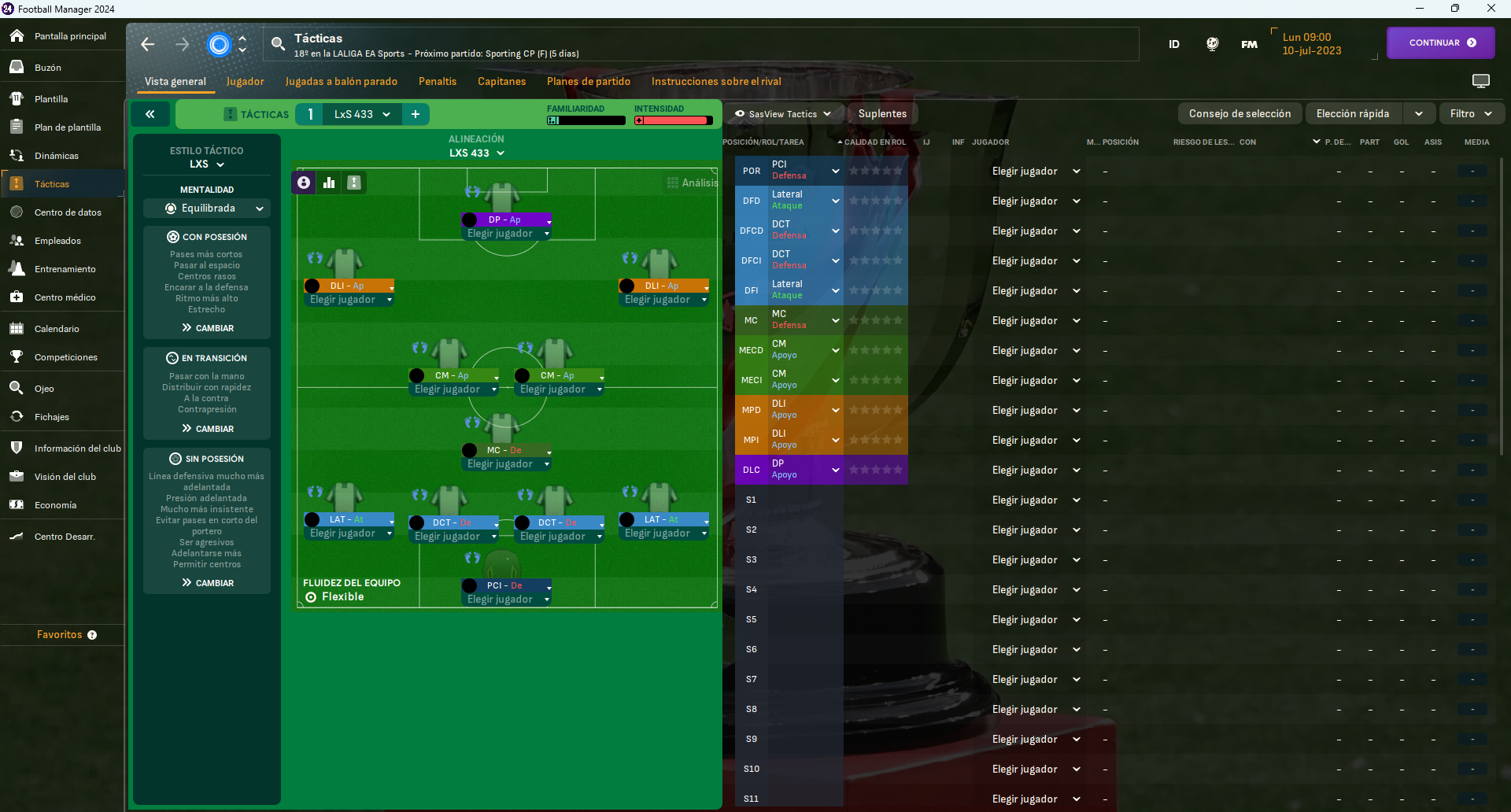
Guides for this formation
The tactical theory behind the 4-3-3 MD Com Extremos: roles, instructions, and the trade-offs that decide whether the system holds up.
Foundations
Understanding the 4-3-3 Formation
Master the classic 4-3-3: player roles, tactical variations, and the trade-offs that decide whether it sings or stalls.
Read guide
Player pairings
Midfield Trios
Holder, runner, creator: the role distribution rule for three-man midfields, the AMC variants, and the antipatterns that break them.
Read guide
Playing styles
Gegenpressing: A Full Guide
Klopp-style gegenpressing in FM, including squad profile, line-and-press pairing, sustainable workload, and the antipatterns to avoid.
Read guide