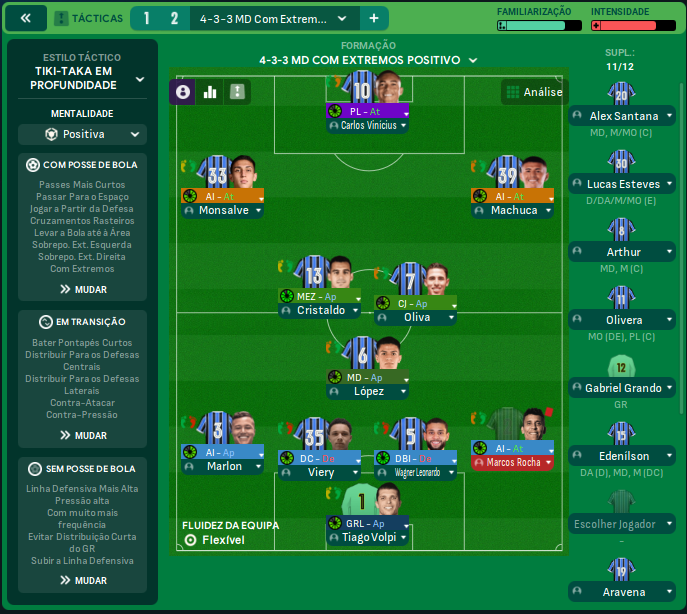
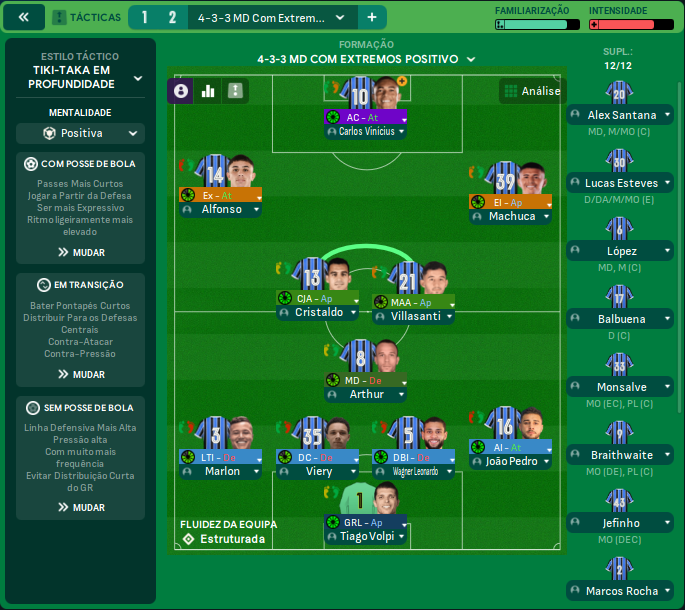
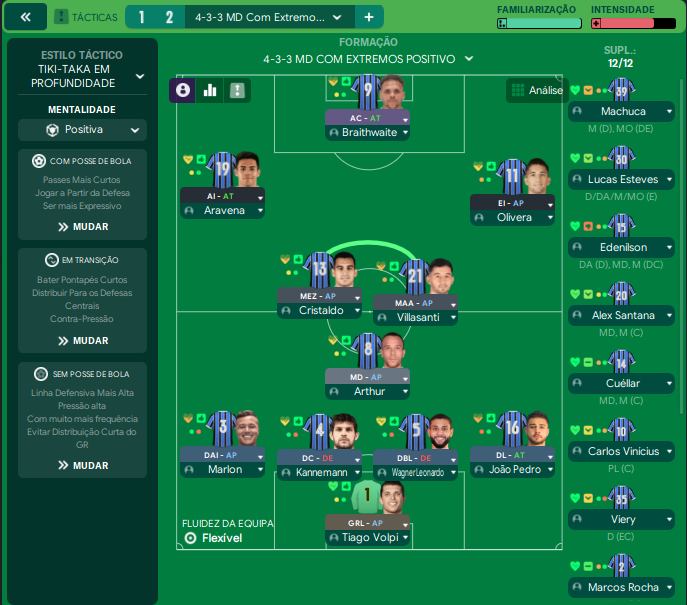
4-3-3 MD Com Extremos Positivo
The use of inside forwards and an advanced forward creates dynamic attacking triangles, allowing for quick interchanges of play.
Loading tactical analysis...
Tiki-Taka
Positive
4-3-3 MD Com Extremos Positivo
Flexible
Pass Shorter
Play Out of Defence
Be More Expressive
Counter-Press
Distribute to Centre-Defenders
Higher Defensive Line
Press More Often
ST
Advanced Forward
Attack
AML
Inside Forward
Attack
AMR
Inside Forward
Attack
MC
Advanced Playmaker
Attack
DM
Deep-Lying Playmaker
Support
DC
Central Defender
Defend
DL
Wing Back
Attack
DR
Wing Back
Attack
GK
Ball Playing Goalkeeper
Support
The use of inside forwards and an advanced forward creates dynamic attacking triangles, allowing for quick interchanges of play.
The advanced playmaker can dictate the tempo from midfield, creating goal-scoring opportunities through passing.
While pressing high can win the ball back quickly, a high defensive line can leave space behind for fast counter-attacks.
Advanced roles can sometimes require more direct play, potentially causing conflicts with the tiki-taka short passing approach.
How effective is our midfield in transitioning from defense to attack?
Are our wing backs providing enough support in attack?
How well are our inside forwards contributing to the scoring?
Are we vulnerable to counters due to our high defensive line?
Is our pressing causing enough turnovers in the opponent's half?
How can we better balance our offensive and defensive responsibilities?
The tactical theory behind the 4-3-3 MD Com Extremos Positivo: roles, instructions, and the trade-offs that decide whether the system holds up.
Why circulation density and zonal occupation aren't the same thing in FM, and the half-space occupation rule that decides build-up.
Build the patient, control-the-tempo style without watching your opponents counter through the gaps you leave behind.
What Higher Tempo, Wider, and Narrower actually do in FM, plus the dial contradictions and antipatterns players run into most often.